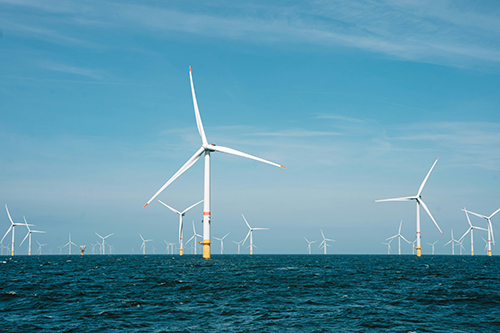
Experts are urging MPs to back ramping up offshore wind production to meet the UK's energy needs.
Researchers from the University of Southampton Marine and Maritime Institute say clean energy targets could be met using less than five per cent of UK waters - with less environmental impact than activities such as oil and gas production, shipping and fishing.
They are meeting with MPs during Evidence Week [6-10 July], which is being held in Parliament.
"Delays in planning and consenting are now one of the biggest barriers to progress," says Susan Gourvenec , Professor of Offshore Geotechnical Engineering at the University of Southampton and Royal Academy of Engineering Chair in Emerging Technologies for Intelligent and Resilient Ocean Engineering (IROE).

"These delays increase climate risks, threaten the UK's energy security, and limit economic opportunities. The evidence we are presenting will help policymakers accelerate offshore wind responsibly."
The UK aims to deliver 50 GW of offshore wind by 2030, and over 125 GW by 2050. Current installation rates need to increase four-fold to meet these legally binding targets.
Recent policy proposals such as the Marine Recovery Fund and ongoing Marine Net Gain consultations risk slowing progress further.
Prof Gourvenec says: "Introducing new, potentially over cautious requirements without strong evidence may add delay at a time when rapid deployment is essential.
"In contrast, the impacts of continued climate change, such as extreme heat, coastal erosion, flooding, disrupted harvests and rising public costs, are well established. Global warming won't wait and we can derisk moving fast."
Researchers will present evidence showing:
- Offshore wind currently uses less than one per cent of the UK waters. Meeting 2050 targets would use under five per cent, compared to oil and gas infrastructure which uses 11 per cent
- 90 per cent of suitable space for future offshore wind production around the UK is in deep water - further from the coast and away from many existing users. Here floating, non-fixed, turbines will be needed
- Offshore wind has comparatively low ecological impacts compared to other ocean uses including shipping and fishing
- Effective monitoring technologies and decision support tools enable evidence based, adaptive management as the sector grows.
The team hope that these insights can help streamline planning, reduce uncertainty, and unlock the rapid offshore wind deployment required for the UK to meet its climate, energy, and economic goals.