Rutgers Health gathers more than 120 leaders from 18-plus organizations to address provider burnout using evidence-based strategies
According to the Centers for Disease Control and Prevention, 46% of health care workers report feeling burned out.
To address this issue, the inaugural Rutgers Health Well-Being in Healthcare Summit brought together more than 120 leaders from more than 18 organizations to address provider well-being and burnout using evidence-based strategies.
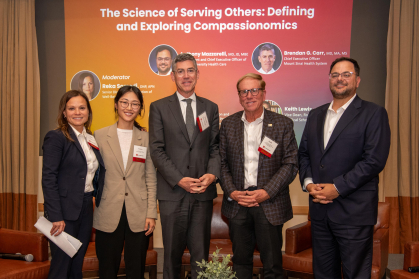
Directed by Reka Somodi, Rutgers Health's senior director for the promotion of well-being, the event aimed to equip faculty, staff and students with strategies to manage stress and prevent burnout.

Somodi discusses the challenges facing health care workers today.
What factors most effects health care practitioners' mental, physical and emotional well-being?
On the workplace and administrative side, major contributors are excessive patient loads and chronic occupational stress from inadequate staffing. There are also significant administrative burdens, such as the time spent on electronic health records, a phenomenon that physicians often refer to as "pajama time," which encroaches on personal time and creates a work-life imbalance. Additionally, rigid clinical schedules can lead to a lack of flexibility and autonomy, leaving many feeling powerless.
Physiologically, we cannot ignore the toll of long hours and circadian imbalances. Night shift work, for instance, has been described by the World Health Organization as an oncologic risk factor, just to list a few risk factors, underscoring the severe risk associated with chronic sleep deprivation.
The emotional and psychological burden is immense: Clinicians constantly deal with chronic human suffering, death, high acuity illness, and vicarious trauma. When coupled with the threat of litigation, the financial stress of medical education debt and exposure to workplace violence, the workplace environment is stressful.
In what ways is Rutgers Health creating a culture of care?
Investing in well-being is foundational to the stability of the entire health system. We know that by 2030, the nursing shortage is predicted to reach 5.7 million. This is in direct contrast to the fact that the population of the United States is living longer and the health care workforce will be managing more complex health conditions.
At Rutgers Health, we approach well-being using the "Eight Dimensions of Wellness" framework developed by Margaret Swarbrick, director of ScarletWell at Rutgers. We offer programming aligned with many of those dimensions, focusing on system-level change, not just individual resiliency.
In collaboration with the entire organization, we implemented programs like "Search Inside Yourself," a mindfulness-based emotional intelligence program. We train individuals and teams from Rutgers Health and the health systems, who work in both clinical and administrative roles, and focus on individual skills as well as how people relate to their environment and optimize leadership skills, such as empathy, compassion and kindness, which are crucial for creating a well-functioning organization.
We also offer other programs such as coaching. We are actively piloting a program that offers coaching support for faculty and staff aligned around goals that the individuals are targeting. Finally, on the health system side and the academic institution side, we are exploring different artificial intelligence resources to streamline work and school.
How do workforce well-being initiatives affect patient care outcomes, health care costs and overall system performance?
Decades of research has shown that when health care organizations invest in workforce well-being, system performance improves and we achieve better patient outcomes. Clinicians are more engaged, make fewer medical errors and organizations report lower litigation costs. In turn, this leads to lower overall health care costs.
Patients also feel the difference: Patient satisfaction scores are higher in facilities that prioritize clinician wellness. Facilities that focus on leadership training, particularly in areas such as emotional intelligence and compassionate leadership communication, achieve better internal health care provider scores. Employees in these organizations are more professionally fulfilled. We observe improved teamwork, higher engagement and stronger leadership scores, while negative workplace measures like burnout are reduced.
How can academic institutions, like Rutgers, assist in providing evidence-based well-being strategies and incorporate wellness into medical education itself?
Academic institutions are very well-poised to provide evidence-based strategies by conducting research and leveraging data science to inform implementation programs. Surveying your organization is critical. At Rutgers Health, we belong to the Professional Well-Being Academic Consortium. We not only survey our own organization, but we also benchmark nationally against other programs and specialties. This allows us to idea-share on what programs have data behind them and what is working.
Using this data guides our strategy. For example, when our surveys identified poor sleep as a key concern last year, our team led a successful Sleep Week program. We're building on that foundation this year with a more robust strategy, featuring a keynote speaker secured from NASA. The idea is to allow the survey data to directly inform the initiatives that are most important to our people.
We are also committed to integrating wellness into the curriculum as a core component of our educational approach. We are strategizing about how best to embed wellbeing into curriculum design and support. We also use smart curriculum design to minimize unnecessary stress, such as optimizing the timing of tests and assessments.
Ultimately, academic institutions achieve this goal by fostering a supportive culture. We encourage simple, everyday connections. An example of this is simply offering kindness, for example, by smiling at a colleague or asking, "How was your weekend?" That is what ultimately helps us build a more durable, supportive and connected community.