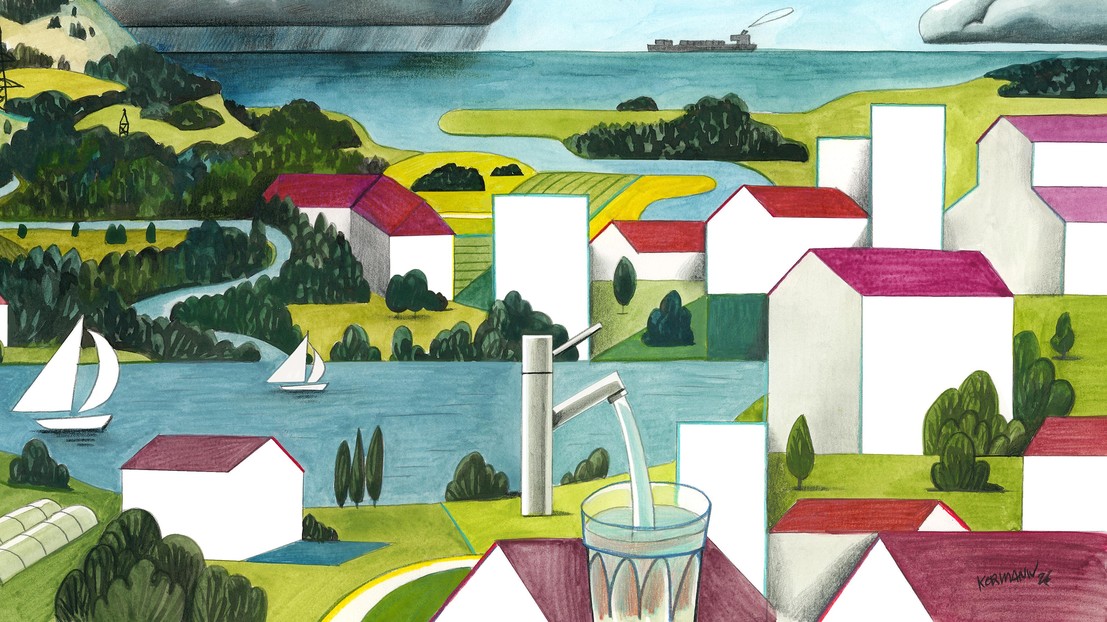
© Illustration by Denis Kormann/EPFL
Water purification and recycling - the process of running sewage water through a treatment plant - is essential for public hygiene and for conserving this natural resource.
The water we drink today was previously consumed by other people as well as by plants and animals - think ferns, dinosaurs, Cleopatra and other organisms closer to us in time and space. That's owing to the very nature of water molecules and the water cycle. This compound continuously transitions between the gas, liquid and solid states, and - depending on wind, temperature and altitude - can be found in rain clouds, rivers, the water table, oceans, glaciers and more. But the molecules themselves, while extremely numerous, are the same ones that have existed since the dawn of time, whether we use them for drinking, cleaning, bathing or evacuating our waste.
In Switzerland, water was officially recognized as a foodstuff in 1990, meaning it's subject to the same specifications as other products we consume. Our country is fortunate to have a high-quality supply of water that needs very little treatment to become potable. "Most of our water comes from the water table, so it's already been filtered over weeks or months - and that water is plentiful," says Tamar Kohn, the head of EPFL's Laboratory of Environmental Virology. "So we can simply drink it as is. But lake water requires a little more treatment to make sure it's free of pathogens." This water purification process is carried out mainly using chlorine, ozone or UV radiation.
Testing only for bacteria, not viruses
Switzerland's drinking water does get contaminated from time to time, but that often goes unnoticed. "Testing is only carried out for bacteria, not viruses," says Kohn. "Viruses are smaller and replicate more slowly, so they're harder to track. But some viruses are common and can affect newborns and patients with weakened immune systems. That's why we recommend boiling water for these people."
"The trick is to find the right balance between eliminating pathogens and maintaining the water's high level of purity," says Kohn. That's because water purification processes based on chlorine and ozone, for example, involve adding chemicals to our drinking water. Kohn's research group is studying adenoviruses, which are pathogens that affect the respiratory tract. "These viruses' DNA is very similar to ours," says Kohn. "Even if we kill them, they can replicate using our cells' own DNA repair mechanisms. What's more, adenoviruses have an array of variants that can be randomly more or less resistant. We need to find a way to get rid of such viruses without having to pour chemical disinfectants into aquatic environments."
In the days before purification systems
"It's important to always keep waste and wastewater separate from drinking water to ensure good hygiene," says Kohn. Things weren't always done that way. In the middle of the 19th century, European homes had cesspits rather than indoor plumbing, and sewers were initially used to drain rainwater. Advances in water provision led to more efficient drainage systems, but it took a few cholera epidemics before large cities started to manage wastewater and dispose of it separately. London was a pioneer in the mid-1800s; Zurich followed suit after a cholera epidemic in 1867.
The problem was that the wastewater was being discharged directly into rivers and lakes without prior treatment, leading to large-scale contamination, wiping out certain organisms and promoting the growth of algae. It wasn't until after the turn of the century, in 1917, that Switzerland's first mechanical-biological water treatment plant was built, in St. Gallen. In the late 1950s, less than 10% of Swiss households were hooked up to a publicly run water treatment plant. Water protection was written into the Swiss constitution three years later, and the implementing act went into effect one year after that. In the 1960s, many lakes still had high levels of phosphate fertilizer, and swimming bans were common. Yet things gradually improved. The number of mechanical-biological water treatment plants rose from 67 in 1964 to 901 in 1983, and the percentage of households connected to one grew from 30% in 1970 to 90% in 1990*.
Turning wastewater back into potable water
Today, people are taking a fresh look at possible uses for wastewater, in response to environmental concerns and the mounting pressure on ecosystems. A growing number of cities and countries are using treated wastewater for irrigation, watering and cleaning, rather than discharging it directly into the environment. The US, South Africa, Australia and southern European countries have been using this approach for a while. Switzerland hasn't yet passed a law to this effect, but Yverdon-les-Bains is leading the way by testing new technology developed in Europe for using treated wastewater to clean its streets and water its parks.
Some countries are planning to go even further by recycling treated wastewater into potable water. "That's a huge challenge because there are many pathogens, and they're the biggest threat," says Kohn. The processes are complicated and vary from one country to the next, as they're subject to different national regulations. These processes are designed to remove not only microbes but also hazardous and toxic chemicals, not to mention nanoplastics - although that's getting harder and harder to do.
Panning for molecular gold
Wastewater is also a social indicator, and it doesn't lie. Scientists can use it to trace the use of addictive substances or, as they did during the pandemic, detect the presence of coronavirus levels. A team of EPFL researchers led by Kohn worked with Eawag in 2020 to track the spread and development of SARS-CoV-2 by measuring coronavirus levels.
In Sion, Wendy Queen, who heads EPFL's Laboratory for Functional Inorganic Materials, is looking not for viruses or narcotics, but rather the gold and heavy metals that result from the excessive use of electronics. She's using molecular sponges with a structure similar to gunpowder that can absorb and separate tiny molecules. The spon-ges' crystalline structure can be adjusted to target different chemicals including gold, mercury, lead and hexavalent chromium - a toxic compound that's occasionally found in wastewater. Her process can both purify water and support the recycling of electronic equipment. While it has shown encouraging results in the lab, the next challenge will be to roll it out at scale.
* Source: Dictionnaire historique de la Suisse.
Turning cities into sponges
A century of concrete-intensive urban development has left a lasting mark. Vast areas are now covered with pavement, preventing the soil from serving one of its primary hydrological functions - absorbing precipitation. Experts describe this process with colors: "blue" water, or rain, becomes "green" when it flows into bodies of water or the water table. But if it runs down buildings and over city squares and roads, it becomes "gray." Most of this gray water ends up discharged into rivers.
Scientists became aware of the problems that this causes only a few decades ago. And the problems have become even more salient with climate change, as, for example, uncontrolled surges in lakes and rivers flood entire cities. "Back in the day, it was perfectly normal to collect a little rainwater for your plants," says Paolo Perona, the academic director of EPFL's Hydraulic Constructions Platform. "But people stopped doing that with the installation of watering systems. Today, urban sprawl has made huge swathes of the ground impervious. As a result, heavy rainfall turns directly from blue to gray and overflows the spillways located upstream of cities, leading to flooding."
Researchers in many fields are working to find solutions. Urban planners are designing cities with more unpaved surface area - parks, squares and the space between tram rails, for example. Architects are incorporating rainwater recovery systems into the roofs of buildings; when installed on new structures, these systems can use collected rainwater for toilet flushing or irrigation and stem the overflow of gray water. Civil engineers and materials scientists are developing porous road surfaces. And computer scientists are programming models to quantify the improvements that can be made over a given surface area.
An open-air laboratory
When it comes to testing these solutions, EPFL is serving as an open-air laboratory. For instance, the Lausanne campus has been taking part in a sponge-city project for several years. "Initially, only 20% of rainwater was recovered on the campus; the remaining 80% turned into gray water and flowed into the Sorge," says Perona. That was due to the large areas that had been paved over more than 50 years ago. "But our models show that it's possible to achieve a 60% to 65% recovery rate, meaning just 35% to 40% would become gray water," says Perona. Potential steps in this direction include changing the pavement on roads and squares, planting more trees, creating wet biotopes and collecting rainwater on rooftops.
Some of these measures are already being taken under EPFL's Campus Piéton initiative. In addition, a sponge-city prototype was set up in Lausanne's Jardin de la Circulation. This pilot project shows how rainwater runoff can be mitigated and illustrates sustainable water handling methods for urban spaces using permeable soil and vegetated ditches. "We hope to work with the Union of Swiss Cities to implement sponge cities widely," says Paola Viganò, a member of the project team and the head of EPFL's Laboratory of Urbanism.
While the concept is still being rolled out in Europe, it has already been adopted in many cities in China. EPFL researchers have also modeled several cities in Mauritania and Kenya, and they're working on a project with the City of Paris to replicate what was done in Lausanne and limit the risk of flooding in the French capital, which is particularly vulnerable owing to its topography and subway system. "We're able to map the extent of flooding that would occur in each Paris neighborhood after a given weather event in the city's catchment area," says Perona. Such modeling can help city officials plan - and most importantly, act - at a time when extreme events will only become more common.