

In 2025, the Australian Academy of Science sharpened its future focus.
With a 70-year record of transforming science excellence into national impact, the Academy strived to boldly shape Australian science, research and innovation for decades to come.
"In an increasingly complex and contested world, ensuring that science continues to serve all Australians is critical," said Academy President Professor Chennupati Jagadish AC.
Shaping Australia's science future
In a groundbreaking report, the Academy cast an analytical eye forward to 2035: does Australia have the scientific capability to meet growing challenges, ten years from now?
Australian science, Australia's future: Science 2035 mapped the scientific landscape, workforce and future needs, and identified eight areas with critical gaps.
"Simply put, our sovereign capacity to innovate and respond to emerging challenges… is undermined," said Professor Ian Chubb AC, Academy Fellow and chair of the report's advisory panel.
"For the first time, we have a map of what needs to be done, backed by evidence, and no excuse to do nothing because now we know."
Launched at a national symposium as part of the Academy's annual event Science at the Shine Dome, the report underscored the Academy's ongoing calls to address underinvestment in R&D - a vital step to boost productivity and secure a safe, prosperous and sustainable future for all Australians.
This essential work complemented the Government's Strategic Examination of Research and Development - a once-in-a-generation opportunity to reset, realign and repair the country's ailing R&D system.
As the examination progressed, the Academy expressed concerns that declining investment in fundamental research was being ignored.
"Fundamental research is the wellspring of innovation. There is no 'D' without 'R'," Professor Jagadish said.
To reverse this funding decline and create a globally competitive R&D system, the Academy has proposed an R&D levy that is budget-positive, incentivises R&D, and creates a revenue stream to support fundamental research.
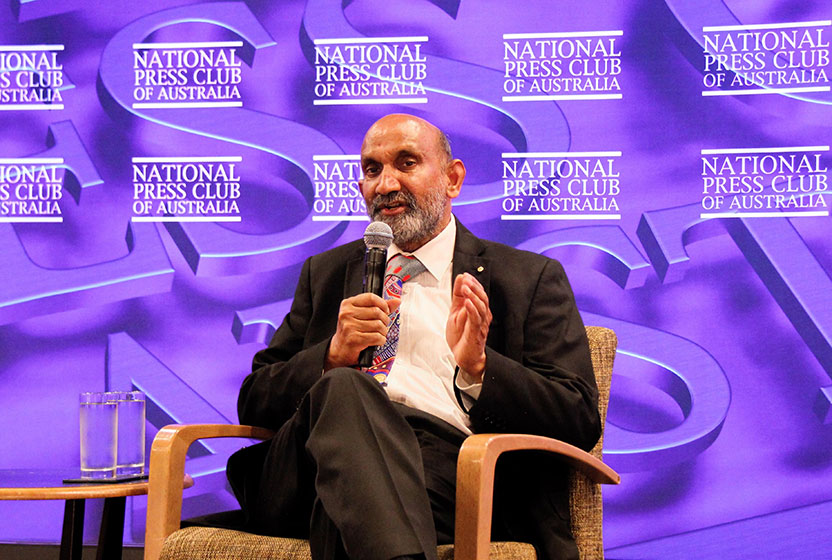
In a landmark speech, delivered as the Ralph Slatyer Address on Science and Society at the National Press Club in November, Professor Jagadish unpacked these issues in-depth and outlined the national strategic imperative for a robust science system as well as the essential recommendations the Strategic Examination must address.
This year the Academy also called for bringing Australia's supercomputers up to speed, as the country's ageing infrastructure can no longer meet the needs of science, defence, industry and society.
The next 10 years of Australian astronomy were charted in a new decadal plan led by the Academy's National Committee for Astronomy, outlining the big questions astronomers are seeking to answer - from the mystery of dark matter to whether we're alone in the universe - and what the sector needs to explore these frontiers.
The Academy's education team released new Science Connections and reSolve resources for secondary science and maths teachers. The resources bring the work and data of Academy Fellows and other Australian researchers directly into the classroom, inspiring a generation of future scientists to explore, discover and lead.
Navigating a turbulent geopolitical world
The rapidly changing geopolitical environment continued to present challenges for science in 2025, with the Academy advocating for Australia's strategic R&D capability in response to abrupt policy shifts from one of our most important research collaborators, the US.
The Academy also established and continues to lead the country's efforts to attract top US researchers and technologists via Australia's Global Talent Attraction Program.
Efforts to deepen and expand Australia's research collaborations with Europe progressed, with a forum at the Shine Dome in July exploring the strategic benefits of association with Horizon Europe, the world's biggest research and innovation funding program. The Academy welcomed the start of exploratory talks between Australia and the European Commission on a possible connection.
Closer to home, the Pacific Academy of Sciences celebrated its one-year anniversary with the election of 13 eminent scholars as Foundation Fellows. The Australian Academy of Science was proud to play a role in this Learned Academy taking flight.
International connections were deepened through the ongoing Tri-Academy Partnership. In November, the Academy led an Australian delegation to Aotearoa New Zealand for a summit focused on shaping Indigenous-led international research agendas and transforming academia for Indigenous knowledge holders.
AI, air quality feature as hot topics
Alongside Burnet Institute and international partners, the Academy co-led global efforts at the United Nations to declare healthy indoor air a human right.
More than 300 leaders gathered at a high-level event on the sidelines of the 80th UN General Assembly in New York in September, while more than 150 organisations signed a global pledge - the first international effort to formally recognise clean air as essential to health and wellbeing.
An Academy report, Indoor air: the science of indoor air and pathways to improve indoor air quality in Australia, launched in November, saw the Shine Dome lit in blue and green to highlight the importance of indoor air quality for public health.
Artificial intelligence was also a trending topic in 2025, with more than 1,400 people attending the Academy's public speaker series, 'AI in science: the promise, perils and path forward'. Expert speakers traversed the intersections of AI with health, food and even tackling scam phone calls across six fascinating sessions. The final event of the year is set to coincide with the publication of discussion papers exploring the role of AI in the science.
The Academy made 22 submissions to government on topics from food security to algal blooms.
Science celebrated in style
Science excellence took centre stage at the Academy's premier event, Science at the Shine Dome 2025, where new Fellows and honorific award winners were celebrated.
Twenty-six of Australia's best and brightest were elected to the Fellowship, with expertise spanning crop genomics to theoretical cosmology.
"Each Fellow has made remarkable contributions in their field, demonstrating the vital role that science plays in addressing our most pressing challenges and expanding human knowledge," said Professor Jagadish.
In 2025, Fellows earned prestigious accolades for their outstanding work. Professor Richard Robson FAA FRS was one of three scientists awarded the Nobel Prize in Chemistry for developing metal-organic frameworks with vast applications. Distinguished Professor Lidia Morawska received the Prime Minister's Prize for Science for her trailblazing advancement of our understanding of indoor air quality.
Twenty-two leading minds and emerging stars received honorific awards, recognising outstanding achievements spanning diverse impact areas such as antibiotic resistance, climate change and photonics.
Scientific excellence was further elevated through award grants - from a trailblazing course on genomics research with Indigenous Australians to supporting early- and mid-career researchers to undertake research with collaborators in Europe.
The Academy continued to advance its reconciliation journey, with a special event during NAIDOC week bringing four inspiring young Indigenous researchers and community advocates to the Shine Dome for an evening of conversation and connection.
Get your science fix over summer
Dive into the Fellows' fascinating recommended reads and listens for summer entertainment that will spark your curiosity.


