
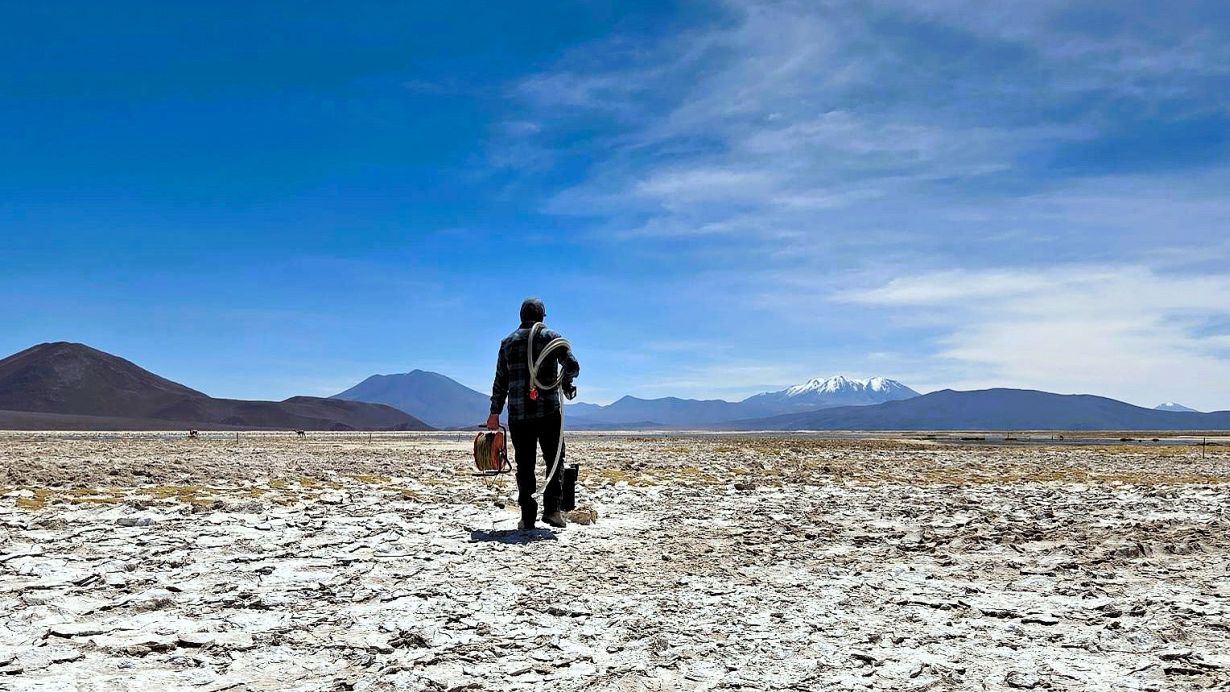
It may be possible to extract critical raw materials like lithium from brines (mineral-rich solutions) in salt lakes and geothermal systems without causing large-scale environmental damage. In the BRIDGE initiative, researchers from the Karlsruhe Institute of Technology (KIT) and Germany's Federal Institute for Geosciences and Natural Resources are investigating relevant deposits in the Atacama Desert with Chilean partners. The initiative's objective is to analyze the resource potential of the deposits and develop strategies for environmentally friendly extraction.
The European Union's Critical Raw Materials Act requires member states to ensure that their supply of strategically important raw materials is more resilient. In the future, at least ten percent of Europe's needs must be met domestically. Even if this target is met, Germany will still import the majority of its critical raw materials. Chile is a key partner in this regard, as affirmed recently by the institutionalized German-Chilean partnership on raw materials and energy based in Santiago de Chile.
"Conventional mining is coming under increasing criticism," said Dr. Fabian Nitschke from KIT's Institute of Applied Geosciences (AGW) and a co-founder of the BRIDGE (German-Chilean Institute for Element Extraction from Brines and Integrated Geological Reservoir Modeling) initiative. "The status quo takes a toll on the people and ecosystems there. We want to show that resource extraction can work differently - more benign, environmentally friendlier, and in close partnership with the local people - in Chile and in Germany."
Research Campaign in the Atacama Desert
In Chile's Atacama Desert, lithium is typically produced in large ponds in which brine solutions are concentrated at the surface over months or years by evaporation. "By evaporating water in the sun, this method doesn't need much external energy input, but it has a major impact on the surface of salt lakes and can usually extract only about 50 percent of the dissolved lithium," said Dr. Valentin Goldberg, also from the AGW and a co-founder of BRIDGE. Thus, the initiative's objective, according to Goldberg, is to use alternative methods that work without needing lengthy evaporation and large areas while enabling more efficient use of resources.
"We're testing direct extraction methods in which critical raw materials can be directly removed from the solutions using selective materials or chemical processes. These materials work like chemical filters that are designed to collect specific elements," said Dr. Fabian Jeschull from KIT's Institute for Applied Materials, who is also involved in the BRIDGE initiative. "After extraction, we return the solutions to the natural reservoirs to maintain a neutral water balance."
To test the conditions under which such processes can be used, researchers are analyzing various mineral brine deposits in the Atacama Desert. During a research campaign lasting several weeks, geologists from Chile and Germany are sampling salt lakes and volcanic reservoir systems and analyzing their chemical and isotopic composition. "We want to know what resources these brines contain in addition to lithium, and how we can best extract them," Goldberg said.
The researchers are also analyzing the deposits as integrated systems, considering their geological reservoirs, material flows, and potential processing methods. "We're also taking into account the geothermal heat stored in the fluid. It can be used to provide energy for the extraction process," Goldberg said, adding that the basic objective of BRIDGE is the development of resource extraction processes that reduce the impact on landscapes and ecosystems while also significantly decreasing energy consumption and emissions.
Application Also Possible in Europe
The research campaign in Chile is taking place in close consultation with representatives of local indigenous communities to promote transparency and local participation, thus ensuring public acceptance of future extraction projects. These communities could benefit indirectly from scientific monitoring of the water balance, from geothermal energy extraction, and possibly even from drinking water supplied by processed geothermal water. "Our joint research is by no means limited to use in Chile," Nitschke said. "The partnership will also enable knowledge transfer to Germany, especially from extensive experience with lithium extraction in Chile, and it brings new opportunities for reservoirs in Germany and Europe."
About BRIDGE
The German-Chilean BRIDGE initiative develops methods for evaluating and exploiting fluid reservoirs with a view to extracting critical raw materials. The German partners are KIT, the Federal Institute for Geosciences and Natural Resources, and the Deutsche Rohstoffagentur; the Chilean partners are the University of Chile and Servicio Nacional de Geología y Minería (SERNAGEOMIN), the Chilean government's national geological and mining service. Germany's Federal Ministry of Research, Technology and Space is funding the establishment of the BRIDGE partnership with Chile


