
'I grew up with people who grow cocoa and depend on it,' says UConn researcher developing an app to help farmers
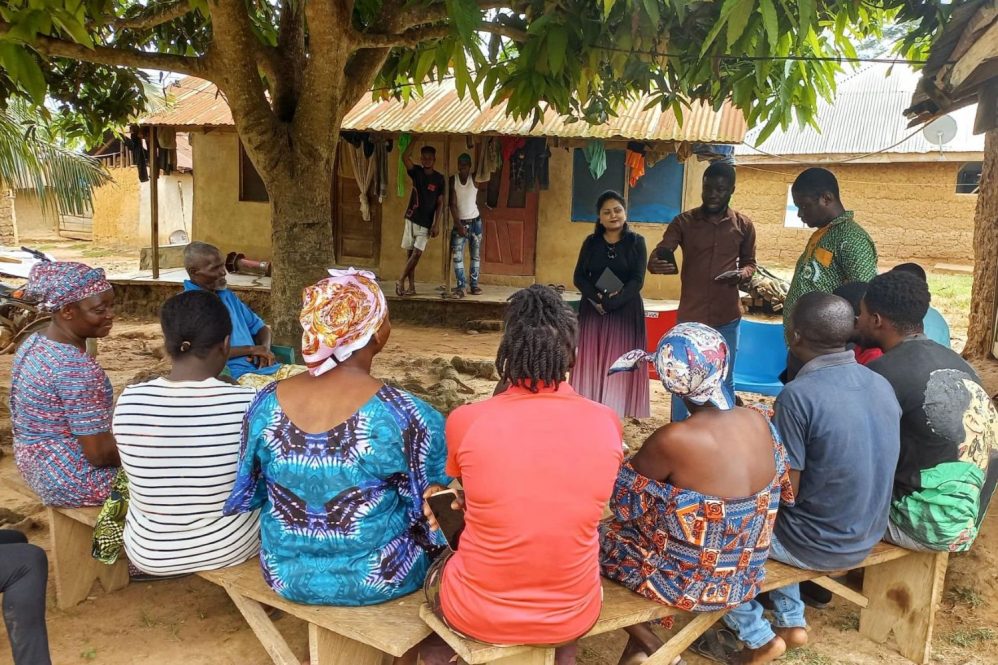
Akandinge (standing, center), shares the app with farmers in Ghana (Contributed photo)
Americans spent $4.1 billion on Halloween candy this year, with chocolate sales accounting for approximately half that amount.
October also marked the start of the cocoa harvesting season in Ghana, the third-largest cocoa producer in the world.
A new European Union regulation designed to combat deforestation is posing a challenge for small cocoa farmers in Ghana. The EU Deforestation Regulation (EUDR) was adopted in 2023 and is set to take effect at the end of this year for large and medium operators, and later in 2027 for small operators. The EUDR prohibits the sale or import of products linked to deforestation occurring after 2020. The regulation applies to six agricultural commodities that have been linked to significant deforestation, including cocoa.
"This means that any company buying cocoa from Ghana has to be able to guarantee that the specific properties they sourced from have not had deforestation happening on them," says Erik Katovich, assistant professor of agricultural and resource economics in the College of Agriculture, Health and Natural Resources (CAHNR).
While many of Ghana's cocoa farms are compliant with the new regulation, they may have a hard time proving this. Most cocoa producers in Ghana work on small farms and lack the capacity that large plantations, like those found Indonesia or Brazil, have to map and track their properties.
"It's much harder in lower-income countries with small-holder agriculture," Katovich says. "It raises a whole bunch of challenges. How do you map these properties? How do you monitor them? How do you actually track where the cocoa is coming from?"
This led Katovich and Ph.D. student George Akandinge to work on developing an app-based system for tracking cocoa production in Ghana.
Katovich began this work as a postdoctoral researcher at the University of Geneva through a grant from the European Commission's Horizon Europe program. At this time, Katovich established a collaboration with the Kuapa Kokoo Farmers Union (KKFU), a cocoa farmer cooperative in Ghana with over 100,000 members.
"The origin of this project was to work with this organization to see if we could actually implement this property level deforestation-free certification system on the ground and then monitor it in a randomized field experiment to understand the impacts," Katovich says.
The researchers have developed a tablet-based app for purchasing clerks to use. When a farmer comes to sell their cocoa at the buying shed in their village, the clerk looks up the farmer's name and checks if their property is compliant. Compliance is based on comparing maps of a property's boundaries, provided by KKFU, against weekly deforestation alerts based on satellite data from Global Forest Watch.
Then, the clerk prints out a QR code to place on each bag that, when scanned further up the supply chain, provides information on whether the cocoa comes from a compliant or noncompliant farm.
In addition to helping farmers prove compliance with the EUDR, this technology will help modernize KKFU's work more generally. Previously, clerks relied on paper records.
"Part of our goal is evaluating this deforestation-free certification," Katovich says. "But another part is digitizing the whole operation and supply chain of the organization, which will, hopefully, help them in other ways as well."
Katovich spent part of this past summer in Ghana. Akandinge, who grew up on a cocoa farm in Ghana, has played a key role as translator and liaison between farmers, clerks, and the app developers.
"I grew up with people who grow cocoa and depend on it," Akandinge says. "Asking these small-scale farmers to individually prove their deforestation status would be rather difficult for them. So, it's important that a cooperative like KKFU and researchers can independently verify this for them."
The researchers are running an experiment this cocoa season. In the control group, the app is only used to collect survey data from farmers; in one experimental group the app tracks deforestation compliance; and in the second experimental group, deforestation-free farmers receive a $5 premium for each bag.
"We're basically testing if this system works purely through monitoring, which could happen if there's social pressure to avoid deforestation," Katovich says. "Or, maybe the farmers are not going to participate without financial compensation."
They will also assess if the clerks find the technology usable and helpful.
Following the harvest season, the researchers will analyze the data they receive. This work has been pre-accepted for publication in the Journal of Development Economics.
"This is very important research to me," Akandinge says. "It has a real-world impact. It's something that's going to be published and that meets the needs of farmers."
This work relates to CAHNR's Strategic Vision area focused on Ensuring a Vibrant and Sustainable Agricultural Industry and Food Supply.


