
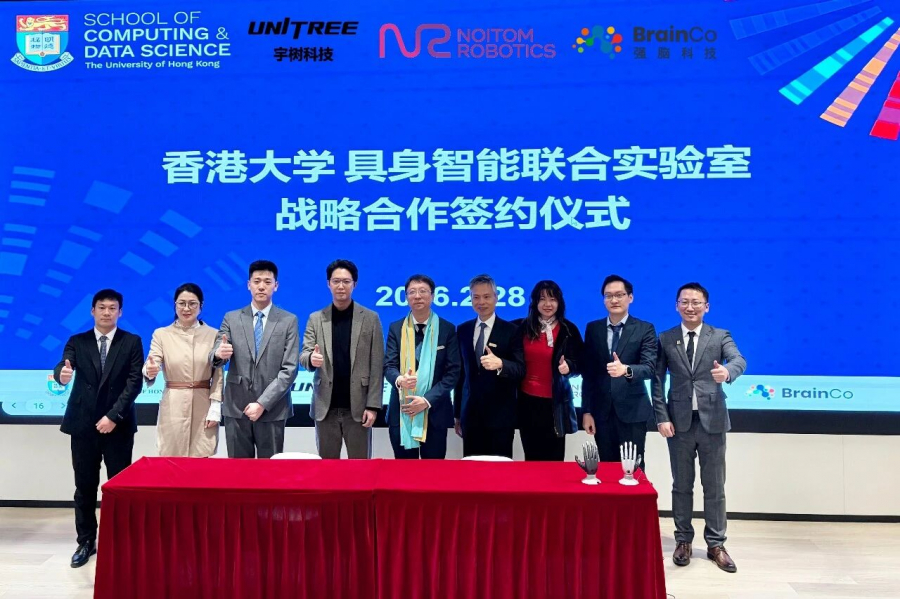
From Right to Left: Prof Hongyang Li, Assistant Professor of HKU's School of Computing and Data Science; Prof Ping Luo, Assistant Director of HKU's School of Computing and Data Science and Associate Professor; Jessica Hu, Secretary of HKU's School of Computing and Data Science and Associate Professor; Prof Tak-Wah Lam, Deputy Director of HKU's School of Computing and Data Science, Executive Director of School of Computing and Data Science(Shanghai); Prof Yi Ma, Director of HKU's School of Computing and Data Science and Chair Professor of Artificial Intelligence; Xinmin Tang, Co-founder and Vice President of Noitom Robotics; Binjie Li, Senior Vice President of Unitree Robotics and Head of Shanghai Branch; Zhige Zhang, Head of Embodied Intelligence Business at BrainCo; Jianyong Liang, Director of Ecosystem Partnerships at Unitree Robotics
The University of Hong Kong (HKU) has formed a groundbreaking collaboration with three major technology companies, marking a significant step towards bridging the gap between theoretical artificial intelligence (AI) research and practical robotic applications. The strategic partnership, formalised on February 28, 2026, at HKU's Zhangjiang Base, brings together Unitree Robotics, Noitom Robotics, and BrainCo to accelerate the development of embodied intelligence technologies.
The ceremony opened with a compelling demonstration by Unitree Robotics' G1 humanoid robot, which executed complex martial arts routines with remarkable precision. The performance showcased current advances in whole-body motion control and set the stage for discussions about transforming intelligent computing from theoretical research into real-world applications.
Charting a New Blueprint for Intelligent Computing
Professor Yi Ma, Director of HKU School of Computing and Data Science and Chair Professor of Artificial Intelligence, outlined the university's strategic vision during his opening remarks. The joint laboratories aim to advance embodied intelligence and humanoid robotics beyond conceptual frameworks into systematic, long-term collaborative research focused on next-generation neural network architectures, world models, and general-purpose robotics applications.
"We must bring intelligence out from behind the screen into embodied intelligence, completing the final millimetre and centimetre of interaction with the physical world—this is when artificial intelligence truly begins to impact physical reality," Professor Ma emphasised.
He described academia's expanded role in not only developing talent but also identifying technological gaps and defining future possibilities. Professor Ma expressed confidence that the partnerships would help drive the nation's AI development from following global trends to setting them, particularly in the emerging field of physical intelligent agents.
Unitree Robotics: From "Movable" to "Usable"
Mr Binjie Li, Senior Vice President of Unitree Robotics and head of the Shanghai branch, described the industry's evolution from proof-of-concept demonstrations to deployable systems. "The question is no longer whether robots can move, but whether they can perform reliably over extended periods in real-world conditions," he noted.
The collaboration will focus on whole-body motion control, dexterous manipulation, brain-eye-hand coordination, world model navigation, and autonomous decision-making using vision-language models (VLMs). Mr Li emphasised building an open platform where academic research can be validated against industrial requirements, with HKU's advanced algorithms integrated into Unitree's real-world robotic platforms.
Noitom Robotics: Unlocking Infinite Possibilities in Perception and Interaction
Mr Xinmin Tang, Co-founder and Vice President of Noitom Robotics, addressed persistent challenges in the field. "Data has become indispensable fuel for the embodied AI industry, yet breakthroughs are still needed in data alignment and quality control of multi-modal data collection," he observed.
Mr Tang described the next phase of competition in embodied intelligence as centred on ecosystem-engineering capabilities rather than on isolated technical achievements. The partnership with HKU will pursue three key objectives: validating algorithms on physical robot platforms, developing integrated pipelines that connect data collection to training and evaluation, and establishing standardised datasets and benchmarks as shared industry resources.
BrainCo: Focusing on High-Degree-of-Freedom Dexterous Hands and Brain-Eye-Hand Coordination
Ms Zhige Zhang, Head of Embodied Intelligence Business at BrainCo, presented the company's "brain-eye-hand" coordination solution for high-degree-of-freedom robotic hands with more than 20 degrees of freedom. She emphasised that the hand serves as the critical interface between intelligent systems and physical environments—functioning simultaneously as both actuator and sensor.
The collaboration will focus on joint hardware-software development for high-dexterity robotic hands, creating closed-loop data systems that integrate brain signals, visual perception, and manipulation, and establishing evaluation frameworks for assessing performance on real-world tasks.
Strategic Positioning in Shanghai and Prospects for Collaboration
In celebration of HKU's 115th anniversary and official launch of its strategic positioning in Shanghai, four HKU bases have been established. These strategic bases will serve as vital platforms for academic exchange, technological innovation, and industry collaboration, further cementing the University's position as a global leader in education and research.
The embodied intelligence joint laboratories will operate on the principles of complementary strengths, collaborative innovation, and shared development, focusing on cutting-edge fields including intelligent computing and embodied intelligence. Spanning the full spectrum from basic research to industrial application, this initiative will drive practical implementations in areas such as intelligent robotics, human-computer interaction, and brain-computer interfaces, ensuring that advancements in intelligent computing deliver tangible benefits to society.


