
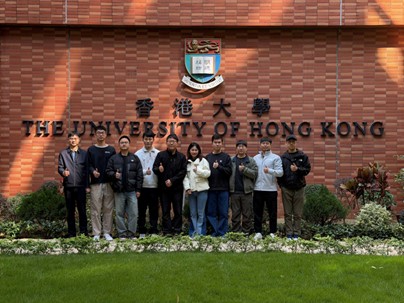
Researchers from the Department of Electrical and Computer Engineering under the Faculty of Engineering at the University of Hong Kong (HKU) and the Centre for Advanced Semiconductors and Integrated Circuits (CASIC) have achieved a major breakthrough in next-generation power electronics. The team has developed an ultra-wide bandgap (UWBG) semiconductor gallium oxide (Ga2O3) power module capable of handling megawatt-level power conversion, opening new possibilities for compact and highly efficient power systems in areas such as power grids, medical equipment and fusion energy.
Led by Professor Yuhao Zhang, Dr Hehe Gong and PhD student Xin Yang, in collaboration with Professor Guo-Quan Lu from Virginia Tech and Professor Jiandong Ye from Nanjing University, the team demonstrated a multi-chip Ga2O3 power module capable of repeatedly switching 1,000 volts and 1,000 amperes. This represents more than a two-order-of-magnitude increase in the power capability previously demonstrated using UWBG semiconductor technologies.
Power semiconductor devices act as the "switches" that control and convert electricity in modern systems, from AI data centres and electric vehicles to renewable-energy systems and power grids. Conventional silicon devices are approaching their physical limits, while newer wide-bandgap semiconductors such as silicon carbide and gallium nitride have enabled major improvements in efficiency and power density.
Gallium oxide belongs to an emerging class of materials known as UWBG semiconductors. Its ability to withstand extremely high electric fields makes it highly attractive for future high-voltage electronics. However, practical Ga2O3 devices have historically been limited to relatively low power because the material does not conduct heat efficiently and because packaging multiple devices together becomes increasingly difficult at high voltage and current.
"Our work shows that the thermal limitations of gallium oxide do not necessarily prevent it from reaching very high-power levels," said Professor Zhang. "Instead of treating the semiconductor device and its package separately, we designed them together as a single system. This device-package co-design allowed us to simultaneously manage the electrical field, heat flow and mechanical stress."
The researchers developed a new "junction-side cooling" architecture that places the heat-generating region of the semiconductor close to the cooling path. They further introduced a high-permittivity insulating layer that helps redistribute the electric field around the device. Together, these approaches allow heat to escape more efficiently while also improving the voltage-handling capability of the module.
A single packaged Ga2O3 device was able to conduct 234 amperes at 1,000 volts during pulsed operation, while remaining functional at junction temperatures exceeding 250 oC. The team then integrated six devices into a larger module and demonstrated repetitive switching at 1,000 volts and 1,000 amperes at a frequency of 1 kHz, corresponding to a peak power level of one megawatt.
"This is the first time that an UWBG multi-chip module has reached the megawatt power level," said Dr Gong. "More importantly, the result provides a scalable approach for translating the exceptional material properties of UWBG semiconductors into practical high-power systems."
The technology is particularly promising for pulsed-power applications, where extremely large amounts of electrical energy must be delivered within microseconds. Pulsed-power systems can take advantage of Ga2O3's intrinsically superior volumetric heat capacility to withstand high electric fields and high transient temperatures.
Potential applications include high-voltage protection for future power grids, advanced medical systems, particle accelerators and fusion-energy facilities. The fast switching capability of the module could also enable smaller and more efficient power-conversion systems.
The study builds on the team's earlier research in the co-design of semiconductor devices and packaging. The team's previous research in this area was selected as a Technical Highlight at the 2025 IEEE International Electron Devices Meeting (IEDM), the top-notch conference in semiconductor device technology.
The significance of this research direction was also highlighted by Nature Electronics in a News & Views article titled "Powering the ultrawide-bandgap era", which discussed the potential of multi-physics device and packaging design to overcome fundamental limitations of emerging semiconductor materials.
The research has been published in Nature Communications in an article titled "A megawatt ultra-wide bandgap semiconductor module for pulsed power electronics".


