
Researchers at the University of Würzburg have shown that dung beetles suffer in canopy openings that have been deliberately created to promote biodiversity. Rising temperatures are significantly exacerbating the problem.
To counteract species loss in Europe's often monotonous commercial forests, forestry and nature conservation are focusing on greater structural diversity. The strategy: by deliberately creating canopy openings and enriching deadwood, the conditions of natural forests are to be imitated. These measures are considered positive for biodiversity as they create habitats for many plants and animals.
In one of Germany's largest forestry experiments, a research team from Julius-Maximilians-Universität Würzburg (JMU) has now investigated how this strategy affects dung beetles. They compared conventionally managed, dense forests with experimental forests in which structural diversity was specifically increased.
A total of 234 areas in eleven forest regions throughout Germany were examined. The areas included the Bavarian Forest National Park, the JMU university forest, and forests around Lübeck.
The result clearly contradicts general expectations: "The diversity of dung beetles did not increase in the more structurally diverse forests. In the newly created canopy openings, it even declined significantly," says Johanna Asch, doctoral student at the JMU Chair of Animal Ecology and Tropical Biology and first author of the study.
This unexpected result shows that these beetles do not benefit from structural diversity. Rather, the key to their survival lies in the microclimate of the forest.
Good intentions don't always lead to good results: Why canopy openings harm dung beetles
Dung beetles are much more than just inconspicuous insects. They act as unpaid, hard-working labourers in the forest ecosystem: as "health police," they remove the feces of wild animals, thereby inhibiting the spread of parasites. As "nutrient recyclers," they work the dung into the soil, making nutrients available to plants again.
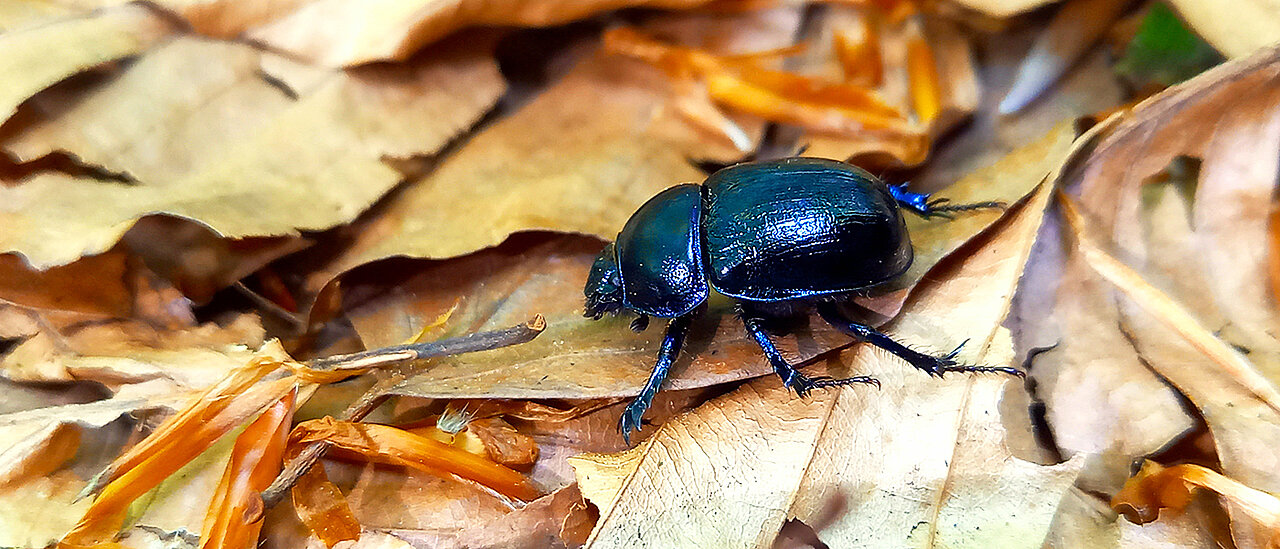
The main player in the forests studied is the forest dung beetle Anoplotrupes stercorosus. It accounts for the largest share of biomass in all regions, often over 90 percent, making it the most important service provider for feces removal. The study shows that this key species, a large tunnel digger adapted to cool and humid conditions, is particularly affected.
The decisive factor is the climate. Closed, dense forests act as a buffer against extreme temperatures. Canopy openings negate this protective effect and lead to higher temperatures and greater drying out of the ground. For the forest dung beetle, which as a large insect is more susceptible to water loss, this can pose a double threat: global warming and locally elevated temperatures in canopy openings create hostile conditions.
As a result, as temperatures rise, both its population and the efficiency of dung removal decline. The researchers use figures to demonstrate the immense importance of insects. When beetles in cooler regions were kept away from dung, its decomposition decreased by 77 to 91 percent.
Climate change threatens the forest's waste disposal system
The research results are of great strategic importance in the context of climate change. They show that measures to promote biodiversity must be considered in a differentiated manner, as not all species groups benefit equally. For dung beetles, the problem is not a lack of food; the study found that it is not the availability of dung but the climate that limits their populations.
In practice, this leads to a clear recommendation for action: "Even if the goal of greater structural diversity remains valid, it is essential to maintain sufficiently large, closed, and thus cooler forest stands at the same time." Only in this way can the dung beetle communities that are central to the ecosystem and their services be protected.
With advancing climate change and rising temperatures, the forest dung beetle could retreat to colder areas. This would create a functional gap. Future research must now observe whether heat-loving species from the Mediterranean regions can migrate and fill this gap.
Ultimately, the study underscores that protecting ecosystems requires a deep understanding of the specific needs of different species. A universal approach is not sufficient to preserve the complex interrelationships in nature.
Original publication
Dung beetles do not profit from enhanced spatial heterogeneity in temperate production forests: a forest manipulation experiment. Johanna Asch, Michael Scherer-Lorenzen, Kerstin Pierick, Clara Wild, Julia Rothacher, Jörg Müller, Orsi Decker, Simone Cesarz, Nico Daume, Jörn Buse, Marcell K. Peters. Journal of Applied Ecology, 15. Februar 2026, https://doi.org/10.1111/1365-2664.70288


