
To recognise this month's Auckland Startup Week, UniNews profiles four exciting start-ups that have benefitted from the University's support.
Behind the gut revolution
In 2008, when gastrointestinal surgeon Greg O'Grady asked renowned biomedical modeller Professor Andrew Pullan which PhD research topic could have the greatest impact, the answer came quickly: the gut's electrical system.
Heart electrics were relatively well understood. But the electrical signals that control the digestive system remained largely a mystery, despite gut disorders affecting an estimated one in ten people worldwide with symptoms such as nausea, stomach pain, constipation and diarrhoea.
Greg joined Andrew's research team, determined to turn discoveries into better patient care.
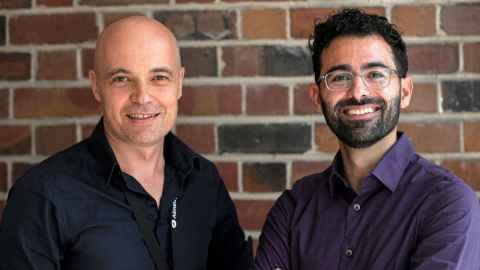
Almost 20 years later, after a diverse academic surgical career, he is co-founder and chief executive of Alimetry, a University of Auckland spin-out company whose Gastric Alimetry device is helping clinicians diagnose disorders linked to the stomach's electrical activity. The company employs 50 people, has raised $50 million in investment and its technology is now being used in more than 50 hospitals and clinics around the world.
Greg says success grew from both world-leading research and the University's innovation ecosystem.
The company's commercialisation journey began in 2019 at the Auckland Bioengineering Institute's medtech incubator Cloud9. Greg also completed the Centre for Innovation and Entrepreneurship's (CIE) Velocity programme, while UniServices contributed investment, commercialisation expertise and introductions to other investors.
"I first encountered commercialisation in the Velocity programme during my PhD," says Greg. "You learn best by doing."
The science behind Alimetry was equally collaborative. Andrew Pullan, who died in 2012, brought together researchers and clinicians from engineering, mathematics, surgery, gastroenterology and physics to better understand the gut's electrical activity through world-first studies and mathematical modelling.
Greg's research attracted American bioengineer Armen Gharibans, who joined Greg in Auckland in 2019.
"Within six months we had a prototype - and a company," says Greg.
"Alimetry is a product of world-leading research and a healthy deep-tech ecosystem at the University. When you're doing something really innovative and meaningful for people, it attracts others and the ecosystem grows."

A bright idea for nits
It started with a problem familiar to many parents: head lice.
It was 2022, and Kate Ricketts was frustrated by the never-ending cycle affecting her two young sons. The real problem, the University staff member realised, wasn't killing the lice but finding the tiny eggs, which could hatch weeks later.
A former veterinary nurse, Kate remembered using UV light to identify ringworm in animals. And she read about researchers using fingerprinting powder to make insect exoskeletons fluoresce. Could the same trick work on nits?
She ordered some powder online and tried it on her son's hair. Under a UV light, the eggs glowed. "I was like, 'This is amazing.'"
Trouble was, the powder wasn't safe for regular use. So, Kate enlisted some postgraduate chemistry researchers to develop and test non-toxic formulations.
Next step: creating her start-up, ISpyNits. She entered CIE's Velocity Ideas Challenge and won $1,000. Encouraged, she moved on to the Velocity $100k Challenge, won the social category in 2022, and earned a place in CIE's six-month VentureLab incubator, which helped her develop the idea into a viable business.
She also pitched ISpyNits to research commercialisation programmes Return on Science and Momentum, and received investment and commercial support from UniServices.
There is much greater emphasis on commercialisation at the University than there was in the past, says Kate. "It feels like you have a true partner to bounce ideas off, and that is so valuable in this space … We were in market within six months."
Today, ISpyNits manufactures its UV Glo-Powder and Lice Lotion in Taiwan and Auckland and sells through distributors in New Zealand and Australia, with further international expansion plans.
Kate says her experience showed her the value of entrepreneurship and innovation within the University ecosystem. And not just for future business owners.
"When you pare it down to the transferable skills, being a founder or learning about innovation is insanely useful."
Building for earthquakes
When the Christchurch earthquakes damaged buildings that had been designed to withstand seismic shocks, Professor Pierre Quenneville saw an opportunity to do better.
The University of Auckland timber engineering expert wondered whether buildings could be designed to not just survive an earthquake, but to move with it and then return to their original position.
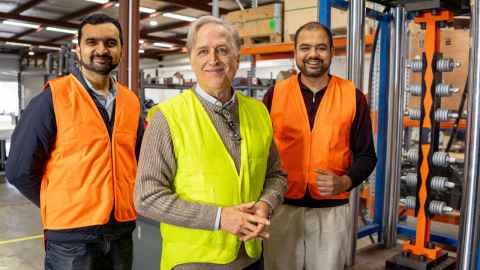
Working with researchers and postgraduate students, he developed the idea that became Tectonus.
"One of the young researchers had an engineering brainwave," says Pierre. The team brought together engineering, business and commercialisation expertise, recruited a business graduate to lead marketing, enlisted support from UniServices, and launched a start-up.
In 2015, the team won the University's Velocity $100k Challenge, while the Faculty of Engineering and Design helped secure $3.4 million in government research funding to develop the technology. A year later, Tectonus won its first major contract for the new Nelson Airport terminal.
Pierre mortgaged his home to help build the company, while UniServices invested and, alongside CIE, introduced the team to early-stage investors.
Today, Tectonus employs 12 people, including University graduates and postgraduate students, and has raised $15 million in investment. Its seismic technology is being used in projects in North America, including Vancouver's The Hive, the world's tallest all-timber seismic-resistant building.
Pierre continues to teach and supervise at the University, believing research and industry are strongest when they work together: "That is how we have impact."
"When academics are connected to industry they can be the link between the need and the idea," he explains.
"When industry starts talking about a problem that needs solving, you get ideas for research that can then be commercialised back to industry."
Researchers, pizza and a start-up
It started with a conversation over pizza after a University of Auckland entrepreneurship workshop.
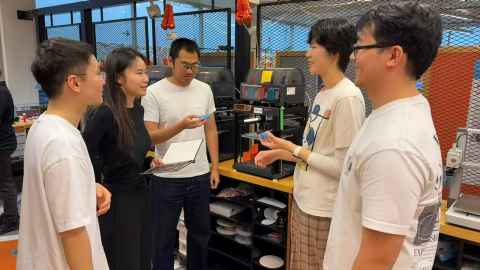
After the CIE session, five postgraduate students got chatting about their research. One was investigating treatments for brain cancer. Another specialised in needle-free drug delivery. Others brought expertise in business, clinical medicine and antibiotic development.
"We started talking about our different projects and suddenly thought, 'Maybe we could combine our expertise'," says biomedical engineering masters student William Si.
The five students, all originally from China and now studying at the University, have since begun developing a start-up aimed at one of medicine's toughest challenges: treating glioblastoma, an aggressive brain cancer with a five-year survival rate of just five percent.
William's research focuses on needle-free drug delivery, while PhD student Yuge Liu is developing new treatments for glioblastoma. Together they came up with the idea of a device that could deliver medicines through the nose, bypassing the blood-brain barrier that prevents many drugs reaching the brain, while potentially avoiding the harmful side effects of traditional treatments.
The project also brings in business masters student Wenyue Ruan, PhD student Yuhang Sui, and clinician and PhD student Jianhua Wu.
For Yuge, CIE's Doctoral Entrepreneurial Leadership Programme changed the way she thought about research.
"We learned how to translate academic ideas into something that can impact society," she says. "I shared my research with William, and together we realised there was a gap we might be able to address."
The team is now preparing for the University's Velocity entrepreneurship programme, while developing its business model through CIE's VentureLab incubator.
"The University of Auckland has rich resources for commercialisation," says William. "There is support from CIE, UniServices and the Auckland Bioengineering Institute. They encourage researchers to develop ideas that can have real benefits."
- Nikki Mandow
This article first appeared in the October 2026 issue of UniNews.


