
A recent study unveils the molecular mechanisms explaining why some 'stealth' drug coatings fail to evade the immune system, as reported by researchers from Institute of Science Tokyo. Using single-molecule atomic force microscopy, they measured how individual antibodies bind to poly (ethylene) glycol, showing that hydration and terminal chemistry strongly influence immune recognition. Their findings pave the way for novel drug coatings that stay effective longer by avoiding unwanted immune responses.
Towards Better Stealth Coatings to Help Nanomedicines Evade the Immune System
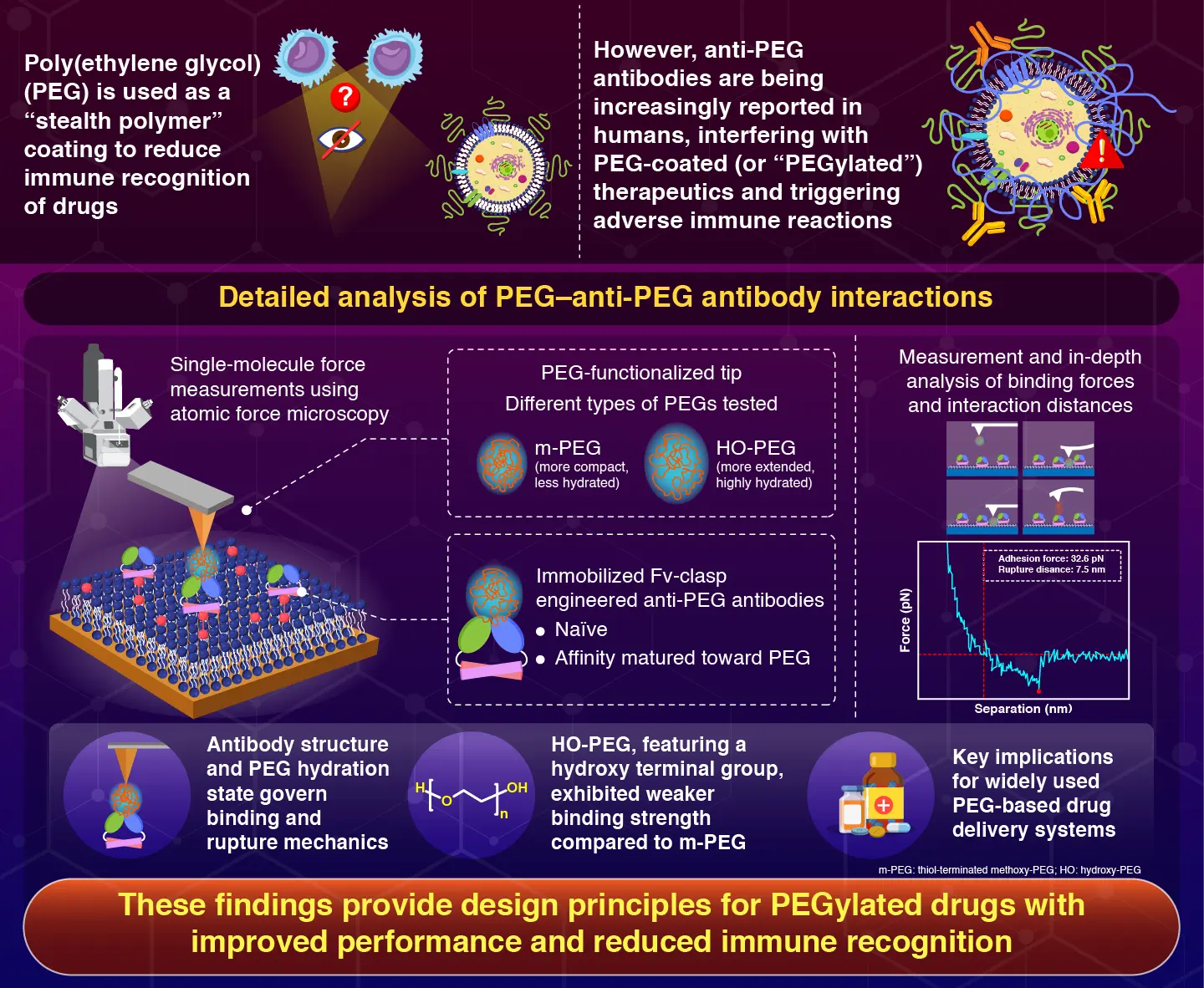
For decades, poly (ethylene) glycol (PEG) has played an essential role in medicine. This biocompatible polymer can be coated onto drugs through a process known as PEGylation, which helps compounds to avoid detection by the immune system and stay in the bloodstream for a longer duration. Often described as a 'stealth' material, PEG is a key component of drug delivery systems and has been used in recent high-profile technologies, such as mRNA vaccines against COVID-19 virus.
In recent years, however, scientists have observed that PEGylation has its limitations. Several studies have shown that PEG can in fact be recognized by the immune system in some patients, leading to the production of anti-PEG antibodies. When these antibodies bind to PEG-coated drugs, the latter are cleared from the body faster, reducing their effectiveness and in some cases triggering allergy-like reactions. Although this issue is now widely acknowledged, scientists have struggled to understand the exact mechanism behind antibodies recognizing PEG. Conventional laboratory methods simply cannot observe the weak, short-lived dynamic interactions that occur when a single antibody binds to a single PEG chain.
To bridge this knowledge gap, a research team led by Associate Professor Tomohiro Hayashi from the Department of Materials Science and Engineering, Institute of Science Tokyo (Science Tokyo), Japan, decided to take a closer look. The team used atomic force microscopy-based single-molecule force spectroscopy (AFM-SMFS) to directly measure the intermolecular binding forces involved in PEG—anti-PEG interactions. AFM-SMFS is a powerful tool to measure forces at the molecular level (in the piconewton range) and characterize the binding and unbinding events between biomolecules. Their findings were made available online on January 20, 2026 and were published in Volume 9, Issue 3 of ACS Applied Bio Materials on February 2, 2026.
The researchers focused on two types of PEG polymers that differ only in their terminal chemical group: methoxy-terminated PEG (m-PEG), which is widely used in pharmaceuticals for its chemical stability, and hydroxy-terminated PEG (HO-PEG), which attracts water more strongly and is chemically reactive. They also compared two types of engineered antibodies representing different stages of immune response-one naïve (generic) and one affinity-matured (tailored) toward PEG.
For their AFM experiments, the researchers attached a PEG molecule to the cantilever tip of the microscope, which enabled them to move the polymer in three dimensions with high precision. Through controlled motions, they brought the PEG-laden tip towards antibodies immobilized on a substrate and carefully registered the forces on the tip as the PEG molecule was stretched to eventually break off. In addition to these force measurements, the team used complementary methods to assess the PEG hydration state and how it affects its interactions with antibodies.
The results showed that m-PEG binds more strongly to anti-PEG antibodies than HO-PEG. The reason lies not only in chemistry, but also in structure. Chemically reactive hydroxy terminals of HO-PEG form a thick, highly hydrated layer that acts as a physical barrier, making it harder for antibodies to reach the polymer chain. "Our analyses provide molecular-level insight into how antibody structure and PEG hydration state dictate binding, paving the way for PEGylated therapeutics with improved performance," says Hayashi.
By directly linking PEG hydration and molecular structure to immune recognition, this study offers a deeper understanding of the factors governing how drug coatings interact with the immune system. Beyond PEG itself, the team's single-molecule AFM approach could be used to evaluate other alternative stealth polymers, as Hayashi concludes: "We expect our findings to provide new guidelines for the design of longer-lasting and safer nanomedicines and drug delivery systems that are less susceptible to elimination by the immune system."
Reference
- Authors:
- Glenn Villena Latag1, Hiroyuki Tahara1, Airi Katase1, Shoichi Maeda1, Yiwei Liu2, Yoshimitsu Kakuta3, Takamasa Teramoto3, Takeshi Mori2*, and Tomohiro Hayashi1*
*Corresponding authors
- Title:
- AFM-Based Single-Molecule Force Spectroscopy of PEG−Anti-PEG Antibody Interactions
- Journal:
- ASC Applied Bio Materials
- Affiliations:
- 1Department of Materials Science and Engineering, Institute of Science Tokyo, Japan
2Department of Applied Chemistry, Kyushu University, Japan
3Department of Bioscience and Biotechnology, Kyushu University, Japan


