
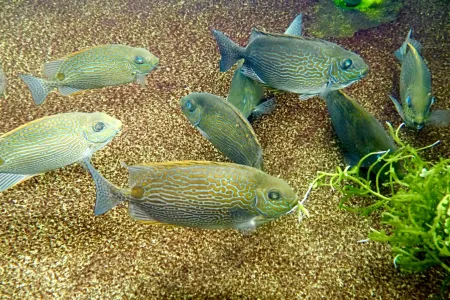
An Australian island's efforts to improve food security and transition into a blue economy will be bolstered by a new project to propagate a nutritious and increasingly popular fish.
The project with Charles Darwin University (CDU), Groote Aqua Aboriginal Corporation (GAAC) and the CSIRO, through the agency's Industry PhD Program, aims to expand GAAC's low trophic aquaculture program by developing production methods for the goldlined rabbitfish.
The goldlined rabbitfish (Siganus lineatus) is a marine herbivore and a popular fish in the South Pacific region. It is a low trophic fish, or a species positioned in the lower levels of the food web.
It has flexible nutritional requirements, high tolerance to variable water quality, strong grazing capacity for fouling control in ponds, sea cages and tanks, and is an excellent food fish - making it an ideal species for aquaculture production.
GAAC, which has a multi-species aquaculture program on Groote Eylandt, has established and maintained broodstock (individuals used in aquaculture for breeding) and produced hatchery-bred juveniles.
The next step is to develop and optimise hatchery and nursery production protocols for the goldlined rabbitfish, with submissions now open for interested PhD applicants.
CDU Professor of Tropical Aquaculture Sunil Kadri, who is with the Research Institute for Northern Agriculture (RINA) and a supervisor on this project, said this was the ideal project to support the development of a blue economy on the island.
"This is an opportunity for the right person who wants to see integrated, low trophic aquaculture develop, and provide opportunities for Indigenous communities," Professor Kadri said.
"The goldlined rabbitfish is the perfect kind of fish to grow in an Indigenous community. You don't have demand from southern states to fill as a project objective, as many previous attempts at Indigenous aquaculture in the NT have had. Instead it could improve food security for the local community, and if there's excess production, it can be traded with other communities.
"There's also a whole Southeast Asian market to trade with, and that's how Indigenous aquaculture opportunities here in the north should be."
Aside from being successfully bred, trials by GAAC showed the fish feed on macroalgal growth, and successful production of the fish could offer a solution to dealing with macroalgae outbreaks in aquaculture ponds.
Interested PhD applicants can contact Professor Kadri for more information on this project.


