We write on behalf of the undersigned Alliance of Industry Associations to raise a growing concern about
government's inadequate consultation on recent complex legislative and regulatory reforms. We represent 30
groups from across the economy including small, medium and large businesses, farmers, builders, retailers,
universities and tax and accounting professionals.
Our organisations support genuine and timely consultation as a cornerstone of good policy making and
democratic governance. This allows government to test its proposals against real-world impact and allows
impacted businesses and professionals to properly understand and respond to proposed change. Indeed,
consultation, when done well, is a critical step in ensuring good policy design and minimising unintended
consequences of policy reform.
Increasingly, however, we are being asked to review and respond to complex exposure draft legislation,
regulations and consultation papers within windows that leave little realistic opportunity for considered input
with recommendations from Departments to limit our submissions to 1,000 words. This leaves us with limited
capacity to highlight complex issues.
This runs contrary to the Government's stated principles
The Australian Government's Guide to Policy Impact Analysis, and the Office of Impact Analysis' guidance note
on Best Practice Consultation, commit policy makers to consulting with impacted businesses and community
organisations "in a genuine and timely way" and point to a minimum consultation period of 30-60 days for
engagement on significant reforms.
These principles recognise that genuine consultation requires sufficient opportunity for stakeholders to
identify practical problems, propose solutions and have those views properly considered before decisions are
finalised.
The Regulatory Initiatives Grid (RIG), maintained by Treasury for the financial sector, is a welcome example of
government seeking to give industry earlier visibility of, and adequate time to prepare for, upcoming
regulatory change. While the RIG is not perfect, we would like to see that same spirit of transparency and lead
time applied consistently across all portfolios and agencies.
The pattern, across portfolios
Recent experience suggests that inadequate consultation is not a one-off issue but is endemic across
portfolios and topics. Stakeholders, businesses, the community or unions – face inadequate opportunities to
consider or provide meaningful responses that will be listened to.
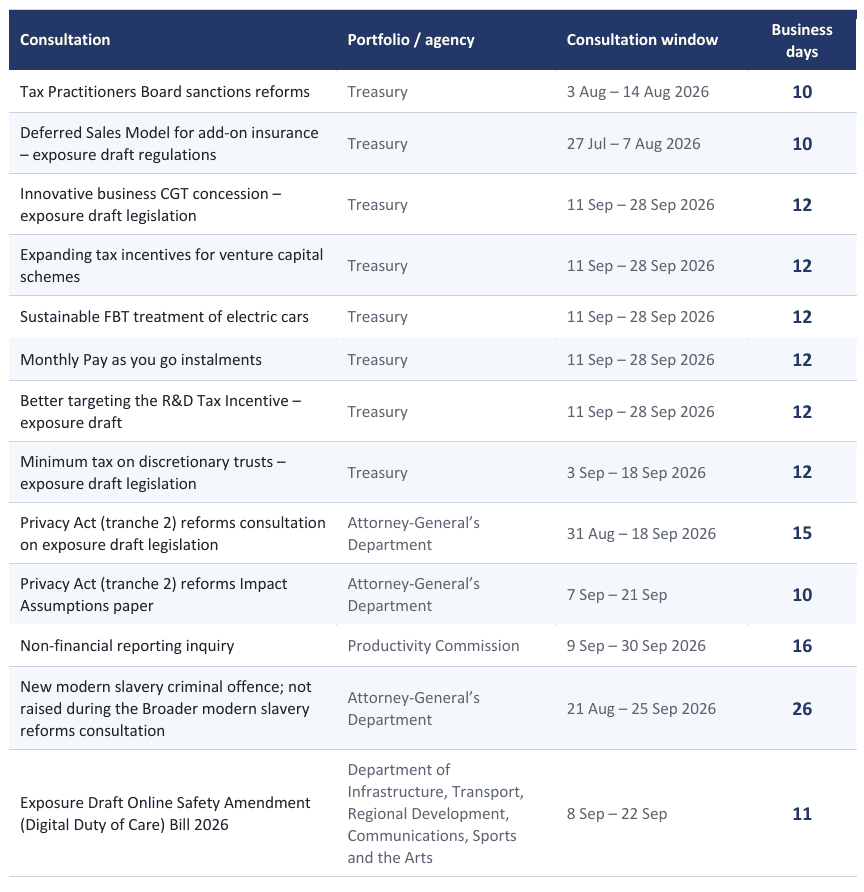
The table in Attachment A provides a selection of recent examples. In every case, the consultation period fell
short of the OIA's minimum, in the shortest cases, government allowed only a third a OIAs suggested
minimum. Government has shown that considerably longer timeframes are readily achievable when it
chooses to apply them. To illustrate:
- The Budget night announcements of changes to capital gains tax and negative gearing saw legislation promptly introduced and passed in less than month.
- Consultation on the Budget night announcement around removing tariffs on yarn and mushrooms will continue into January. Consultation on tranche 2 of the Privacy Act reforms were only released this month following passage of the Privacy and Other Legislation Amendment Act 2024.
- The Department of Agriculture, Fisheries and Forestry on the Forests Australia website user experience consultation started October last year and finishes in December - this year.
- A 65-business day review into the Wheat Port Code.
- A 41-business day consultation run by the Department of Health, Disability and Ageing/OGTR on the commercial supply of a genetically modified vaccine for chickens.
These examples underscore that the constraint on consultation is one of prioritisation, not capacity. At the
same time, the risks are plain to see with policy that may ultimately require further changes, not achieve its
policy intent, or require future delays.
Proposed solution
To address this pattern and restore confidence in the consultation process, we ask that government commit
to the following:
- Strengthen Cabinet scrutiny of new regulation, consistent with the rigor applied to new expenditure proposals.
- Appoint an independent Office of Impact Analysis Commissioner to strengthen the key role of the OIA located within PM&C.
- Adopt standard minimum stakeholder consultation periods across all Commonwealth policy initiatives, to ensure that rushed legislation does not create unnecessary compliance costs or unintended consequences.
We welcome the opportunity to discuss these concerns and recommendations directly, and to work with the
government on a more consistent and workable approach to consultation timeframes for policy reforms.
Recent consultation windows