
PULLMAN, Wash - A low-cost, simple robotic apple picker arm developed by Washington State University researchers may someday help with fruit picking and other farm chores.
The inflatable arm can see an apple, then extend and retract to pick a piece of fruit in about 25 seconds. Weighing less than 50 pounds with its metal base, the two-foot-long arm is made of a soft fabric filled with air that is similar to, but stronger than, the wacky inflatable arm-flailing tube men that are used in outdoor advertising. The researchers in WSU's School of Mechanical and Materials Engineering recently published their work on the robotic arm in the journal, Smart Agricultural Technology.
The team is collaborating with researchers at the Prosser Research Extension Center and with Manoj Karkee at Cornell University to adapt the arm to an automated moving platform that is also being developed to move through orchards.
"The uncomplicated nature of the design makes it low-cost, easy to maintain, and highly reliable for a soft robot," said Ming Luo, Flaherty Assistant Professor in WSU's School of Mechanical and Materials Engineering and corresponding author on the work.
With an aging population and a decrease in migrant farm workers, Washington farmers have struggled to meet their needs for workers during harvest season.
Tree fruit growers worldwide are facing labor shortages for critical operations like harvesting and pruning. Washington state leads the nation in apple and sweet cherry production, which, in 2023, contributed more than $2 billion dollars to the U.S. gross domestic product. Throughout Washington, farms employ hundreds of workers each year for orchard operations, including for pollination, pruning, flower thinning and fruit harvesting. With an aging population and a decrease in migrant farm workers, however, farmers have struggled to meet their needs for workers during harvest season.
When he traveled across the state this fall, Luo saw orchards with fruit rotting on the ground.
"It is just a waste," he said.
In recent years, researchers have started developing robotic apple harvesting systems, but they are generally large, expensive and complex to use in orchards.
The materials for the arm developed by the WSU team cost about $5,500. Because the arm is an inflated tube, it doesn't weigh much, so it's safe to use with people nearby and won't harm delicate branches or apples. It is also designed to work in modern apple orchards, which have branches organized linearly along a plane or as a V-trellis to make for ideal growing and picking conditions.
"Having this very low-cost, safe robotic platform is ideal for the orchard environment," said Ryan Dorosh, a PhD candidate and lead author on the work.
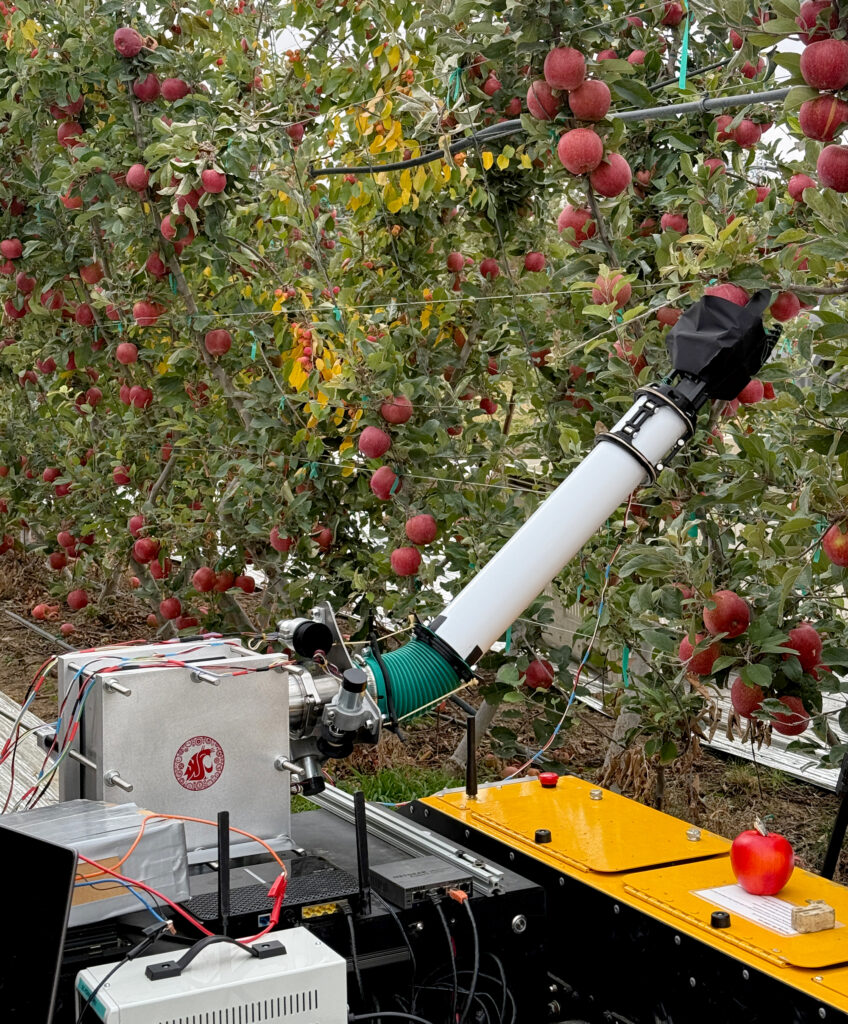
Compared to human pickers who pick an apple every three seconds, the robotic arm is still slow. The researchers are refining some of the mechanical components as well as working to improve its rudimentary detection system, which hinders the picking more than the robotic arm's movement. They are also working to develop the arm's ability to do other orchard tasks, such as pruning, flower thinning, and spraying. By producing a cost-effective solution and having the robot arm be able to do several tasks, they hope that farmers will eventually be able to buy multiple, inexpensive robots.
The researchers are working with WSU's Office of Innovation and Entrepreneurship team for the intellectual property protection and commercialization of this technology. The work was funded by the National Science Foundation, the USDA National Institute of Food and Agriculture, and Washington Tree Fruit Research Commission and tested at Allan Brothers Fruit in Prosser, Washington.


