
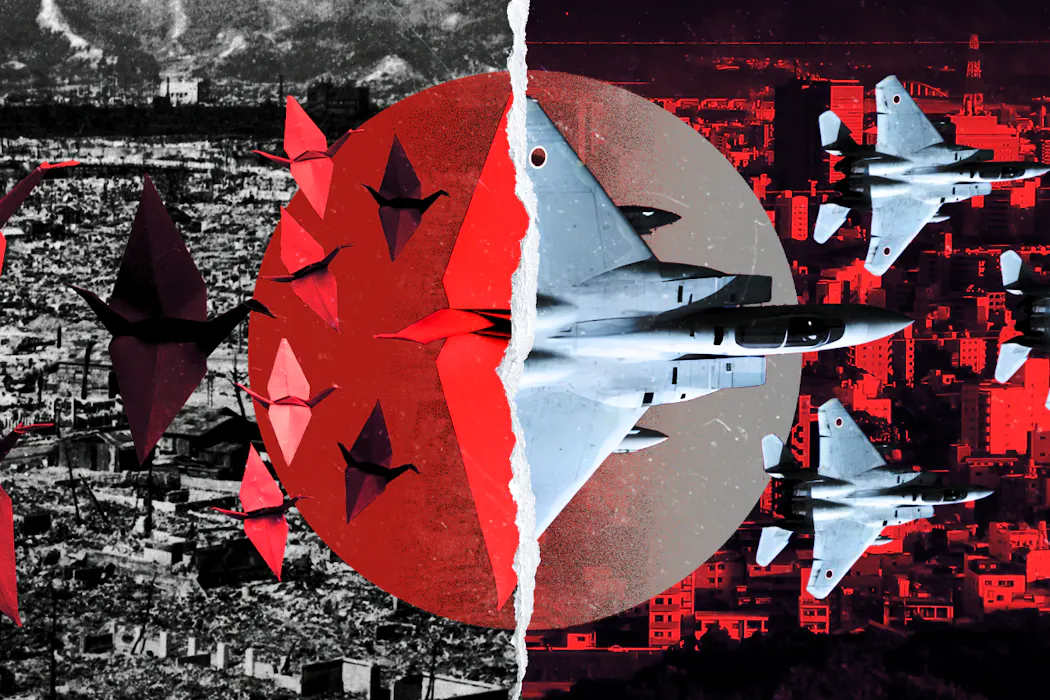
When Japanese Prime Minister Sanae Takaichi visited the White House in March, she reportedly told US President Donald Trump that Japan could not send forces to help secure the Strait of Hormuz due to limits under the country's constitution.
Author
- Simon Avenell
Professor in Modern Japanese History, Australian National University
Article 9 of Japan's constitution renounces war and says the country will not maintain military forces for the purpose of settling international disputes. Since 1947, it has been the centrepiece of Japanese pacifism.
However, this could be changing. Takaichi's conservative government has backed higher defence spending , looser arms-export restrictions, stronger regional security ties and, most controversially, a revision of Article 9 .
Her government argues this is necessary to respond to rising threats from China and North Korea. Late last year, she enraged Beijing when she raised the spectre of coming to the defence of Taiwan. Earlier this month, Beijing accused her government of pursuing " reckless militarism ".
Public opinion in Japan remains divided over Takaichi's more hard-line approach. Thousands have demonstrated in defence of the constitution, with many opposed to changes that might make it easier for Japan to join foreign wars.
But Japan's pacifism has never simply been a static constitutional principle. For 80 years, it has been shaped by war memory, nuclear trauma, alliance politics, regional tensions and fierce political struggles over the meaning of peace.
The postwar view of peace
Around three million Japanese people died in the second world war, along with many millions across Japan's Asia-Pacific empire. Several forces shaped what peace meant at this moment.
Early postwar thinkers connected peace to atonement. They spearheaded a " community of contrition " committed to addressing the social and individual shortcomings behind the country's militarism. Shortly after Japan's defeat, Prime Minister Naruhiko Higashikuni called for the " repentance of the entire nation ".
But postwar pacifism also drew heavily on a sense of victimhood . Many Japanese suffered through the firebombings of their cities and the deaths of loved ones on distant battlefields. Many felt their leaders had deceived them into fighting an unwinnable war.
The US-led occupation from 1945 to 1952 reinforced this sense of victimisation. The Tokyo War Crimes Tribunal tried 28 Japanese leaders for war crimes. Although the tribunal was criticised as " victors' justice ," it confirmed for many Japanese that their leaders were to blame.
Assigning guilt in this way made it easier to reimagine Japan around the defining slogan of the era, " peace and democracy ".
The 1947 constitution, which gave this slogan legal force, was drafted by American occupation officials. The origins of Article 9 remain ambiguous, but a note from US General Douglas MacArthur to the drafting group specified that the constitution should eliminate Japan's capacity to wage war.
Although US President Richard Nixon would later describe Article 9 as a " mistake ", it became the symbol of postwar pacifism in Japan.
An anti-nuclear movement is born
The Cold War soon turned peace into a fiercely contested issue.
A key moment came in 1954 when the United States detonated a hydrogen bomb at Bikini Atoll in the Pacific. A nearby Japanese tuna fishing vessel, the Daigo Fukuryū Maru , was exposed to radioactive fallout and one of its crew later died.
The incident shocked Japan, leading to a media frenzy over "atomic tuna" and "ashes of death" . It also helped spark a mass movement against nuclear weapons.
Cultural groups - many led by women - began a nationwide petition opposing nuclear weapons. This led to the formation of the influential Japan Council against Atomic and Hydrogen Bombs and another group, Nihon Hidankyo , which won the Nobel Peace Prize in 2024.
American fears about social unrest in the occupation years led to heavy censorship of any discussion of Hiroshima and Nagasaki. With these restrictions removed, writers and artists began directly linking pacifism with antinuclear sentiment. The first Godzilla film, released just after the Bikini Atoll incident, brilliantly blended traumatic war memories, nuclear anxieties and aspirations for a peaceful future.
Antiwar and pacifist groups also began protesting against US military bases in Japan, permitted under the US-Japan Security Treaty of 1952.
The largest confrontation came in 1959-60 when the Liberal Democratic Party (LDP) pushed a revision of the treaty through the Diet (Japan's parliament). Hundreds of thousands of citizens, political groups, labour unions and civic organisations participated in the largest confrontation over peace and democracy in modern Japanese history. Although the treaty was ultimately passed and ratified, Prime Minister Kishi Nobusuke and his cabinet were forced to resign.
The lesson for Japanese leaders was clear: pacifist sentiment ran deep and could erupt if sufficiently provoked. As a result, the ruling LDP largely avoided the issue of constitutional revision for decades.
Staging ground for the Vietnam War
Instead, conservatives forged their own version of pacifism.
In the 1950s, Prime Minister Yoshida Shigeru's postwar strategy (known as the "Yoshida Doctrine") kept defence spending low, with a focus on economic recovery and heavy reliance on the United States for security. The doctrine resonated with the national pacifist sentiment, but was also a pragmatic strategy for a poor and vulnerable Japan.
Yet, cracks emerged in the doctrine almost immediately. With the outbreak of the Korean War in 1950, the Japanese relented to US pressure and established the National Police Reserve. In 1954, this became Japan's Self-Defense Forces (SDF).
Ever since, critics have challenged the constitutionality of the SDF , arguing Japan shouldn't have a military force of any kind (even one focused solely on self-defence) when Article 9 says the country will not maintain "war potential".
In the years that followed, conservative Japanese leaders continued to use the language of pacifism pragmatically and opportunistically, while gradually expanding the SDF and the security alliance with America.
The Vietnam War sharply exposed this contradiction. From 1965, US bases in mainland Japan and US-occupied Okinawa became staging grounds for American bombing of North Vietnam. Japanese antiwar activists responded by building a large movement of students, writers and local citizens' groups against this action. Protest leaders such as novelist Oda Makoto questioned whether Japanese people could call themselves peace-loving while the US waged war in Asia from Japanese bases.
'Chequebook diplomacy'
By the 1980s, Japan was an economic superpower. Its cars, electronics and cultural products spanned the globe, and its people were enjoying unprecedented prosperity. Japan may have lost the war, but in the 1980s it seemed to have won the peace.
Reflecting this new confidence, Prime Minister Nakasone Yasuhiro argued Japan should take greater responsibility for its own defence by formally recognising the SDF under Article 9.
In the early 1990s, the economic bubble burst and Japan entered a period of stagnation. During the 1990-91 Gulf War, President George H. W. Bush asked Japan to contribute more than money to the US-led coalition against Iraq. Prime Minister Kaifu Toshiki attempted to authorise a deployment of defence personnel , as well, but strong political and public opposition blocked the plan.
Japan eventually contributed US$13 billion and sent minesweepers only after the fighting had ended.
Despite this significant contribution, Japan was criticised in the international community for its " chequebook diplomacy ". Stung by the criticism, the Japanese government passed landmark legislation in 1992 allowing the SDF to join United Nations peacekeeping operations. To appease pacifists, the law included strict limits on where Japanese personnel could be sent and what they could do. Later that year, Japan contributed to a peacekeeping mission for the first time in Cambodia .
Prominent politicians seized the opportunity to redefine Japanese pacifism. In his bestselling 1993 book, translated in English as Blueprint for a New Japan , the conservative politician Ozawa Ichirō called on Japan to become a " normal country ".
By "normal", he meant Japan should go a step further and revise Article 9 to allow SDF forces to join multilateral security missions under the banner of the United Nations.
New threats emerge
When Prime Minister Shinzō Abe took power in 2012, he was committed to this constitutional change. But strong public and political resistance again stood in the way, forcing him to adopt an incremental approach.
At the core of Abe's vision was the notion of " proactive pacifism ". He believed Japan was facing new threats that required it to play an active role in maintaining regional and international security. Being a passive bystander was not enough.
In 2014, the Abe cabinet changed the government's interpretation of collective self-defence in Article 9, allowing the SDF to provide limited forms of assistance to an ally under attack, even if Japan itself had not been attacked.
Then in 2015, the Diet passed a package of security laws that significantly expanded what the SDF could do.
Abe's security laws provoked widespread public opposition, resulting in some of the largest demonstrations Japan had seen in decades. Citizens worried the reinterpretations would draw Japan into American wars and undermine the spirit of the pacifist constitution.
In a sense they were correct. Abe had not revised Article 9, but he had certainly changed the official meaning of pacifism.
Now, Takaichi , as Abe's self-described ideological and political heir, is actively embracing many of his aspirations when it comes to defence and security.
Where Japan goes from here is unclear. But eight decades after the war, this national debate over what pacifism means will no doubt continue to shape Japan's future, and that of the entire region.

Simon Avenell does not work for, consult, own shares in or receive funding from any company or organisation that would benefit from this article, and has disclosed no relevant affiliations beyond their academic appointment.


