
For more than 25 years, Liopleurodon has been one of the world's most recognisable prehistoric marine predators. Immortalised in the BBC's landmark Walking with Dinosaurs series as a colossal 25 metre marine hunter, it captured the imagination of millions and became synonymous with the giant reptiles that ruled Jurassic seas.
Now, a new study from the University of Portsmouth has revealed that the real Liopleurodon was smaller than television legend suggested, while remaining one of the most formidable apex predators of its time.
Researchers have re-examined every known specimen of Liopleurodon ferox, combining evidence from a near complete skull and two exceptionally well-preserved skeletons with extensive postcranial remains.
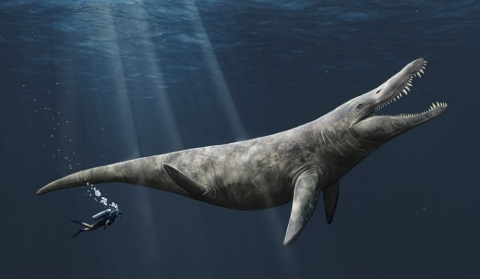
An artist's impression of a pliosaur. Credit: Megan Jacobs, University of Portsmouth
The study provides the most accurate reconstruction of the animal's proportions to date and resolves long standing uncertainty over its true size.
Lead researcher, Edward Bartlett, from the School of the Environment and Life Sciences , at the University of Portsmouth, said: "Our study is the first comprehensive reappraisal of every specimen assigned to Liopleurodon ferox. By bringing together all of the available material, we can finally provide a robust estimate of its size and body proportions. Although it was smaller than some famous reconstructions, it was still the dominant marine predator in the Jurassic Oxford Clay seas."
The analysis shows that Liopleurodon ferox reached a maximum length of just over eight metres, substantially smaller than estimates of 18 to 25 metres that have circulated for decades. Those larger figures were based on isolated giant fossil fragments that cannot confidently be assigned to Liopleurodon.
The new work also demonstrates that Liopleurodon possessed an unusually large skull, making up around a quarter of its total body length. This proportion is greater than that seen in other pliosaurs from the same ecosystem, suggesting it was capable of tackling exceptionally large prey despite its revised body size.
The story of Liopleurodon stretches back more than 150 years. The species was first described in the nineteenth century from a single large tooth discovered near Boulogne-sur-Mer in northern France by the French palaeontologist Henri Émile Sauvage, who named it Liopleurodon ferox, meaning the "ferocious smooth-sided tooth".
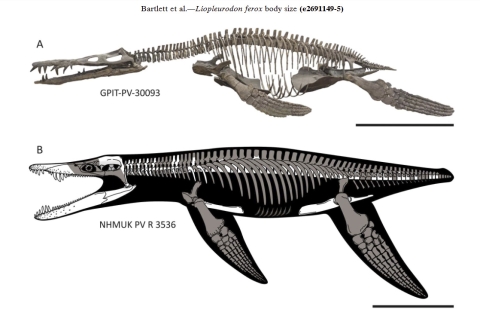
Well-preserved specimens of Liopleurodon ferox
University of Portsmouth Emeritus Professor David Martill also worked on the paper. He said: "During the late nineteenth and early twentieth centuries, the rapid expansion of the brickmaking industry around Peterborough exposed vast quantities of Jurassic clay. Hundreds of brickworks sprang up, driven by the area's abundant Oxford Clay, which was cheap to extract and fire.
"Because fossils could damage bricks during firing, clay workers were paid to remove them, carefully collecting everything from belemnites, or 'thunderbolts', to bones. Those discoveries caught the attention of local farmer Alfred Leeds, whose remarkable fossil collections, including complete Liopleurodon skeletons and skulls, transformed our understanding of these Jurassic predators and found their way into museums across Britain, Europe and America."
Despite these discoveries, Liopleurodon received relatively little scientific attention throughout much of the twentieth century. Interest surged after the 1999 BBC series Walking with Dinosaurs, in which the predator was portrayed as a 25-metre giant in the episode Cruel Sea.
Professor Martill, who advised the BBC production, said the size estimate reflected the best understanding at the time and a degree of informed speculation.
"We knew there were fragmentary remains of enormous pliosaurs, and at the time it seemed reasonable that Liopleurodon might have reached extraordinary sizes. Like many scientific ideas, that estimate has now been tested against much better evidence. This new study lets the fossils speak for themselves."
Rather than diminishing the importance of Liopleurodon, the revised reconstruction paints a clearer picture of one of the Jurassic's most specialised predators. The research confirms that it was the largest aquatic vertebrate in the Oxford Clay ecosystem and occupied the top of the food chain around 165 million years ago.
Our study is the first comprehensive reappraisal of every specimen assigned to Liopleurodon ferox. By bringing together all of the available material, we can finally provide a robust estimate of its size and body proportions.
Edward Bartlett, Lead researcher
The new body model also has wider implications. Applying the revised proportions to other giant Jurassic pliosaurs suggests that some closely related species, including later members of the group, reached lengths of around 12 metres. This indicates that true gigantism evolved in pliosaurs by the Middle Jurassic and that these marine reptiles dominated the world's oceans for around 80 million years before being replaced by mosasaurs during the Late Cretaceous.
By resolving the true size of one of palaeontology's most famous predators, the study replaces decades of speculation with the most complete and scientifically robust picture of Liopleurodon ever assembled.
The paper 'Re-evaluating body size in the Middle Jurassic pliosaur Liopleurodon ferox Sauvage, 1873' is published in the Journal of Vertebrate Palaeontology .


