
Mapping nature involves generating and analyzing massive streams of data in all shapes and forms. Consequently, biology and computer science are becoming increasingly intertwined. The appointment of Stowell at the Leiden Institute of Advanced Computer Science (LIACS) strengthens the collaboration between Naturalis and Leiden University.
Understanding the lives of animals
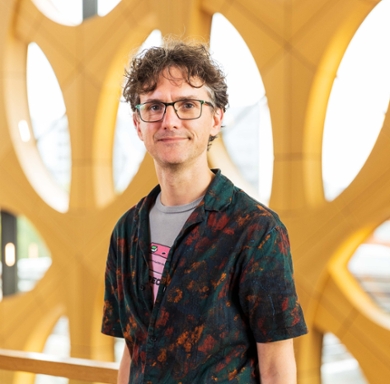
'Here in Leiden, you have large flocks of jackdaws - everyone knows them,' says computer scientist Dan Stowell. 'We see them flying, and we hear them making sounds, but we have no clear idea what each bird is actually doing, or how we're affecting them. We want to understand the lives of animals through their behaviour and communication, and help the world keep a close eye on biodiversity.'
We want to understand the lives of animals through their behaviour and communication
Linking computer science to biodiversity research
Stowell is one of the pioneers in a growing army of computer scientists applying their talents to biodiversity research. He was already conducting biodiversity research at Naturalis and is combining his expertise in artificial intelligence and animal sounds with the computer science expertise at LIACS. That app on your phone that recognises bird sounds? It works using tricks Stowell helped invent. Similarly, people are working on AI for species recognition in images, or on algorithms that can link a tiny trace of DNA to an animal or plant species at lightning speed.
Our new senses
However, to keep pace with the current biodiversity crisis, we need to scale things up. Because nature is in a critical state, Naturalis is pushing for a digital leap forward. Large-scale, innovative projects like ARISE, eDentity and ABM are driving this big step. By linking scientific expertise and natural history collections with AI and modern technology, the complete web of life can be mapped out much faster and more accurately on a national scale.
This approach uses new digital 'senses' out in the field. Smart sensors watch and listen day and night to continuously gather data. Where cameras and microphones stop, modern DNA techniques go a step further, uncovering invisible traces of life directly from the soil, air or water. Thanks to AI, species are recognised many times faster than before. This brings the interconnectedness of nature into view in ways that were previously impossible - which is essential to understanding and reversing the decline of biodiversity.
The indispensable AI acceleration
Once all those data streams come in, the next crucial step begins. There is simply too much data to process and manage by hand, making AI absolutely essential to actually do something with it. Computer scientists like Stowell - specialising in animal sounds - and his colleague Rita Pucci, an expert in image recognition, are therefore indispensable to 21st-century biology.
So-called multimodal machine learning is incredibly interesting to us.
Scaling up and accelerating
The collaboration is a win-win, emphasizes Prof. Marcello Bonsangue, Scientific Director of the LIACS. 'So-called multimodal machine learning is incredibly interesting to us. Combining different sensors in real time brings up exciting new questions, and very little research has been done on this so far.'
Maaike van de Kamp-Romijn, Director of Research & Education at Naturalis: 'We want to lead the way in this field, and not just apply existing technology. We are looking for scale and speed, because the challenge the biodiversity crisis puts in front of us is enormous.'
Stowell: 'There is a lot of scope for methods to be better at delivering useful biodiversity information with minimal side effects. To be able to learn as much as possible, we really need to get to work building the next generation of these techniques.'


