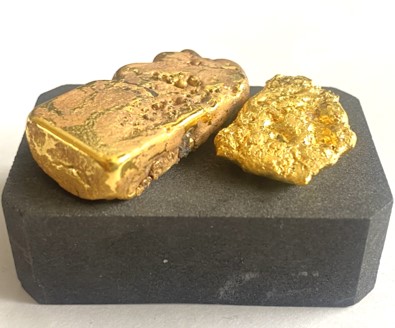
New gold recovery technology developed at Flinders University has received a major boost towards its commercialisation this year, with an Australia's Economic Accelerator Ignite grant.
Collaborating with Adelaide Control Engineering, the $500,000 Federal Government AEA grant will be used to fast track and scale-up the gold extraction and recovery technology which uses a low-cost polymer sorbent to remove gold from ore or electronic waste.
The method has been shown to be safe, sustainable and more cost effective than traditional methods, according to Matthew Flinders Professor of Chemistry Professor Justin Chalker, from Flinders University.

"Our invention features a low-cost and recyclable method for extracting gold, and a novel and selective polymer sorbent to remove the gold from complex mixtures," says Professor Chalker, an Australian Research Council (ARC) Future Fellow.
"The team plans to trial their gold recovery technology in collaboration with new partners in the gold mining, e-waste recycling, and jewellery industries. These collaborations will support safer and cleaner gold recovery in Australia and abroad."
A global study published by high-profile journal Nature Sustainability last year illustrated the success of the technology, both in eliminating the need for toxic chemicals such as mercury and cyanide regularly used in gold mining - and in recovering substantial amounts of high-quality gold contained in e-waste streams including mobile phones and computers.
"The timing of this grant investment couldn't be better," says Professor Chalker, "We have validated our gold recovery method for ore and e-waste on a pre-pilot scale. We are now in a position to deploy our solution on a larger scale and ensure impact across the mining and e-waste sectors."
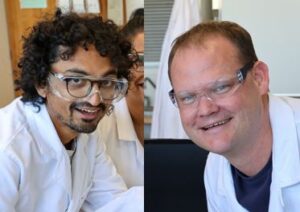
The Australia's Economic Accelerator project will be driven by Dr Thomas Nicholls and Dr Harshal Patel, in collaboration with Professor Chalker.

ARC Discovery Early Career Researcher Award (DECRA) Fellow Dr Nicholls says the potential of the Flinders University technology is immense.
"The ability to recover pure gold and copper makes recycling electronic waste more attractive, and more financially viable to our industry partners," says Dr Nicholls, from the College of Science and Engineering.
"We can do this in a safe and sustainable way on a lab scale and this AEA Ignite grant will allow us to scale-up to much greater volumes."