
The guest book of the French photography pioneer Nadar (1820-1910) is the focus of a new DFG project involving the Universities of Würzburg, Konstanz and Tübingen.
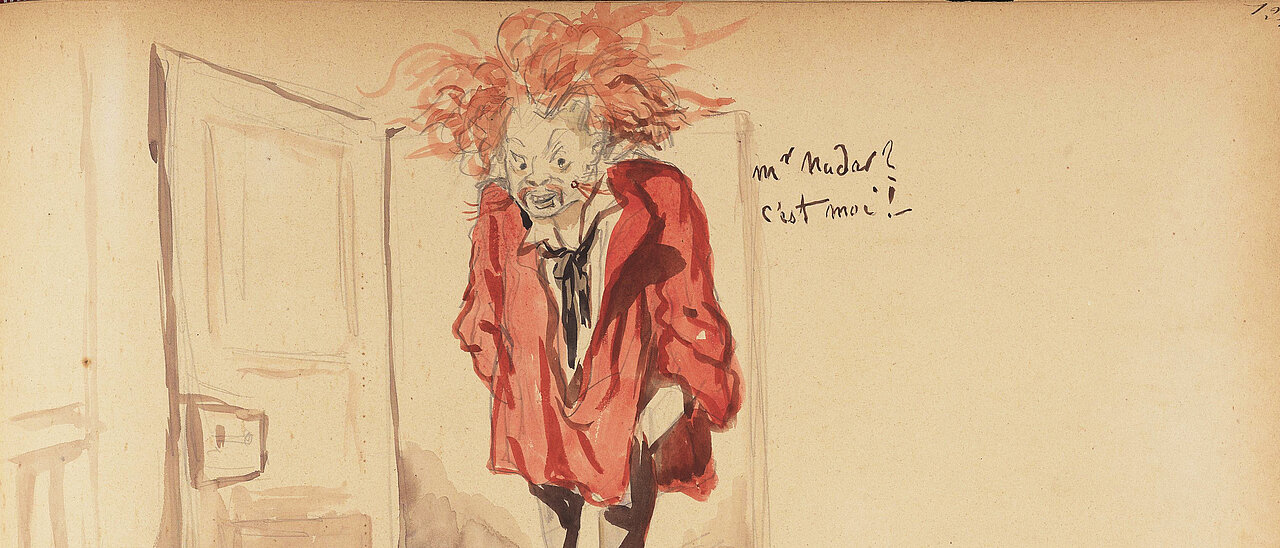
Gaspard-Félix Tournachon, born in Paris in 1820 and better known by his pseudonym Nadar, was a pioneer of photography. A trained physician, journalist and balloonist, he produced the first aerial photographs of Paris, as well as the first images of the city's catacombs and underground sewers.
At Nadar's Parisian studios, the first of which opened in 1854, numerous prominent figures had their photographic portraits taken. In turn, selected figures from politics, the arts and cultural life signed Nadar's guest book, the livre d'or (literally: Golden Book).
The large-format volume was kept on display in the Paris studio, while individual entries also circulated in the contemporary press. It later made its way to Philadelphia as part of the estate of the American dentist Thomas W. Evans and is now held by the University of Pennsylvania Libraries.
A new digital edition project is now dedicated to the guest book, in which the Universities of Würzburg, Konstanz and Tübingen are collaborating. It is funded by the German Research Foundation (DFG).
Reconstruct the cultural-historical context
The project is led by Karl Philipp Ellerbrock (University of Würzburg), Paul Mellenthin (University of Tübingen) and Bernd Stiegler (University of Konstanz). They will systematically investigate the livre d'or, together with a second, recently discovered album, with a particular focus on reconstructing its cultural and historical context.
"The guest book offers new insights into the social world of nineteenth-century Paris," says Bernd Stiegler, Professor of Modern German Literature specialising in media and photographic history at the University of Konstanz. "In order to understand and describe the processes of symbolic communication, we want to link the contributors--including such prominent figures as the poet Charles Baudelaire, the artist Gustave Doré and the composer Jacques Offenbach--with the portraits and caricatures that Nadar produced of them."
"We would like to gain a better understanding of the mechanisms underlying the selection of contributors and to highlight the processes of social self-positioning and positioning by others documented in the album," adds Paul Mellenthin, art historian at the University of Tübingen.
"The project aims to shed new light on the more than 400 entries--ranging from aphorisms and occasional verse, as well as drawings and musical compositions--through philological scholarship and textual criticism,in order to reveal their contexts and the diversity of voices they contain," says Karl Philipp Ellerbrock, Professor of French and Italian Literature at the University of Würzburg.
Project to start in April 2027
The aim is to produce an online edition of the livre d'or, which will be accessible via the Heidelberg University Library's digital collections arthistoricum.net. The new DFG-funded project is scheduled to run for three years and is expected to start in April 2027. The journal Fotogeschichte will mark the launch with a special issue.


