
Aging, obsolete and energy inefficient buildings are usually prime targets for urban renewal projects. But instead of levelling them and rebuilding a district from the ground up, a new Concordia study proposes a model that would make a neighbourhood increase local resource self-sufficiency while reducing the neighbourhood's overall carbon footprint.
Using the Pointe-St-Charles neighbourhood, a mixed industrial-commercial-residential in Montreal's southwest, as a case study, the researchers developed a neighbourhood-scale framework that transforms underused rooftops, vacant lots and parking areas into local food, energy and water resource hubs.
As described in the journal Energies, the model combines urban agriculture, solar power, rainwater harvesting and local food-sharing networks. It proposes that rooftops would be assigned greenhouses, green roofs or solar panels depending on the building, while vacant lots could be used to grow crops.
Solar-panel canopies over parking areas could generate electricity without reducing parking capacity, and harvested rainwater could be used for irrigation.
"Rather than looking at food, energy and water as separate systems, our approach considers how they interact as an integrated system," says Caroline Hachem-Vermette, corresponding author and an associate professor in the Department of Building, Civil and Environmental Engineering. "Instead of trying to optimize each system in isolation, we look at how they can work together to increase local resource self-sufficiency while reducing carbon emissions."
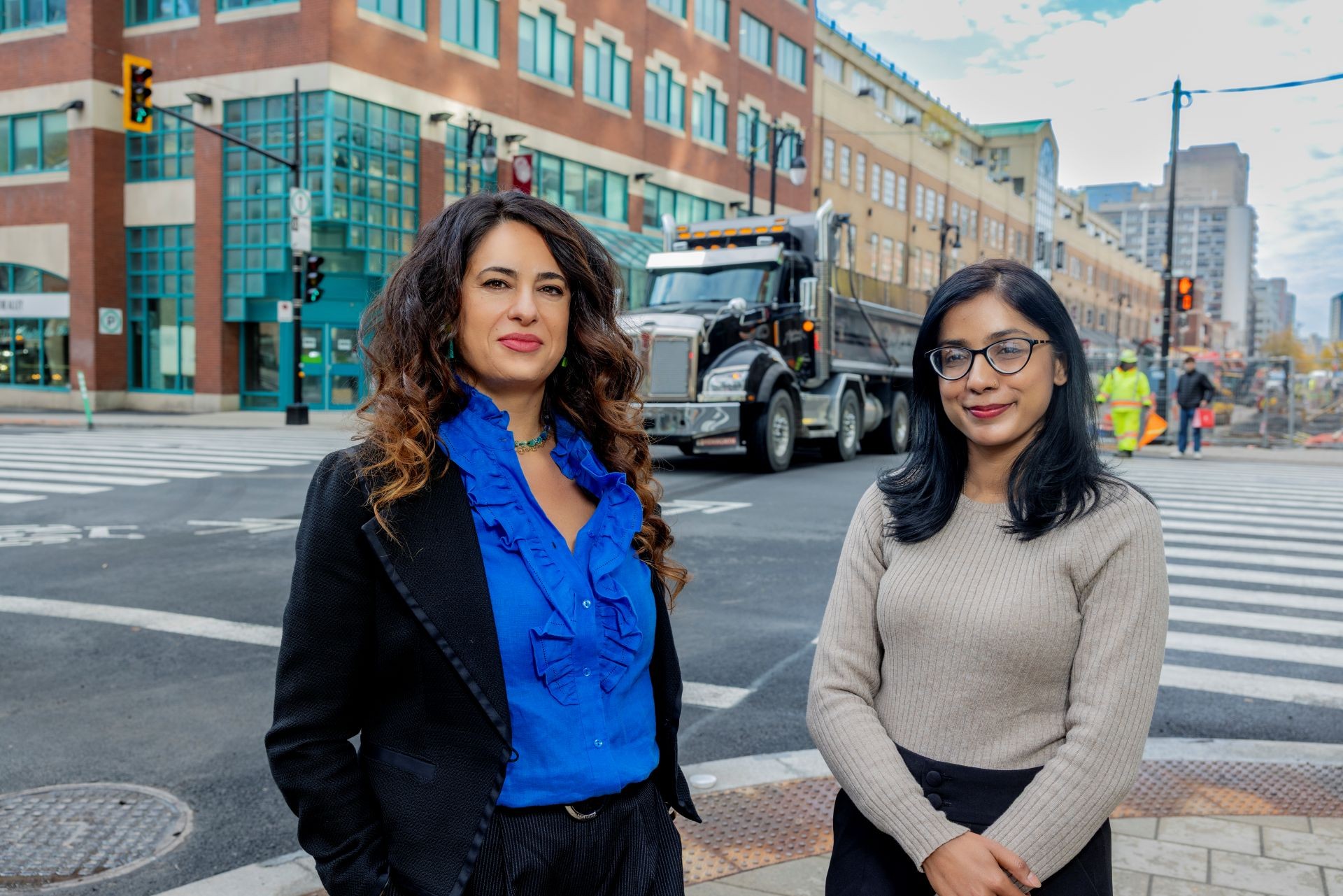 "Rather than looking at food, energy and water as separate systems, our approach considers how they interact as an integrated system," says Caroline Hachem-Vermette, left, with Mahnoor Sohail
A whole-neighbourhood approach
The researchers divided Pointe-St-Charles into 91 neighbourhood units and evaluated three scenarios: the neighbourhood as it exists today; a version with food, energy and water interventions; and a third version that added a network through which food produced in one unit was shared with others nearby. Local grocery stores served as distribution points, allowing residents to access food within a 15-minute walk.
"This study focuses on the neighbourhood scale, where one neighbourhood unit complements another; surplus food items from one area can be transported easily to be consumed in another where there is a deficit," says Mahnoor Sohail, PhD candidate and the study's lead author.
The researchers estimate these changes could produce about 407 tonnes of crops each year - enough to meet roughly 30 per cent of demand for the selected foods. Solar panels could supply about 14 per cent of the neighbourhood's building energy needs, while green roofs and rooftop greenhouses could help reduce heating and cooling demands by providing additional thermal buffering.
The environmental benefits extend beyond local production, the researchers say. The model estimates that producing food closer to home and generating renewable electricity could cut emissions from food transportation by 96 per cent and reduce emissions associated with grid electricity by 27.5 per cent, not counting the electricity demands needed to power the greenhouses.
Updating and preserving
The framework was designed to be adapted to other neighbourhoods, although real-world implementation would still require local assessment, testing and permits.
"This kind of transformation could be implemented in stages, depending on local priorities," says Hachem-Vermette. "Existing neighbourhoods could be progressively retrofitted to reduce energy demand and carbon emissions, increase local renewable-energy and food production, and make better use of water resources, while avoiding the substantial impacts of demolition and rebuilding."
The approach also helps preserve a sense of place and neighbourhood continuity, she says.
"There is a growing call for more human-scaled, village-like development. This is reflected in concepts such as the 15-minute city, where people can feel connected to their neighbourhood and meet more of their daily needs close to home," Hachem-Vermette says. "Integrated design brings these objectives together - decarbonization, local resource production, efficient use of water and energy, and quality of place - rather than treating them as separate challenges."
Read the paper: "Proximity-Based Food-Energy-Water (FEW) Integration in a Neighborhood-Scale Montreal Case Study


