
Psst, have you heard that mushrooms can "gossip" and spread information to their neighbours? Underneath the umbrella-like shapes we see on the forest floor is a hidden underground network that allows mushrooms to communicate. This interconnected network we often overlook - called a mycelial network - is actually the main body of a mushroom.
Like gossip, information can spread across mushrooms via their mycelial networks. However, there is a lot we don't know about how this communication truly works given how complex these sprawling connections are.
A research team lead by Yu Fukasawa, an associate professor in Tohoku University, showed evidence of electrical information flow across mushrooms by attaching electrodes to 37 mushrooms of ectomycorrhizal fungi. The researchers measured the response to various applications of either water or urine. Under certain conditions, mushrooms either increased or decreased their communication levels. This remarkable study reveals the detailed behaviour of how fungi communicate in the field.
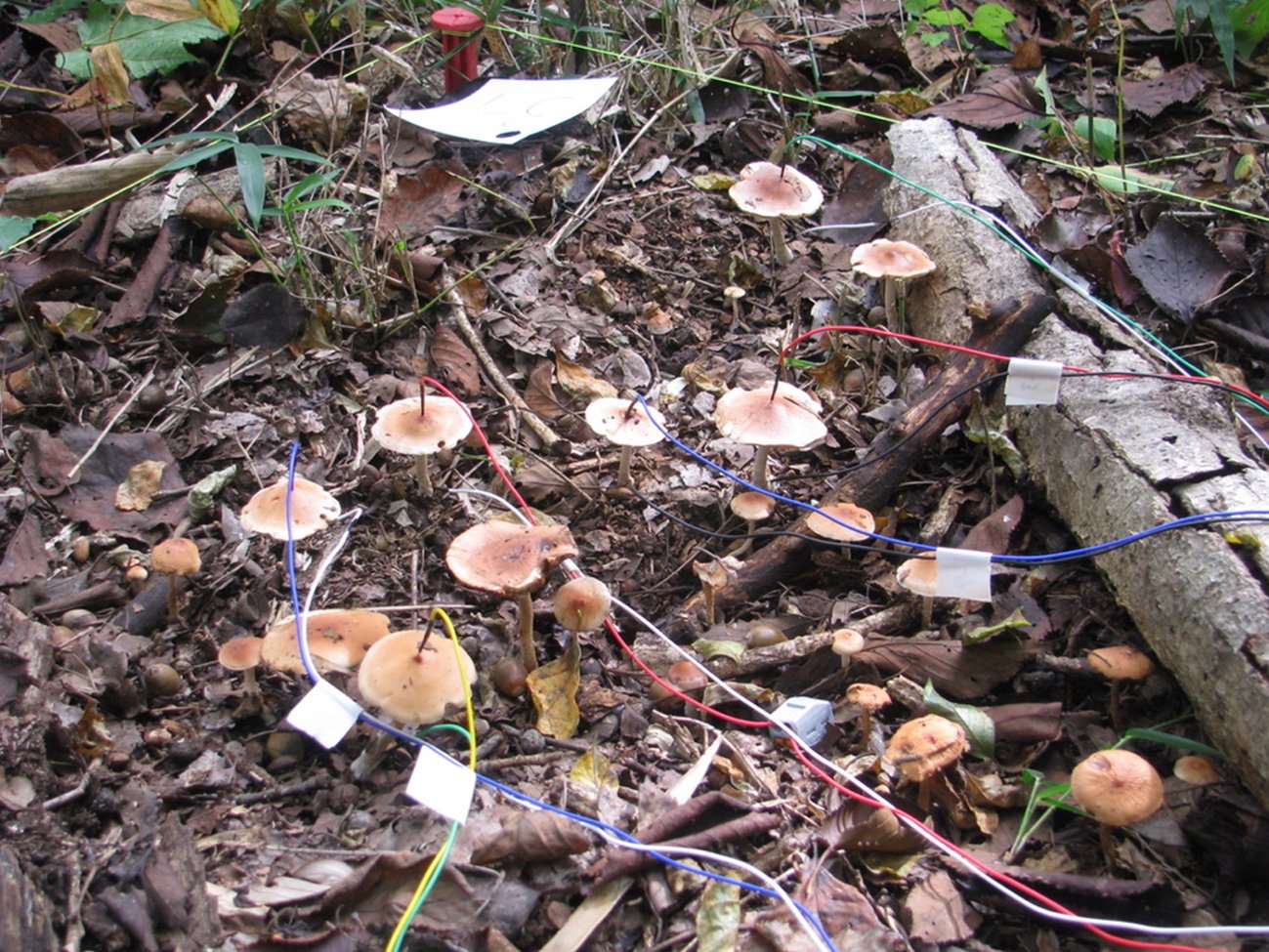
The ectomycorrhizal fungi investigated are part of an ecological group of fungi called ammonia fungi, which are activated by a high concentration of ammonia in the soil. Since urea (a chemical component of urine) is a precursor for ammonia, it can actually promote the growth of these mushrooms. Simply put, they like pee - or rather, one of the chemicals it turns into. Therefore, to better understand how these mushrooms communicate, the researchers chose urine as a potential trigger.
Fukasawa applied either tap water or urine to the soil around mushrooms grown locally in Kami town, Miyagi Prefecture, to see their reaction. After analysing the data of electrical dynamics of the 37 mushrooms, they found that their results differed depending on whether they added tap water or urine, whether it was applied to a concentrated area or a widespread area, the spatial distance between the mushrooms, and the genetic distance between mushrooms (how closely related they are, based on a genomic analysis).
The experiment alternated between applying water or urine each day. When they applied water around one particular mushroom, it increased the flow of information. However, there was a decrease on the days when urine was applied. When applying water to a more widespread area, it reduced the flow of information.
"It's fascinating to think about why the mushrooms communicate the way they do," says Fukasawa, "For example, applying water to all the mushrooms may mean that there's no need to share information since the whole network already knows what's going on, which could be why the flow of information decreased in this situation."
These results indicate that forest mushrooms can flexibly change their electrical information flow in response to a variety of disturbances. These findings could help in solving the mysteries surrounding electrical communication in mushrooms, such as what type of activity the electric signals measured in this study are meant to trigger.
The paper was published on March 2, 2026, in Scientific Reports.
- Publication Details:
Title: Electrical information flows across the sporocarps of two ectomycorrhizal fungi in the field
Authors: Yu Fukasawa, Daisuke Akai, Takayuki Takehi, Daiki Takahashi, Yutaka Osada
Journal: Scientific Reports


