
Tiny, light-driven nanorobots that can selectively capture, transport, and remove bacteria? A Würzburg research team has now demonstrated how such microscopic cleaners can be employed and precisely controlled.
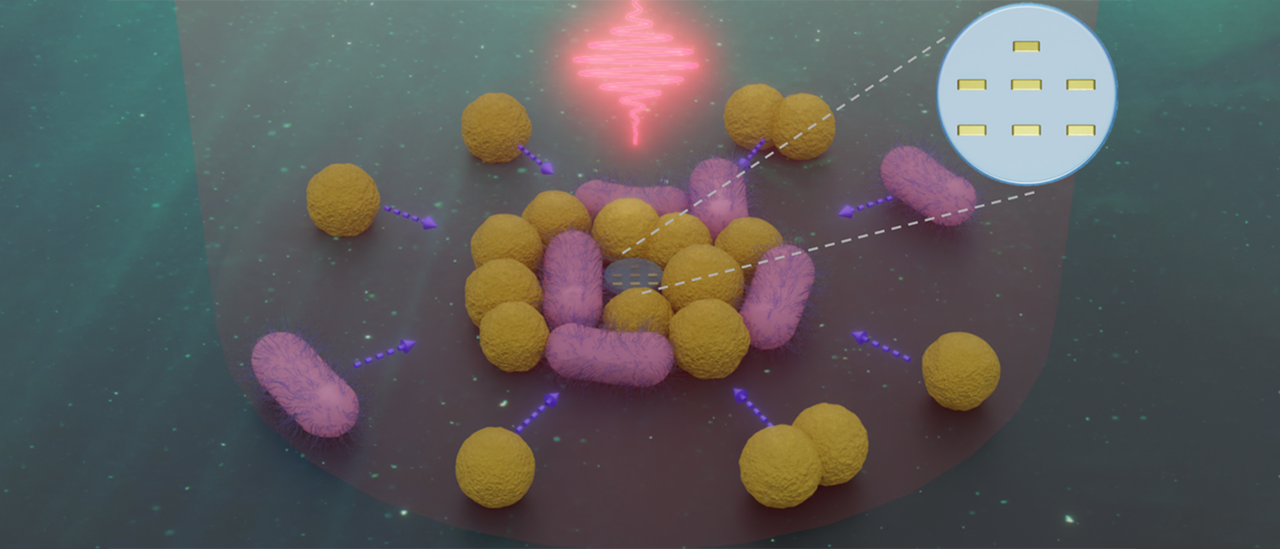
Tiny robots - around 50 times smaller than the diameter of a human hair - open up fascinating possibilities: they enable the controlled manipulation of objects far too small for human hands. This brings us closer to a long-standing dream - the direct interaction with the microscopic world.
Particularly relevant are biological objects in aqueous environments, such as single cells or bacteria. Handling such objects in a controlled and targeted way has remained a major challenge. The nanorobots presented here demonstrate that controlled manipulation, including collection and relocation of bacteria, is already achievable.
Light-driven propulsion and control
A key challenge is how to power and steer such extremely small machines. At Julius-Maximilians-Universität Würzburg (JMU), the research group led by Professor Bert Hecht has already pioneered this approach: the researchers use the recoil of individual photons to move micrometer-sized devices - so-called microdrones.
These devices incorporate up to four plasmonic nanoantennas that absorb light of specific color and helicity and re-emit it directionally. Each redirected photon generates a recoil force - comparable to the recoil when firing a bullet. Due to the extremely small mass of the microdrones, this results in substantial accelerations and velocities.
In the current work, the team has succeeded in further miniaturizing these light-driven robots to sizes below one micrometre. A key factor was simplifying the steering mechanism without compromising the photon-based propulsion.
The researchers exploit the tendency of nanoscale antenna wires embedded in the robot to align with the polarization direction of incident light. By controlling the light polarization, they can thus steer the orientation of the nanorobot, while propulsion continues to be driven by photon recoil - a principle reminiscent of steering in macroscopic vehicles.
"Microscopic cleaners" in action
"In essence, we have built a light-driven nanorobot that can track down and collect bacteria," says Jin Qin, lead experimental scientist of the study. "By simplifying the design, we reached a size at which these robots can operate directly in the microbial world - almost like microscopic cleaning devices."
The nanorobots are remarkably agile: they can perform extremely rapid 90° turns, allowing them to systematically and efficiently scan large areas of a sample. In addition, they are capable of selectively capturing, transporting, and releasing significant numbers of bacteria.
This enables them to effectively "clean" microscopic environments under controlled laboratory conditions by collecting bacteria and depositing them at defined locations.
"This is a striking example of how light can be used not only to observe the microscopic world, but also to actively shape it," adds Bert Hecht. "The idea of tiny robotic cleaners may sound futuristic, but we are already demonstrating the physical principles that make it possible."
Even when transporting larger clusters of bacteria, the nanorobots remain fully manoeuvrable - albeit at slightly reduced speed. This robustness highlights their potential for future applications in microbiology, biomedical research, and targeted manipulation at the microscale.
Publication
Qin, J., Büchner, C., Wu, X., Hecht, B. "A nanoscale robotic cleaner". Nat Commun 17, 3027 (2026). DOI: https://doi.org/10.1038/s41467-026-70685-9


