
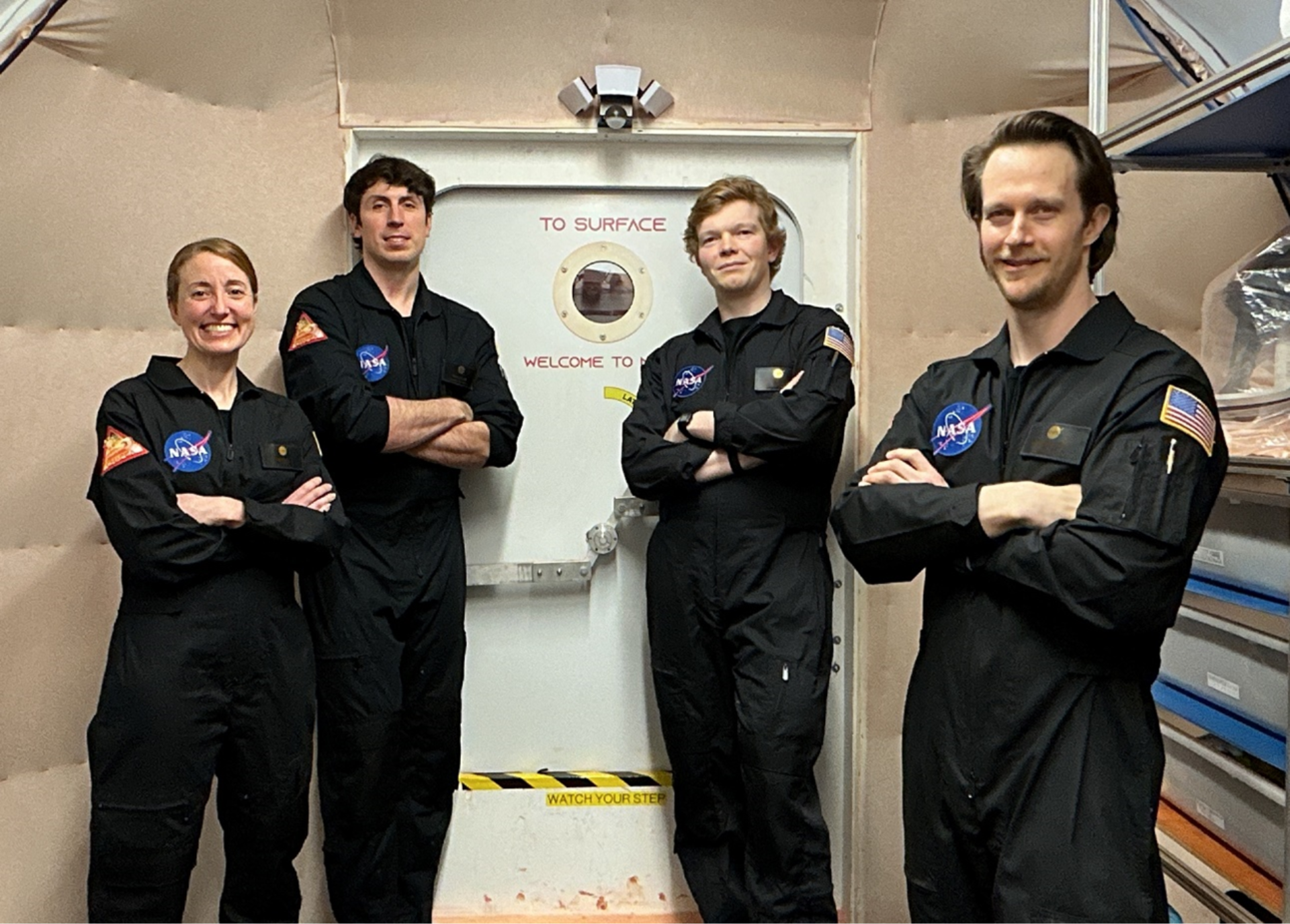
The four crew members of NASA's Mars simulation recently marked 200 days into their 378-day Red Planet mission on May 7. Currently, the crew is in a simulated two‑week loss‑of‑signal period that mimics a Mars-Earth communications blackout when Mars moves behind the Sun. During this blackout, the crew works without contact with mission control, using preplanned procedures and available resources to complete tasks and handle any issues that may arise.
The CHAPEA (Crew Health and Performance Exploration Analog) mission 2 crew, commanded by Ross Elder and with medical officer Ellen Ellis, science officer Matthew Montgomery, and flight engineer James Spicer, entered the 3D-printed habitat last year at NASA's Johnson Space Center in Houston on Oct. 19. They will exit in about six months on Oct. 31.
"I'm proud of the crew's accomplishments over the past 200 days - facing each challenge with fortitude and finding new ways to improve our performance and efficiency daily," said Ellis.
Now over halfway through the mission, the crew continues to provide NASA with valuable insights and data on how humans adapt to isolation, confinement, and resource limitations - all critical factors for future exploration of the Moon and Mars.
"We approach every day committed to doing our best work, whether we're doing a simulated spacewalk, geology, exercise, a medical activity, or anything in between," said Spicer. "What keeps us motivated is knowing that we're contributing directly to NASA's deep space exploration objectives."
The crew has completed robotic operations, performed habitat maintenance, and grown crops inside the 1,700-square-foot habitat. Crew members also experience mission constraints such as delayed communications, limited supplies, and simulated equipment malfunctions. These realistic stressors are designed to help researchers better understand how crews perform under pressure during deep space missions.
"Having limited resources, be it tools, equipment, software, supplies, or no internet, really bounds what you have to solve problems," said Montgomery. "Finding creative and clever solutions has been both challenging and rewarding."
A key objective of NASA's CHAPEA missions is to gather data on cognitive and physical performance during extended isolation. Researchers monitor how the crew adapts to the environment, manages stress, and maintains productivity. The data will help NASA refine mission planning, habitat design, and support systems for future long-duration missions.
"Extended-duration missions are relatively rare in NASA's history to date," said Sara Whiting, project scientist and mission manager at Johnson for NASA's Human Research Program. "The operational lessons learned, along with the detailed health and performance data this crew is providing, come at the perfect time to inform the development of a sustainable lunar presence and longer-term objectives for crewed Mars missions."
As NASA advances toward its long-term goal of human exploration of Mars, simulated missions like CHAPEA are essential to understanding how to keep astronauts healthy, safe, and mission-ready - both during the journey and on the surface of another world.


