
5 min read
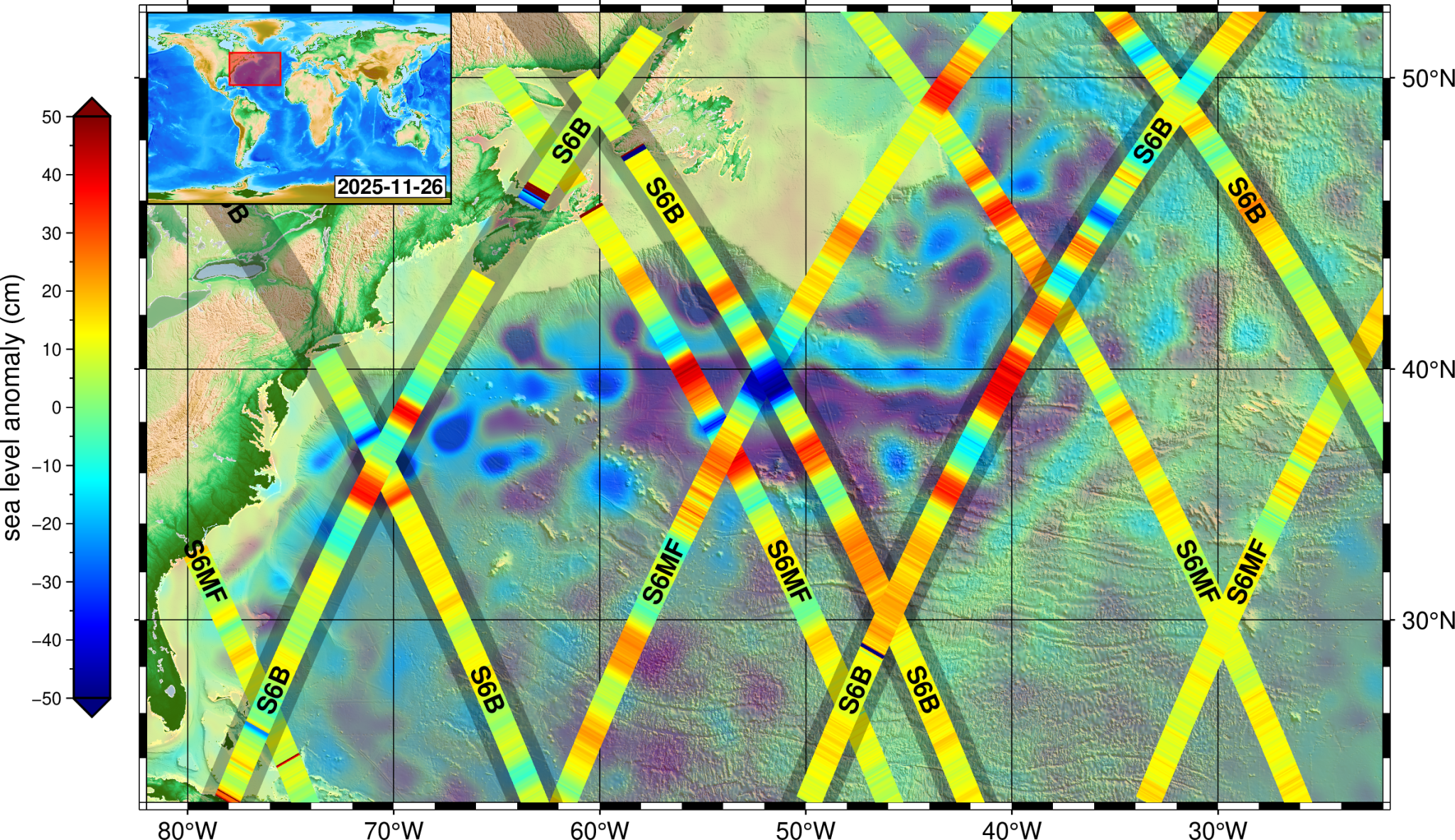
Launched in November, Sentinel-6B will track ocean height with ultraprecision to advance marine forecasting, national security, and more.
Sentinel-6B, a joint mission by NASA and its U.S. and European partners to survey 90% of the world's oceans for the benefit of communities and commerce, has started sending back its first measurements since launching in November. A newly published map of the data shows sea levels across a vast stretch of the Eastern Seaboard and Atlantic Ocean.
About the size of a pickup truck, Sentinel-6B extends a decades-long effort led by the United States and Europe to track ocean height down to fractions of an inch using radar altimetry. Once its instruments and algorithms are fully calibrated next year, Sentinel-6B will return actionable data for ship crews, weather forecasters, national security, and the millions of people who live and work near coastlines.
"NASA does incredible science using the unique vantage point of space every day to deliver life-saving data directly into the hands of decision-makers for storms, navigation, flooding, and more," said Nicky Fox, associate administrator, Science Mission Directorate, NASA Headquarters in Washington. "The ocean measurements that Sentinel-6B collected during its first months in orbit benefit all, providing key insights to ensure the prosperity and security of coastal communities around the globe."
In addition to measuring sea level, instruments aboard the satellite will gather information on wind speeds, wave heights, atmospheric temperature, and humidity. In turn, that data can be used by U.S. agencies as well as to refine the Goddard Earth Observing System atmospheric forecast models, which the NASA Engineering and Safety Center relies on to plan safer re-entry of astronauts returning from Artemis missions.
Mission teams in recent weeks have verified that Sentinel-6B and all its instruments are in good health. That includes the Poseidon-4 Synthetic Aperture Radar altimeter, the Advanced Microwave Radiometer for Climate, the Global Navigation Satellite System – Radio Occultation, and the Precise Orbit Determination Package.
In the visualization above, featuring data captured by Sentinel-6B on Nov. 26, the crisscrossing bands trace the satellite's path as it orbits Earth. The image also shows data collected on the same day by the satellite's twin, Sentinel-6 Michael Freilich, which launched in 2020. The data in those bands is layered over the combined observations of other sea-level satellites across the region shown. Red indicates higher water relative to the long-term average; blue areas indicate lower water. Because the spacecraft's instruments have not been fully calibrated, the data is considered preliminary but also quite promising.
Together, Sentinel-6B and Sentinel-6 Michael Freilich make up the Copernicus Sentinel-6/Jason-CS (Continuity of Service) mission developed by NASA, ESA (European Space Agency), EUMETSAT (European Organisation for the Exploitation of Meteorological Satellites), and the National Oceanic and Atmospheric Administration (NOAA).
"These first light images from Sentinel-6B underscore the value of Earth science observations in providing life-saving and economic-empowering data to communities along our world's coastlines, where a third of the globe's population lives," said Karen St. Germain, director, NASA Earth Science Division at the agency's headquarters. "This achievement also highlights the power of partnerships with ESA, EUMETSAT, and our sister science agency NOAA in advancing our collective understanding of Earth systems and putting that Earth science understanding to work for the benefit of humanity."
Sentinel-6/Jason-CS adds to a continuous sea level rise dataset that began in the early 1990s. Since then, the rate of sea level rise globally has doubled and currently averages about 0.17 inches (4.3 millimeters) per year. The rate differs between locations, with implications for coastal infrastructure, trade routes, and storm formation.
"The accuracy and precision of this mission's gold-standard dataset speaks to the foresight, more than 30 years ago, of investing in the technology and expertise that make it possible," said Dave Gallagher, director, NASA's Jet Propulsion Laboratory in Southern California. "We're proud to continue partnering to collect these critical measurements into another decade, and even prouder of the teams behind this most recent milestone."
Flying 830 miles (1,336 kilometers) above Earth, Sentinel-6B is about 30 seconds behind its twin, Sentinel-6 Michael Freilich, currently the official reference satellite for sea level. Eventually, Sentinel-6B will take over that role, and Sentinel-6 Michael Freilich will move into a different orbit.
More about Sentinel-6B
Copernicus Sentinel-6/Jason-CS was jointly developed by ESA, EUMETSAT, NASA, and NOAA, with funding support from the European Commission and technical support from CNES. The mission, starting with Sentinel-6 Michael Freilich, marked the first international involvement in Copernicus, the European Union's Earth Observation Programme.
Managed for NASA by Caltech in Pasadena, JPL contributed three science instruments for each Sentinel-6 satellite: the Advanced Microwave Radiometer, the Global Navigation Satellite System – Radio Occultation, and the laser retroreflector array. NASA also contributed launch services, ground systems supporting operation of the NASA science instruments, the science data processors for two of these instruments, and support for the international ocean surface topography community.
For more about Sentinel-6B, visit:
https://science.nasa.gov/mission/sentinel-6B/


