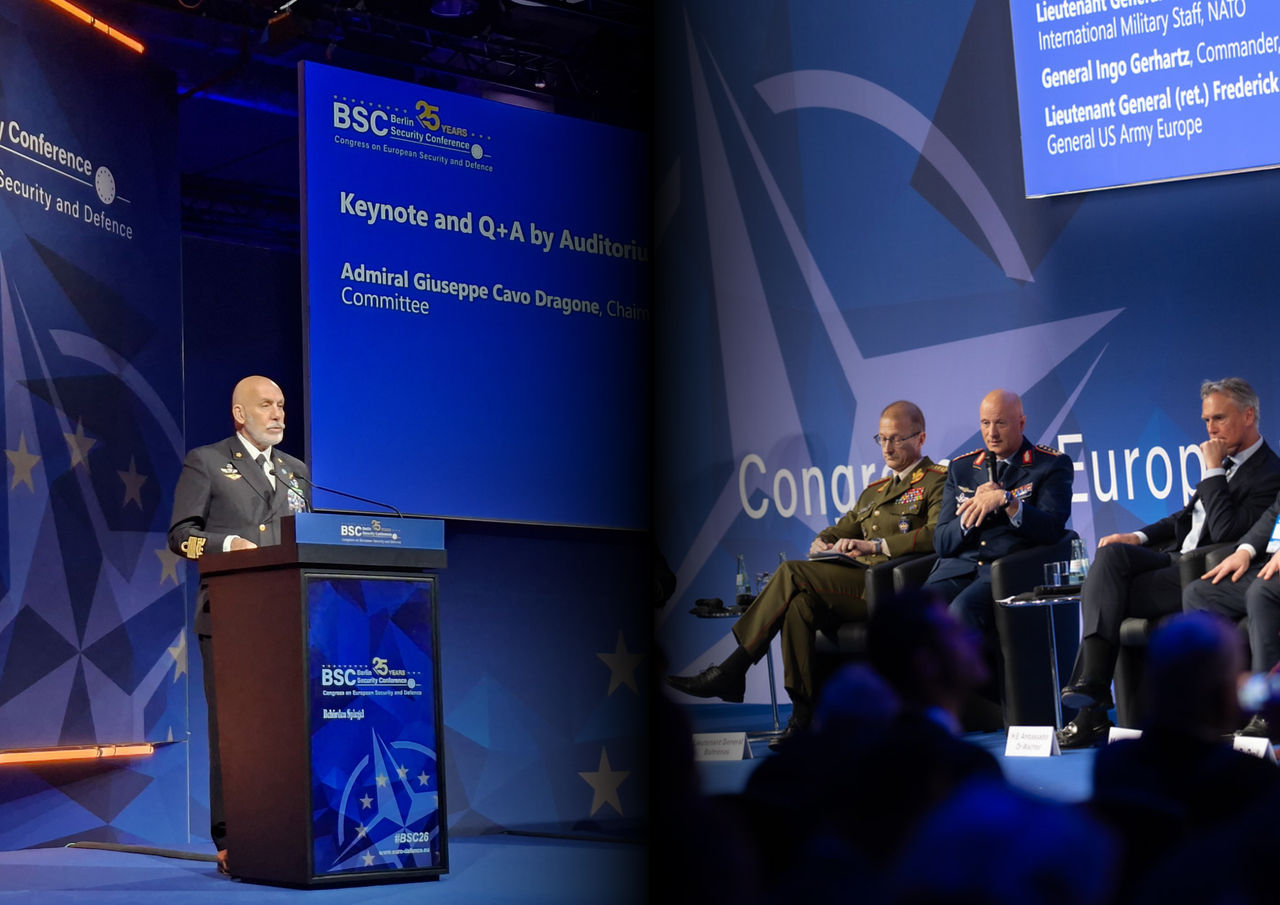
3-4 November 2026, Berlin, Germany - From 3 to 4 November, the Chair of the NATO Military Committee (CMC), Admiral Giuseppe Cavo Dragone, and the Director General of the NATO International Military Staff (DGIMS), Lieutenant General Remigijus Baltrėnas, attended the 25th Berlin Security Conference (BSC), organised with Lithuania as the partner nation.
In his keynote speech, Admiral Giuseppe Cavo Dragone touched upon the topic of multipolar threats: "Threats reach us across multiple domains and from several centres of power, at the same time and often in coordination. We are not at war, but we are certainly not at peace," said the CMC. During the high-level debate "Europe and NATO: Together Strong", the Chairman highlighted the current alignment of NATO's and the EU's security and defence agendas, ranging from cyber defence to standardisation and innovation, with a focus on complementarity. In this light, Admiral Cavo Dragone also underscored the need to combine the strengths of each organisation, with the specific example of military mobility, ensuring the movement of equipment and personnel into and across Europe.
At the BSC, Lieutenant General Remigijus Baltrėnas participated in a panel discussion on "Deterrence through Vigilance: How to contain the Russian interference." DGIMS emphasised that the primary goal for the thirty-two Allies is to ensure a shared understanding of what is occurring to prevent being misled by Russian actions. He also underscored that building resilience within societies is a key deterrent against hybrid actions. "A key aspect of countering hybrid actions is the resilience of societies, as it is by itself a deterrent. Therefore, we need to use our strategic communication and open engagement with our societies. We need to be very frank in explaining to people that they are part of our defence architecture, and have a role to play in countering hybrid actions," said Lieutenant General Baltrėnas.