
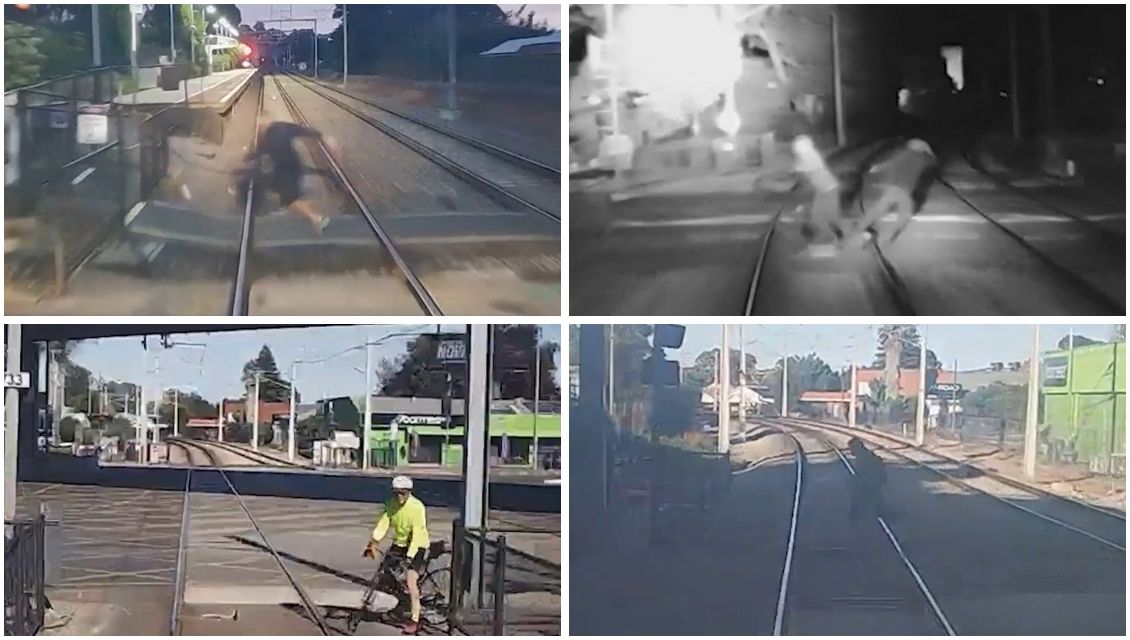
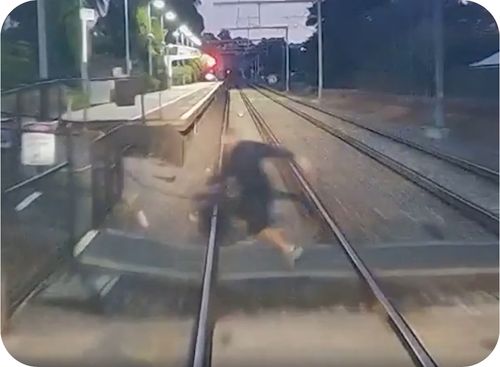
A man, seemingly unaware of his surroundings, makes a last-second lunge across the railway track and narrowly avoids being hit by a train.
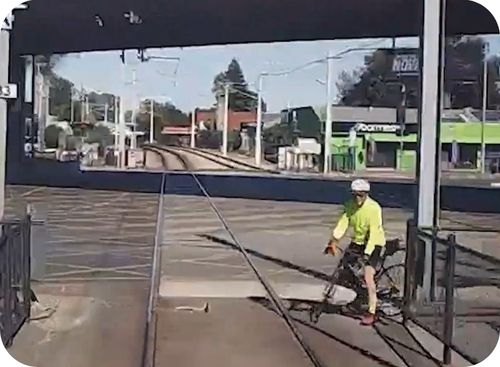
A cyclist hits his brakes just in time to prevent a potentially fatal accident. Two friends walking casually on the line jump out of the path of an approaching passenger train with seconds to spare.
These are some of the harrowing close calls released by authorities during Rail Safety Week (10-16 August) to highlight the need to take extra care near train and tram lines.
Near misses were up four per cent last financial year, with 163 incidents recorded across the Adelaide metropolitan area, and one rail line – the Gawler line – accounting for 44 per cent of the heart-stopping incidents.
Over the 2025-2026 period, 72 near misses were recorded across the Gawler line, an increase of 22 per cent on the previous financial year.
And while there was a small increase identified on the Belair line in the past financial year, there was a decre
 ase of near miss incidents identified along both the Seaford and Outer Harbor lines.
Almost 35 per cent of near misses involved cyclists, while there were seven level crossing vehicle incidents. Pedestrian crossing and maze incidents increased 54 per cent on last year with 98 incidents.
On the tram network, however, near misses have decreased by more than 30 per cent – 113 incidents this financial year, compared to 165 in 2024-25.
High-risk locations remain in the CBD, with the North Terrace and King William Street intersection and the Adelaide Railway Station stop incident hot spots.
Train near miss incidents are most prevalent during the afternoon and evening, with the peak identified as between 7pm and 8pm, followed by 5pm and 6pm. For trams, the peak is between 4pm-5pm.
The troubling statistics serve as a timely reminder for pedestrians to remain cautious and vigilant when crossing nearby to a railway station, or while traversing near a station more generally.
Pedestrians are r
 eminded to always use a pedestrian crossing to cross the tracks or access the station platform and be alert by ensuring they are looking up from their phones and not using headphones.
It is illegal to walk or run along the tracks or cross between the platforms via the tracks.
Motorists travelling near level crossings are reminded to ensure there is sufficient space for their vehicle to cross to the other side without stopping. It is illegal to enter a level crossing if the road beyond the crossing is blocked or to stop inside the markings.
A typical passenger train weighs around 140 tonnes and can travel at speeds of up to 110km/h. If an emergency brake is activated a train at full speed needs 470m of track to be able to stop safely.
Freight trains, which can weigh up to 10,000 tonnes, need more than 1km of track to stop.
If boom gates seem to be stuck down or warning signs flash for too long, do not cross. Level crossing faults can be reported to 1800 018 313, where calls are required to be made in compliance with mobile phone laws.
For more information about how to stay safe around rail corridors and level crossings, visit the safety and security page.


