
Among the first labs in the world to develop bovine embryonic stem cells before, the UConn team's work has distinct advantages
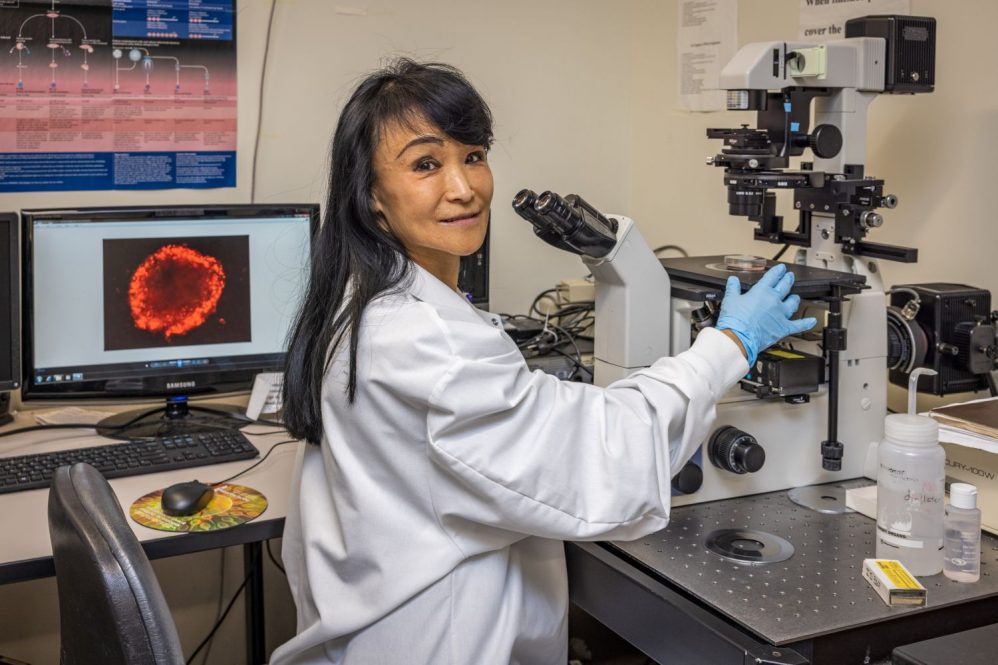
Cindy Tian of the Department of Animal Science in the College of Agriculture, Health and Natural Resources works in her lab in the Agricultural Biotechnology Laboratory (ABL). Oct. 19, 2022. (Milton Levin/UConn Photo)
Researchers in the College of Agriculture, Health and Natural Resources have developed a novel line of bovine embryonic stem cells, which have significant potential for a variety of new innovations, from lab-grown meat to models for human tissue replacement.
This work, led by Xiuchun "Cindy" Tian, professor of biotechnology in the Department of Animal Science, and her former and current graduate students Yue Su, Jiaxi Liu, and Ruifeng Zhao, was published in Stem Cells.
Understanding the Science
The researchers derived the pluripotent stem cells (PSCs) during the blastocyst stage of embryonic development. The blastocyst is a clump of cells with a fluid-filled center that is ready to implant in the uterus. They then grew the cells using feeder cells from mice and cultured them in a unique medium to keep them in the pluripotent state in the lab.
Few other labs in the world had developed bovine embryonic stem cells before, and UConn team's work has distinct advantages.
"The advantage of our cells compared with previous publications is that we can generate the formative embryonic stem cells which can directly induce the primordial germ cell-like cells (PGCLC), the precursor to sperm and eggs, for potential in vitro gametogenesis," Liu says.
The team also developed a unique culture medium to produce higher-quality formative stem cells than previous efforts.
They used a commercially available base medium to which they added a number of supplemental small molecules, producing a unique mixture.
"Every animal species has different requirements to maintain pluripotency because the cells from different animals are all slightly different," Zhao says. "If you use the medium from another animal species, it will not work. So we added some of the extra factors to make the system work better."
This is a necessary step, as the cells do not naturally want to remain in their pluripotent stage - they want to continue developing into differentiated cells.
"Our cells, based on our special cocktail of medium, are maintained in such a more pluripotent state than previously reported studies," Tian says. "This is an advance in the field."
Tian's lab had previously developed bovine induced pluripotent stem cells (iPSCs). This method essentially took already differentiated cells and reprogrammed them to act like embryonic stem cells using genetic engineering.
Embryonic stem cells by contrast, do not contain any foreign genes. This is a major advantage for applications like lab-grown, or cultivated meat which is subject to regulatory frameworks regarding genetically modified products.
"That could be a safety issue or a regulatory issue," Zhao says. "Therefore, we wanted to derive a clean pluripotent cell line just from the embryo."
Using embryonic stem cells is also faster, easier, and more efficient because there is no reprogramming step. There is also less variation among cell lines.
A World of Possibilities
Cultivated meat is a promising response to concerns about the sustainability and ethics of traditional practices. These embryonic stem cells could be induced into muscle and fat cells to produce meat products like hamburgers.
In addition to cultivated meat, these cells can be used to produce human-relevant models for medical research including drug development and antibody screening.
They also have potential applications for human tissue replacement research. Many standard laboratory animals, like mice and rats, are small. This means that their tissues do not scale accurately to humans. Cows have the advantage of being a much larger animal.
These cells can also help develop disease-resistant cattle through genetic engineering as well as supporting studies of early bovine development.
The team is now working on finding a way to eliminate the need for mouse feeder cells, which pose a potential problem for commercializing lab-grown meat derived from these stem cells. This will mean all the growth and maintenance will be dependent on the medium and special culture dish coating.
They are also trying to develop a medium that will allow the cells to be maintained for more than a day at a time without medium replacement to reduce cost and culture waste, and consequently burden to the environment.
"We're trying to develop longer-term cultures, basically a weekender medium," Tian says.
By closely working with UConn Technology Commercialization Services (TCS), the group has filed for patent protection. Tian had also previously worked with TCS on the bovine iPSC cell line.
UConn's TCS works with innovators, entrepreneurs, investors, and industry partners to transform UConn discoveries into products, companies, and jobs that benefit society and fuel economic development. Through a coordinated approach between tech transfer, licensing, and startup teams, TCS helps advance promising technologies like Tian's to market.
TCS is currently working with The Good Food Institute (GFI), which promotes available cell lines for cultured meat production, to list this new bovine ESC cell line. UConn's bovine iPSC cell lines had been previously distributed around the world through the GFI site.
"We hope the bovine ESC cell line now available will further close the gap on this unmet need for bovine culture meat development," says Ana Fidantsef, UConn industry liaison.


