
Management of sports-related concussions has come a long way in the past 25 years: Once considered a minor problem involving minimal time out of the game, a severe knock to the head is now assessed as a potential traumatic brain injury and, if confirmed, requires a structured recovery and an average wait of 13 days before play resumes.
Many of the academic experts who have advanced the science behind concussions in student-athletes - and, in collaboration with the Department of Defense, in soldiers as well - are now focused on addressing these head injuries in a population that's similar, but different: first responders.
The considerations are many, spanning from a first responder's potential sports or military injuries in a previous life to the factors that signal when it's safe to return to duty after a strike to the head. Getting a clinical diagnosis is key to putting an injured first responder on the proper trajectory of recovery - not just working safely, but also maintaining a satisfying quality of life, experts agree.
Researchers will soon publish the first evidence-based guidelines for traumatic brain injury (TBI) recognition and management and return to duty in first responders - a group encompassing law enforcement officers, corrections personnel, firefighters and emergency medical technicians (EMTs).

The authors will be the nearly 60 experts who convened at The Ohio State University in late March to pursue consensus on protocols surrounding six frameworks: workplace policies, injury prevention measures, challenges of recognizing injuries, diagnosis and treatment of the injury, mental health monitoring, and steps needed to get a concussed first responder back to work.
"This is a critical step in improving the care and support for our first responders who risk so much for us every day," said Jaclyn Caccese, associate professor in the School of Health and Rehabilitation Sciences (HRS) at The Ohio State University.
Caccese co-hosted the 1st International Conference on TBI in First Responders with James Oñate, interim director of HRS, interim vice dean for health and rehabilitation sciences in the College of Medicine, and a professor in the HRS Division of Athletic Training.
One universally accepted fact drove the work: Brain health in first responders is a matter of public safety - for the injured personnel, their colleagues, their families and the public they are sworn to protect.
After working together for several months in six workgroups, the scholars, clinicians and first responders met March 26-27 to share what they've learned and vote on a series of recommended guidelines. The final recommendations and consensus statement will be published early next year in the Journal of Head Trauma Rehabilitation.
While head injury data on first responders is minimal, a meta-analysis of studies to date suggests that about 60% of law enforcement and corrections officers have suffered at least one traumatic brain injury in their lifetime, and 17% have experienced a TBI on the job. Among firefighters, lifetime TBI prevalence ranges from 62% to 77%. There have been no studies of head injuries in EMTs.
Though what has been learned by studying sports and military concussions has given these teams a head start, most workgroups indicated that the need for more research specific to the first responder workforce is apparent.
"We've lumped first responders together. We're going to stop doing that," Oñate said. "This is the beginning, and we're starting with many things we've advanced already. We're not starting from scratch."
In a first-of-its-kind survey of Ohio law enforcement officers in 2024, Caccese, Oñate and colleagues reported that 74% of officers had a lifetime history of one or more head injuries, and 30% had a head injury that happened on the job. Further analysis showed post-traumatic stress disorder and depressive symptoms were higher in those who had experienced one or more head injuries.
At the conference, each of the six workgroups brought forward four to five recommendations for a vote. Consensus was reached on all but two, though many will undergo refinements before publication.
Overarching themes included standardizing methods of recognizing and treating TBIs and assessing return-to-duty readiness; ensuring no punitive actions are taken against an injured and recovering first responder; protecting the head as much as possible during training intended to expose new personnel to risks linked to blasts and being hit at work; and educating agencies, first responders, families and health care providers about TBI risks, prevalence and potential lasting effects when they're not managed well.
"Almost every workgroup talked about the importance of education," Caccese said.
The educational component is critical because this effort is still very new. Many agencies are unaware that an international effort is afoot to address TBI in first responders. In addition to publishing the conference outcomes in a scientific journal, the group plans to present at academic and first responder-specific conferences and approach publications targeted to first responder agencies.
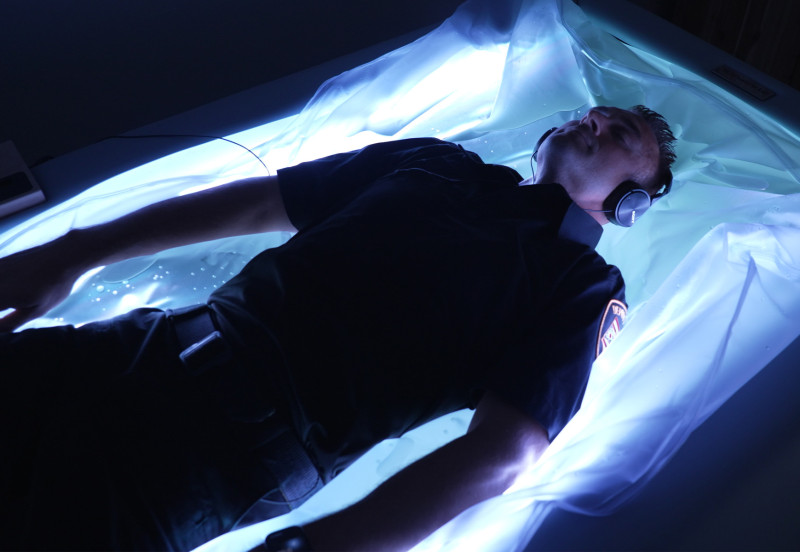
Conference attendees acknowledged TBI in this workforce is a delicate subject for so many reasons, not the least of which is the stigma linked to injuries that affect performance in a profession characterized by a mission-first mindset that leads to underreporting. First responders served on every workgroup alongside the academic researchers to help keep suggestions realistic for the workplace cultures and practices that are being asked to change.
The conference featured a panel discussion with three law enforcement officers who had received a head injury on the job. They described symptoms including double vision, dizziness, chronic migraines, short-term memory loss, speech problems and temporary paralysis, as well as complications navigating recovery - with one eventually losing her job as a result of her occupational injury.
Hearing from these officers "helps give us context about the stakes to come up with recommendations for first responders to return to full capacity," said Nathan Edwards, a research scientist in Ohio State's Human Performance Collaborative.
Improving care for first responders isn't stopping with the brain: Researchers are investigating musculoskeletal issues, physical performance and heart health in the first responder population as well, Oñate said.
"It's on us to get the level of evidence much higher," he said. "It's also on us to communicate with the first responder community to look at what impacts they're looking for and what they need to have happen."
This work was supported by the Assistant Secretary of Defense for Health Affairs endorsed by the Department of Defense, through the Traumatic Brain Injury and Psychological Health Research Program. The conference was also supported by HRS and Ohio State's Center for Brain Injury Recovery & Discovery.


