
Backed by a grant from the NSF, WISER was established in 2023 to apply the research and expertise at UAlbany and UConn to solve challenges related to energy systems
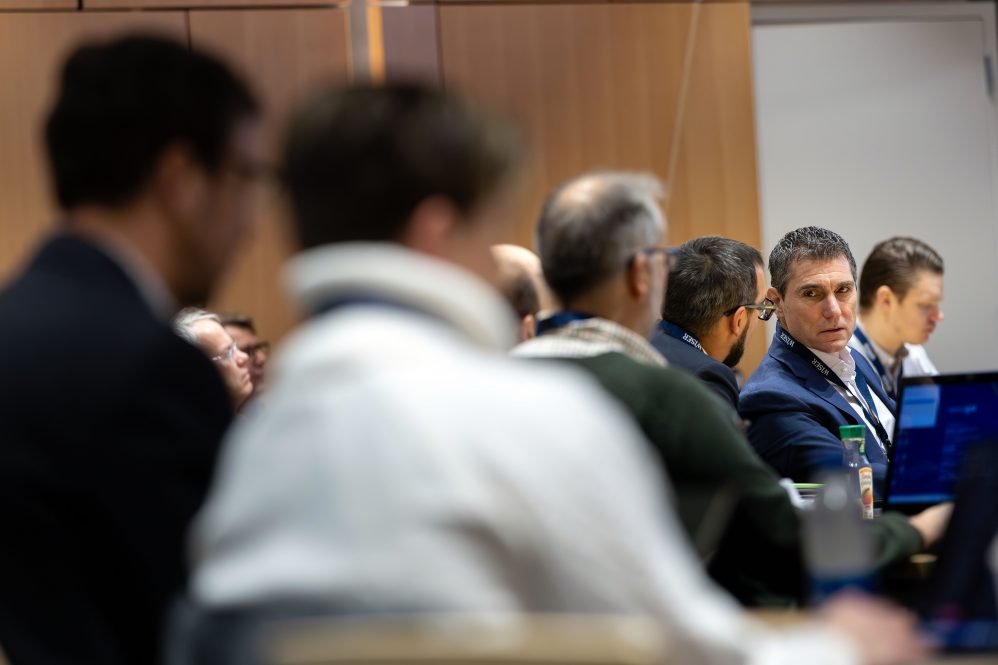
Emmanouil Anagnostou at the University of Albany on February 12, 2026. (Photo by Patrick Dodson / UAlbany)
Researchers at the University at Albany and University of Connecticut are working on a new initiative to better predict storm-related power outages, reduce restoration times, and strengthen the resilience of the electric grid.
The initiative, called the North American Forecasting Weather, Outage, Load & Damage Initiative, will create a scalable outage-prediction model to forecast system failures across the United States and Canada.
The forecasting model is the latest project to emerge from the Center for Weather Innovation and Smart Energy and Resilience (WISER). Backed by a grant from the National Science Foundation, WISER was established in 2023 to apply the research and expertise at UAlbany and UConn to solve challenges related to energy systems, now and in the future.
Chris Thorncroft, director of UAlbany's Atmospheric Sciences Research Center and Emmanouil "Manos" Anagnostou, director of UConn's Institute of Environment and Energy, are leading WISER for their respective universities.
"As the climate changes, extreme weather events are becoming increasingly disruptive and destructive," Thorncroft says. "By combining high-resolution weather forecasts with real-world outage data from utilities, we believe we can create tools that help keep the lights on and improve power grid resilience. This represents a first-of-its-kind collaboration that has the potential to reduce economic impacts from severe weather across the country."
"Anticipating storm impacts on the electric grid and its interdependent infrastructure would allow power utilities to work closely with state/local governments, communities and other stakeholders to take preemptive steps, such as requesting out-of-state assistance, increasing readiness of repair teams, as well as community energy, conservation, and coordination, to mitigate the effects of storm impacts," Anagnostou says. Anagnostou is also a Board of Trustees Distinguished Professor in Civil and Environmental Engineering, within the UConn College of Engineering.
Smarter Power Grid Forecasts
The North American Forecasting Model will be a multi-year effort. The first phase will focus on local pilot regions, including New England, New York, and California. Later phases will expand to regional areas along the east and west coasts, followed by a full North American rollout if additional funding is available.
The model will rely on UAlbany and UConn's expertise in advanced weather models and artificial intelligence, combined with publicly available outage data, to improve system outage predictions over entire regions and help utilities more efficiently allocate resources before storms.
Tens of millions of Americans are now facing higher utility bills after regulators approved dozens of rate hikes last year. Regulators green-lit 43 rate hikes across the country in 2025, totaling $11.6 billion in increases, according to an analysis by Power Lines. This is especially true in New York, where electricity bills have spiked 33% over the past decade on average, outpacing growth nationally.
Researchers involved with the new initiative say better outage forecasts could help utilities position crews more precisely, speed up restoration, and lower operating costs that ultimately impact rates.
"We have spent more than a decade building and validating power outage prediction models through one-on-one collaborations with utilities," says Diego Cerrai, interim director of the UConn Eversource Energy Center and principal investigator of the project. "The North American Forecasting Model enables us to move beyond individual utility partnerships and, for the first time, to develop a scalable platform with national reach, contributing to improving the energy security of North America." Cerrai is also an assistant professor in the School of Civil and Environmental Engineering.
"Weather affects every aspect of the power grid, especially with more frequent and impactful severe events threatening the reliability of an aging transmission infrastructure," says Jeff Freedman, research faculty at UAlbany's Atmospheric Sciences Research Center and project co-principal investigator. "A critical component of maintaining a resilient energy system is our ability to predict, with precision, where and when weather-related power outages will occur. More accurate outage predictions help utilities better position crews in the field, reducing their costs, limiting disruptions to the power grid, and keeping electricity affordable for residential and commercial customers."
Safeguarding the Energy Industry
During the week of Feb. 9, WISER hosted its third annual industry advisory board meeting at UAlbany. During the meeting, the WISER industry advisory board members announced $550,000 in support to launch the North American Forecasting Model, along with select other new research projects that are related to improving the energy industry.
More than 30 project proposals were presented during the meeting, as well as results from the 10 projects funded last year. "WISER is delivering actionable insights to guide investments and strategies for resilient grid operations and prioritization methodologies, and tradeoff analyses to inform short- and long-term investments," Anagnostou says.

UConn postdoctoral research associate presenting at UAlbany on February 12, 2026. (Photo by Patrick Dodson / UAlbany)
WISER's industry advisory board consists of energy industry executives from Avangrid, Central Hudson Gas & Electric Corp, Con Edison, Eversource Energy, HydroQuébec, National Grid, New York Power Authority, New York State Energy Research and Development Authority, New York State Foundation for Science, Technology, and Innovation and Pacific Gas and Electric Company, NASA and Southern California Edison.
The WISER research team includes faculty from UAlbany's Atmospheric Sciences Research Center, Department of Atmospheric and Environmental Sciences and College of Emergency Preparedness, Homeland Security and Cybersecurity and UConn's College of Engineering, School of Business, and the College of Agriculture, Health and Natural Resources.


