
Ethiopian researchers are using a new diagnostic test created by John Innes Centre researchers to identify wheat blast, a growing wheat disease threat. The system provides a simple test that can confirm within just 90 minutes whether the infected material contains wheat blast, a devastating disease that spreads on the wind and can cause up to 100% losses in severe outbreaks.
Wheat blast is a fungal disease (Magnaporthe oryzae pathotype Triticum) that spreads on the wind over great distances and thrives in warm, humid conditions. Infection causes wheat grains to become shrivelled or absent within a week. The disease is a particular concern for Ethiopia, the largest producer of wheat in sub-Saharan Africa, providing a major food source and livelihood for millions of people.
While wheat blast has not been found in Ethiopia yet, the disease has spread from South America into southern Africa through changing weather patterns and trade and needs careful monitoring. The new tests provide Ethiopian researchers a fast tool to confirm wheat blast should it enter the country, allowing control measures to be deployed as early as possible to stop further disease spread.
Professor Diane Saunders, John Innes Centre Group Leader, said: "We're delighted to launch this new diagnostic test that will improve both the speed and accuracy of wheat blast identification. This supports researchers, like our collaborators in Ethiopia, to stay agile to the potential introduction of wheat blast, and enable a more rapid response."
A challenge for detection is that the symptoms of wheat blast can look similar to another disease, Fusarium head blight, which is commonly found in Ethiopia. The potential to confuse these two diseases in the field raises the likelihood that an introduction of wheat blast could be missed, as farmers and researchers generally identify wheat blast or Fusarium head blight by eye. The longer the disease is left unnoticed, the more chance the disease has to develop and spread, inhibiting the effectiveness of control measures. Therefore, it is vital to be able to quickly and accurately confirm the presence of wheat blast in the field.
A more accurate alternative is for researchers to use lab-based techniques, but previously these techniques have been slow, requiring several days and specialist lab equipment. These demands restrict the number of samples researchers can run and give the disease more time to develop and spread.
Because of these challenges, researchers in the Saunders lab at the John Innes Centre developed the new diagnostic tests that can confirm the presence of fusarium head blight or wheat blast within 90 minutes using easily accessible equipment. This same group also manages MARPLE Diagnostics, a mobile system to identify wheat rust strains.
Dr Dejene Girma, Head of Biotechnology at the Ethiopian Institute of Agricultural Research (EIAR), said: "It is wonderful to have this collaboration between UK and Ethiopian research, bringing new tools from discovery science into tools for impact on the ground."
The first trial of the new diagnostic tests took place in June 2026 at the Ambo research centre, a location specialised in studying wheat diseases.
Dr Jemal Tola, Centre Director of the Ambo research centre for EIAR, said: "Ambo research station has a long history of collaboration with the John Innes Centre for disease diagnostics and surveillance. This new technique further supports our capacity to identify and research wheat diseases to protect Ethiopian farmers."
Liam Butler, Research Assistant at the John Innes Centre, said: "Our visit to Ambo highlighted the importance of international collaboration in addressing emerging crop disease threats. It was exciting to see the method in the hands of Ethiopian research colleagues, where it can help strengthen diagnostic and surveillance capacity and support timely responses should wheat blast enter the country."
This new diagnostic test for works through a Loop-Mediated Isothermal Amplification (LAMP) system – a rapid, nucleic acid amplification technique. The system works by using a few DNA primers and a displacing DNA polymerase to copy DNA. Unlike PCR, it occurs at a constant temperature, allowing the tests to run with more basic equipment, making the test more widely accessible for field teams.
Professor Saunders concluded: "We've designed this test to be usable by labs globally, irrespective of access to specialist equipment and resources. The next step is to further simplify these assays so they can be used directly in the field."
This work was developed by CIMMYT in collaboration with the John Innes Centre and made possible by the generous support of the Government of the United States of America. Any opinions, findings, conclusion, or recommendations expressed in this publication are those of the author(s) and do not necessarily reflect the view of the Government of the United States of America.
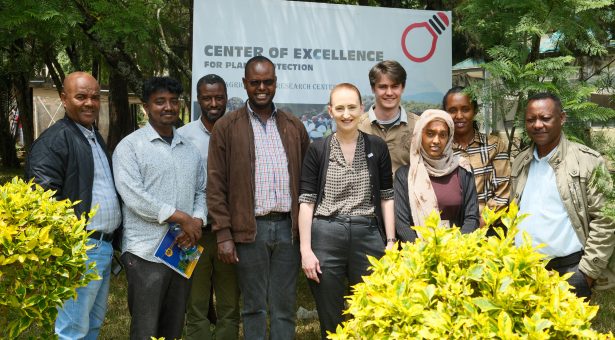
Image Caption – Dr Diane Saunders and Liam Butler of the John Innes Centre meet with Centre Director Dr Jemal Tola and the research team for the LAMP assay training at the Ethiopian Institute for Agricultural Research Ambo station.
Image Credit – Matt Heaton


