
Key Points
More cost-effective way to produce the medical radioisotope molybdenum-99 (Mo-99), with less enrichment of uranium-235 (U-235) and less waste developed
Porous, reusable target being synthesised and tested
Nuclear materials research and technology group collaborated with cross disciplinary teams at ANSTO
ANSTO has made progress on a more cost-effective way to produce the medical radioisotope molybdenum-99 (Mo-99), with less enrichment of uranium-235 (U-235) and produce less waste.
ANSTO supplies the Australian medical community with molybdenum-99, the precursor of technetium 99m, which is one of the most commonly used nuclear diagnostic imaging agents for the diagnosis of cancer, heart disease, organ structure and function, and supports other medical applications.
Porous, cylindrical reusable targets are currently being tested in the OPAL multi-purpose reactor by nuclear materials research and technology group scientists, working with teams across the organisation.
"The goal is to produce as much Mo-99, while consuming as much of the target U-235 as possible. The more effectively this is done, the larger the sustainability index," explained Senior Principal Research Scientist Prof Gordon Thorogood.
"Making the production on Mo-99 more cost effective, with less enrichment of U-235 in the target and reduced waste, brings significant benefits to ANSTO and Australia."
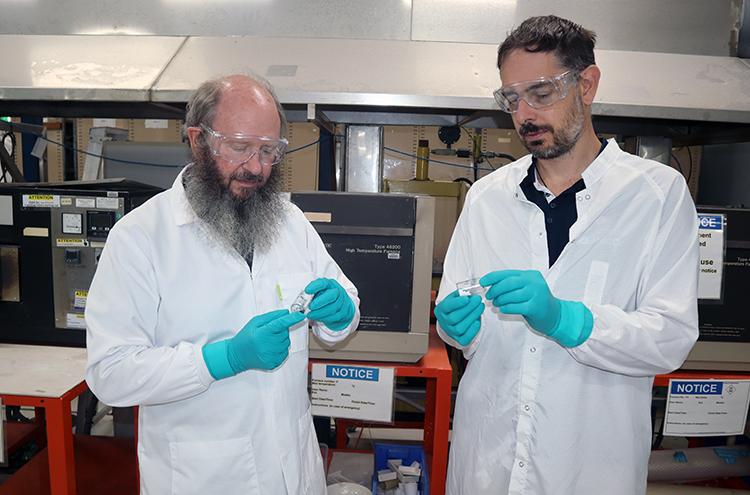
Previous and current work has focused mainly on modelling of neutron yields from a porous, reusable target. These investigations have resulted in four research papers, three patents and a PhD (awarded to Robert Raposio) by the University of Wollongong.
Dr Raposio's PhD work was supervised by Distinguished Professor Anatoly Rosenfeld at the University of Wollongong and Prof Thorogood.
The research published in Frontiers in Nuclear Engineering explored changing the shape of the uranium target.
Computer simulations compared three target shapes: flat (rectangular), spherical, and cylindrical.
Targets of different sizes were tested, all made with the same uranium material and density. Each target was simulated under typical operating conditions for several days to see how shape and size affected Mo-99 production, heat build‑up, long‑term usability, and the creation of unwanted by‑products.
The cylindrical target performed best overall as it produced the most Mo-99, had good long‑term performance, and resulted in the lowest amount of undesirable by‑products. Heat levels were low for all target shapes and sizes, suggesting that overheating was unlikely to be a problem.
Following successful modelling, proof of concept experiments followed using simulated targets to confirm predicted yields and stability. The targets were irradiated using neutron activation analysis in the OPAL multipurpose reactor.
The prototype spherical target that was developed enables fission recoil to eject the Mo-99 from the matrix into the pores, where it can be removed using a liquid compatible with the current molybdenum extraction processing system at ANSTO.
"Once the uranium-235 is exhausted, it can be disposed of using ANSTO's Synroc® waste encapsulation technology," said Prof Thorogood.
"We now have a much greater understanding of the entire process of molybdenum-99 production, which provided unique training opportunities in nuclear materials research as well," he said.
Dr Robert Raposio, who was a PhD candidate at the time and now works for ANSTO as a Process Performance Manager, undertook the fundamental research. He continues to seek improvements in the M0-99 production process.
Two nuclear chemists, Dr Jessica Veliscek-Carolan and Dr Tim Ablott are currently involved in synthesising and testing the spherical targets.
The research team at ANSTO along with a Masters student from UOW, Mr James Manning is also working on studies to determine if the Mo-99 can be produced by accelerator-based neutron systems, which might lead to its implementation on a smaller scale than reactor-based production.


