
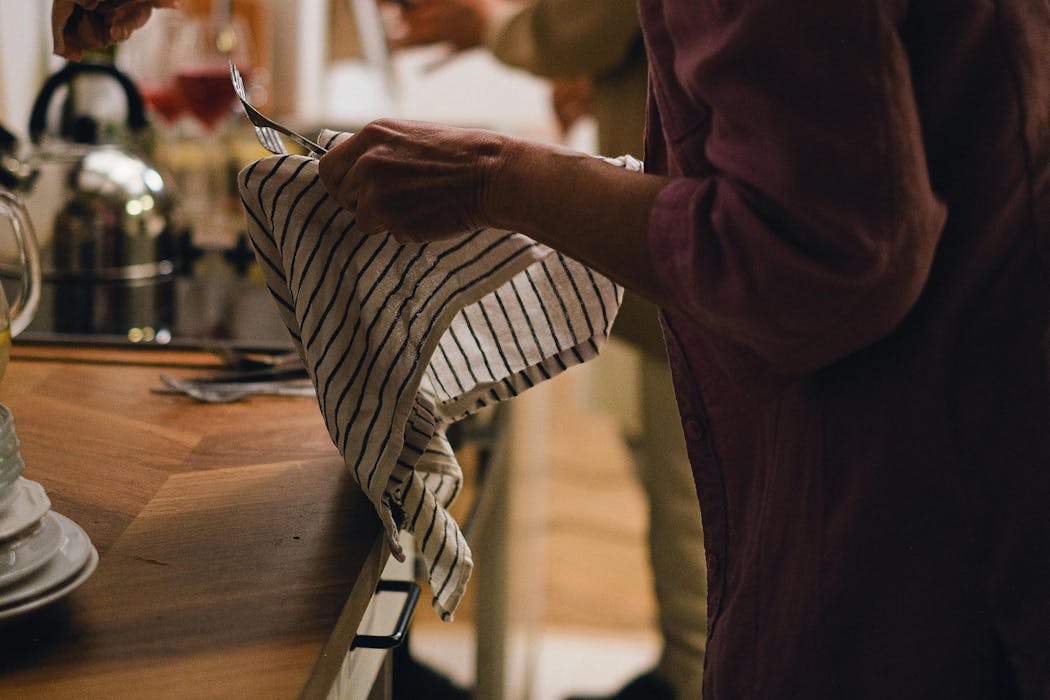
There's a peculiar ritual in many kitchens: reaching past the crisp, pristine tea towel hanging on the oven door to grab the threadbare, slightly greying one shoved in the drawer.
Author
- Rebecca Van Amber
Senior Lecturer in Fashion & Textiles, RMIT University
We all know that old faithful dries dishes better, even if we can't quite explain why. It seems counter-intuitive - shouldn't brand new towels, fresh from the packaging, outperform their worn-out predecessors?
Yet here we are, instinctively choosing the frayed over the fresh.
This isn't just kitchen superstition. There's genuine science behind why your tea towels actually improve with age, and understanding it might change how you think about all your household textiles.
The science of soaking it up
Tea towels are typically made from cotton or linen fibres, chosen specifically because these natural cellulose fibres are inherently hygroscopic, or water-loving.
But fibre type alone doesn't determine how well your towel performs. A textile's absorption is the result of a complex interplay between fibre, yarn, fabric structure, and any finishes applied during manufacturing.
Textiles absorb and hold water in two key places: within the fibre structure itself, and in the spaces between fibres and yarns. This is why fabric structure matters so much.
Think about bath towels - when was the last time you used a smooth, thin one? Bath towels are typically thick terry pile construction with lots of small loops on the surface. These loops dramatically increase surface area, allowing water to be easily wicked into the fabric.

Tea towels come in various constructions: plain weave, twill weave, waffle cloth, or terry. Plain weave towels - the kind you see with printed designs - require a smooth surface for clean, crisp screen printing.
Waffle cloth, which looks exactly as its name suggests, has a three-dimensional texture that makes it incredibly effective. Like with terry towels, this structure increases surface area and enhances water absorption.
Why old beats new
So what makes your battered old tea towel superior to its pristine replacement? Three key factors are at play.
Silicone finishes. Many brand-new textiles arrive coated in silicone softeners that provide softness and wrinkle resistance, making them appealing on store shelves.
But here's the catch: these same finishes are often water resistant. Your brand new tea towel may literally have a water-repellent coating. The fix is simple - always wash new tea towels in hot water before first use.
The impact of laundering. Fabrics undergo significant changes during their first several washes - typically up to six cycles . During manufacturing, whether knitted or woven, fabrics are held under tension. Washing causes the yarns to relax in what's called "relaxation shrinkage", reverting to their natural, tension-free state. Industry typically tolerates up to 5% shrinkage.
Here's where it gets interesting: while your tea towel's dimensions may shrink slightly, its mass stays the same, meaning the fabric becomes thicker and denser. In waffle weave towels, this shrinkage can make the three-dimensional texture more pronounced, increasing surface geometry and absorption. This phenomenon has been documented in terry bath towels, as well .

Fabric ageing. Repeated washing and drying causes minor surface damage that actually improves performance. Small fibres gradually raise up from the fabric surface , creating a fluffier, "hairier" texture.
Really smooth tea towels aren't very absorbent because water struggles to wet the surface - it can almost bead up due to the contact angle between water and the smooth fabric.
But as washing raises more fibres off the surface making a "rougher" textile, the contact angle decreases, making the fabric easier to wet. Waffle fabrics, with their irregular surfaces, are inherently more absorbent from the start due to favourable contact angles.
In short: washing leads to more surface texture, leading to better absorption.
Not just tea towels
The real revelation here isn't just about tea towels - it's about how we think about textiles in general.
That "worn in" feeling we associate with our favourite bath towels, tea towels and even bed linens isn't just nostalgia. Many of our home textiles are genuinely performing better after repeated laundering, having shed their factory finishes and relaxed into their true structure.
So before you send your old tea towels off for recycling to replace with new ones, remember: those frayed edges and faded patterns represent months of your towel becoming exactly what it was meant to be.
And when you do buy new household textiles, wash them at least once before using to remove any residual finishes.

Rebecca Van Amber is a chartered member of The Textile Institute.


