The Yong Siew Toh Conservatory of Music (YST) at the National University of Singapore (NUS) unveiled the YST Cube today, transforming its former Orchestra Hall into a flexible, reconfigurable arts space for music education, artistic creation, and performance.
As approaches to artistic creation, learning and performance continue to evolve, students are exploring broader possibilities in how music can be created and presented, while taking greater ownership of their work. The transformation forms part of YST's broader academic and artistic development, including reimagining how its physical spaces can support these changing approaches. By building on an existing space while expanding what it can enable, the Cube provides YST with greater capacity to respond to developments in music education over time.
The Cube was officially opened by NUS President Professor Tan Eng Chye at the Opening Ceremony of Performers(') Present, YST's triennial international artistic research symposium, on 22 October 2026.
"The YST Cube will create new and exciting possibilities for students and faculty to experiment and push the boundaries of artistic practice," said Professor Tan.
"It will also be a convening space for visiting artists, educators and researchers from around the world to converge, create and showcase."
The opening of the Cube strengthens YST's role in the arts at NUS, advancing the University's Arts for All (AFA) framework by broadening the range of artistic experiences that can take place on campus. While primarily serving NUS's Music students, the new venue will also welcome the wider NUS community through public performances, presentations and other activities, creating further opportunities to engage with the arts at NUS.
A flexible space for 21st century music education
The Cube reimagines the Conservatory's former Orchestra Hall - previously used primarily for orchestra rehearsals and masterclasses - as a purpose-built, flexible space for music education and performance. The transformation comes 20 years after the Conservatory building first opened.
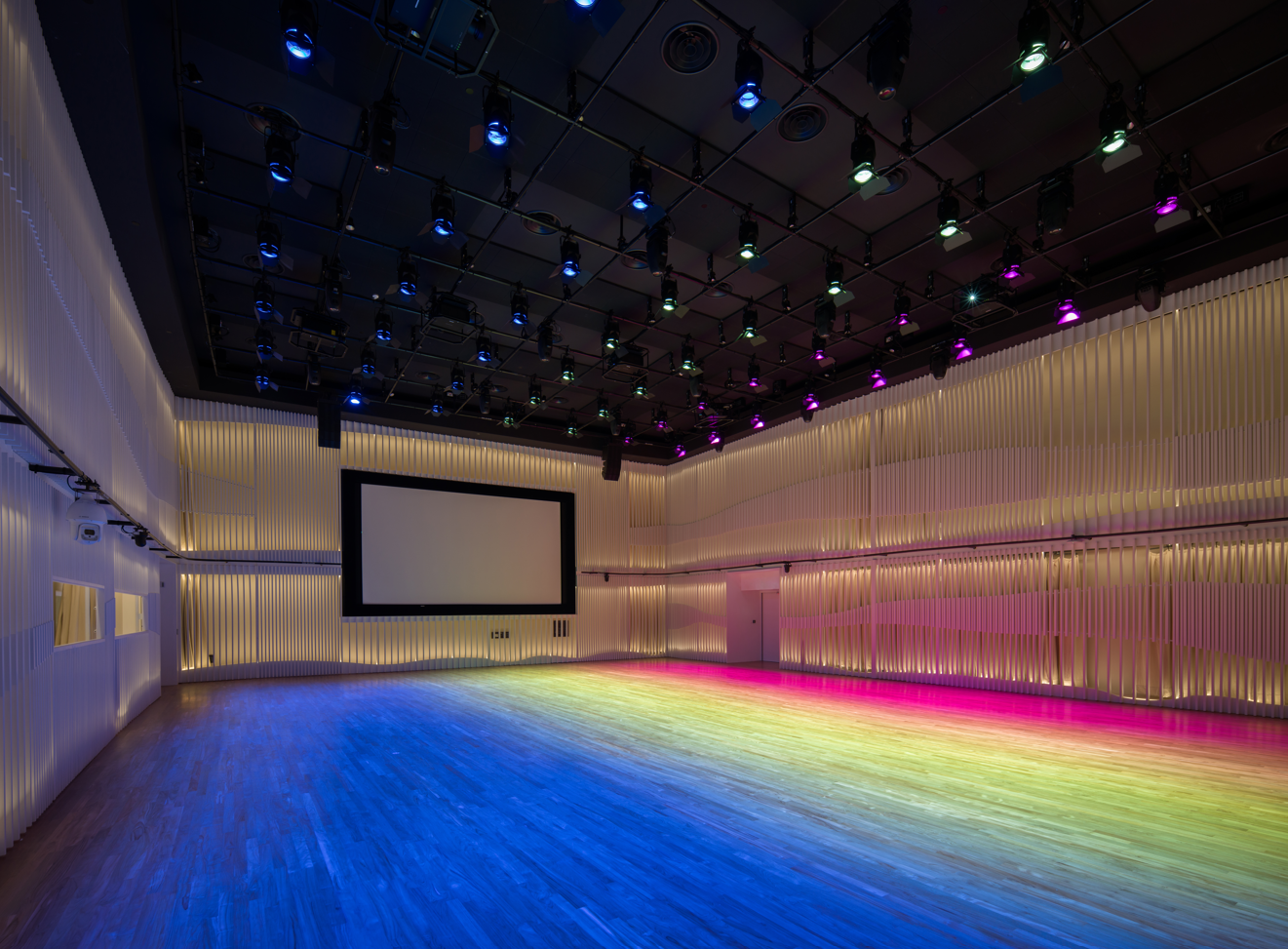
The Cube's 254 sqm adaptable configuration, akin to black box performance spaces, allows it to be tailored to different uses, accommodating a range of performance formats, audience layouts and production requirements. For example, the Cube can shift between conventional performance formats and 360-degree arena-style setups where audiences surround the performers, or for multimedia work incorporating projection and lighting.
Not only can it support conventional teaching, rehearsals and recitals, the new space can also accommodate workshops, presentations, multimedia events and performances that make use of space in more creative ways. The transformation also incorporates sustainability considerations through adaptive reuse, retaining key elements of the former Orchestra Hall while introducing new infrastructure and building systems to improve functionality and operational efficiency.
This flexibility allows the space to evolve with the needs of its users, providing a future-ready environment that can adapt to changing approaches to how students learn, collaborate and present music as part of their education.
"As music education evolves, we need spaces that allow students to move beyond fixed performance formats and encourage students to rethink how music can be created, presented and experienced," said Professor Peter Tornquist, Dean of YST.
"The Cube brings these possibilities together under one roof, giving students the freedom and flexibility to experiment with new ways of learning, collaborating and performing, while preparing them to navigate and shape the future of music."
Creating opportunities for applied learning
The Cube will provide students with opportunities to apply their learning in a practical environment that mirrors real-world artistic practice. The venue features state-of-the-art audio, visual and lighting systems that brings professional production capabilities that is on par with world-class venues into the student learning environment.
The Cube's variable acoustic system allows the room's acoustic response to be adjusted to suit different uses, while its lighting and multi-projection systems give artists greater flexibility in how performers and audiences are positioned within the space.
For students, these capabilities provide hands-on opportunities to work with different acoustic conditions, technical setups, spatial configurations and modes of presentation, helping them understand how these choices can shape an artistic outcome. This supports YST's continued development of its curriculum, including areas that place greater emphasis on student-led performance projects and collaborative music-making.
"Applied learning is central to the YST experience," shared YST Assistant Professor Jonathan Shin.
"The Cube allows for different modes of learning-it gives students a playground to dream in, a laboratory to try practical and creative ways to bring their dreams to life, and a space to learn through the process."
The launch of the Cube at Performers(') Present will demonstrate the versatility of the new venue, with the symposium making use of both the main space and its adjoining pre-function area. Designed as an extension of the Cube, the pre-function area can operate independently as an intimate event space for smaller audiences.
By hosting activities of this nature within YST, the Cube brings professional artistic and research practices directly into the student learning environment, creating opportunities for students to encounter and engage with different approaches to artistic practice as part of their education.
Supporting the arts ecosystem at NUS and in Singapore
The addition of the Cube creates a new focal point for artistic activity within NUS, strengthening the University's Arts for All (AFA) framework by bringing students across different faculties and disciplines together through the arts.
"The arts is a deeply fascinating and enriching discipline, and we want every student, whatever their discipline may be, to discover and learn about the arts," said Professor Tan.
"They stretch our imagination, give us new lenses to see the world, and deepen our understanding of the human experience."
Beyond NUS, the Cube will provide Singapore's arts community with a new purpose-built platform for performances, rehearsals, creative residencies and collaborative projects. The venue will welcome arts organisations and external hirers, fostering artistic exchange and partnerships between YST and the local arts sector.
The Cube joins YST's existing Concert Hall and Recital Studio, expanding the spaces available at the Conservatory to support different scales and forms of artistic activity. Together, these venues reflect YST's commitment to shaping the future of music education, strengthening connections between students and the professional arts sector while contributing to the cultural landscape of NUS and beyond.