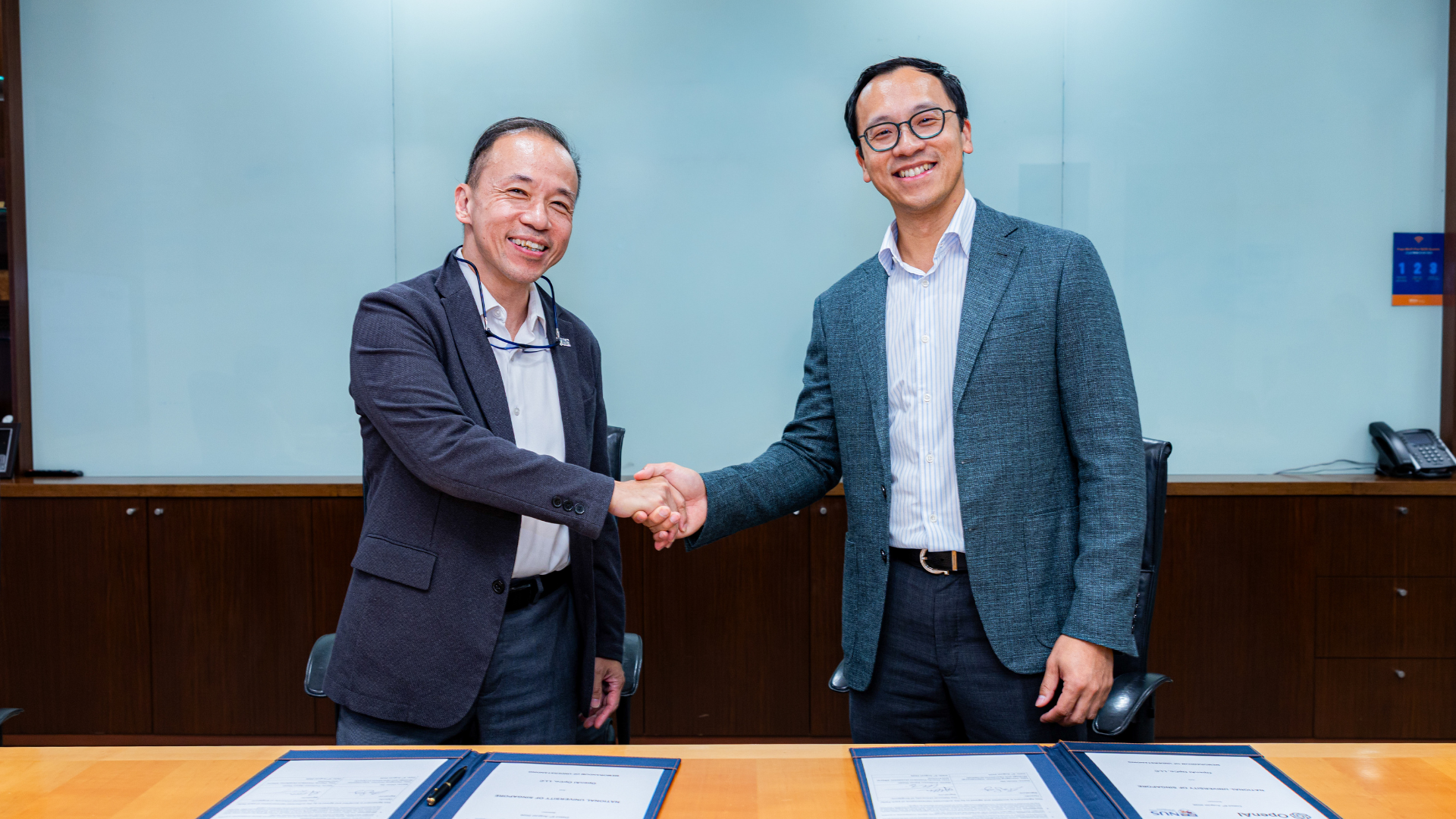
The National University of Singapore (NUS) is supercharging its artificial intelligence (AI) ecosystem with a new addition to its expanding suite of AI resources, enhancing support for its community across all key functions. Today, the University announced a strategic collaboration with OpenAI, a leading research and deployment AI company, aimed at augmenting the University's AI capabilities.
Beyond advancing state-of-the-art AI infrastructure, NUS and OpenAI will jointly champion initiatives to nurture AI talent and drive innovation that enables the University to effectively harness AI as a force multiplier across education, research and administration.
"This collaboration with OpenAI is a pivotal step in our human-centric AI strategy, further enriching the robust suite of tools we provide," said Professor Aaron Thean, Deputy President (Academic Affairs) and Provost of NUS. "We aim to leverage these advanced AI technologies not as replacements, but as powerful amplifiers of human intellect, creativity and judgement. By providing direct, hands-on access, we empower our students, faculty and staff to develop the critical thinking and ethical discernment essential to innovate and lead in an AI-driven world, ensuring human capabilities remain at the forefront."
Expanding the repertoire of advanced AI tools
From 31 August 2026, all NUS students, faculty and staff will have access to ChatGPT Edu by OpenAI, further strengthening NUS' growing portfolio of AI platforms and services. Unlike the free ChatGPT, it provides NUS with broader access to core capabilities within a secure, university-managed environment with stronger privacy, security and administrative controls. Conversations and data within the NUS workspace are not used to train OpenAI's models.
During the initial phase, advanced tools from OpenAI's enterprise-grade platform - ChatGPT Edu - will be strategically piloted in some selected courses. These powerful resources are designed to empower students, faculty and staff, fostering innovation, accelerating research and addressing complex challenges with greater depth and efficiency. Following this pilot, these advanced tools will be progressively made available for undergraduate courses where AI adds educational value and augment learning objectives.
This expansion builds on the earlier collaboration with NUS School of Computing which began in March 2026, providing Computing students access to OpenAI's software development tools.
The collaboration now enters its next phase, scaling access and enablement across the University.
To further develop practical AI skills, students will have opportunities to participate in hackathons and build days focused on AI-enabled solutions. These activities will give students across disciplines opportunities to develop ideas, work on real-world problems and connect with OpenAI's global networks and communities.
"As AI becomes increasingly embedded in how NUS operates, it is critical that we adopt it in a secure, scalable and sustainable way. This collaboration with OpenAI provides NUS staff and students the access to advanced AI capabilities in a governed and responsible manner. Complementing NUS' in-house built AI-Know platform, OpenAI's tools will strengthen our operational capabilities, drive smarter digital services and more efficient administration that benefit our entire community," said Ms Tan Shui-Min, NUS Chief Information Technology Officer and Vice President.
"Singapore has an extraordinary opportunity to shape how AI contributes to education, research and innovation, and NUS has an important role to play in that future. Building on our earlier collaboration with the NUS School of Computing, we've seen users engage more deeply with ChatGPT and adopt Codex at higher rates than users at similarly sized universities. This reflects a growing appetite not only to find answers with AI, but to experiment, prototype and build with it. We look forward to deepening our work with NUS to help develop the next generation of AI-native talent and prepare Singapore's workforce for an AI-enabled future. By bringing together NUS' leadership in education and research with OpenAI's technology and global community, we aim to strengthen Singapore's AI ecosystem and support innovation across the wider region," said Mr Oliver Jay, Managing Director, International at OpenAI.
New foundational AI competency course for all NUS freshmen
This strategic collaboration aligns with NUS' broader educational philosophy, which integrates AI competencies directly into the curriculum.
To ensure all incoming NUS students achieve AI literacy before they start their courses, foundational AI competencies are built directly into their freshman university experience through the Transition to Higher Education (T.H.E.) Programme.
Starting from Academic Year 2026/27, THE1008 Applied Generative AI: From Prompting to Evaluation will be a compulsory module for all first-year undergraduates, ensuring every student gains practical skills in effectively interacting with large language models (LLMs) and multimodal AI before they begin their coursework.
Following the completion of this requirement, NUS will ensure all students achieve AI fluency when they graduate through the deliberate integration of AI competencies at every stage of their studies in their common curriculum and major. They will have the confidence to deploy AI tools strategically, critically interpret AI-generated results and apply AI thoughtfully within their disciplines. This proactive approach equips all NUS graduates with the latest AI expertise and its application across interdisciplinary subject domains while amplifying their adaptable human-centred skills such as critical thinking, judgement and sense-making valued by employers. Students will be ready to harness AI for analysis, problem-solving and creative work, preparing them to thrive as agile and innovative professionals in an AI-driven world.
Innovating research discovery
In a first for Southeast Asia, NUS Libraries and NUS IT have jointly developed AI Sense Maker, a proprietary web-based conversational AI platform powered by OpenAI's LLM. To be officially launched on 20 August 2026, AI Sense Maker draws on over 150,000 digitised materials from NUS Libraries' ScholarBank and Digital Gems collections. Supporting academic inquiry, the platform enables students and researchers to ask questions in everyday language and uses semantic search to generate concise topic summaries, identify related concepts, curate references and create interactive knowledge graphs for deeper exploration of ideas.
NUS remains committed to the thoughtful integration of AI into education, research and administration, ensuring its community is equipped for technological advancement while upholding principles of responsible and ethical AI use.