
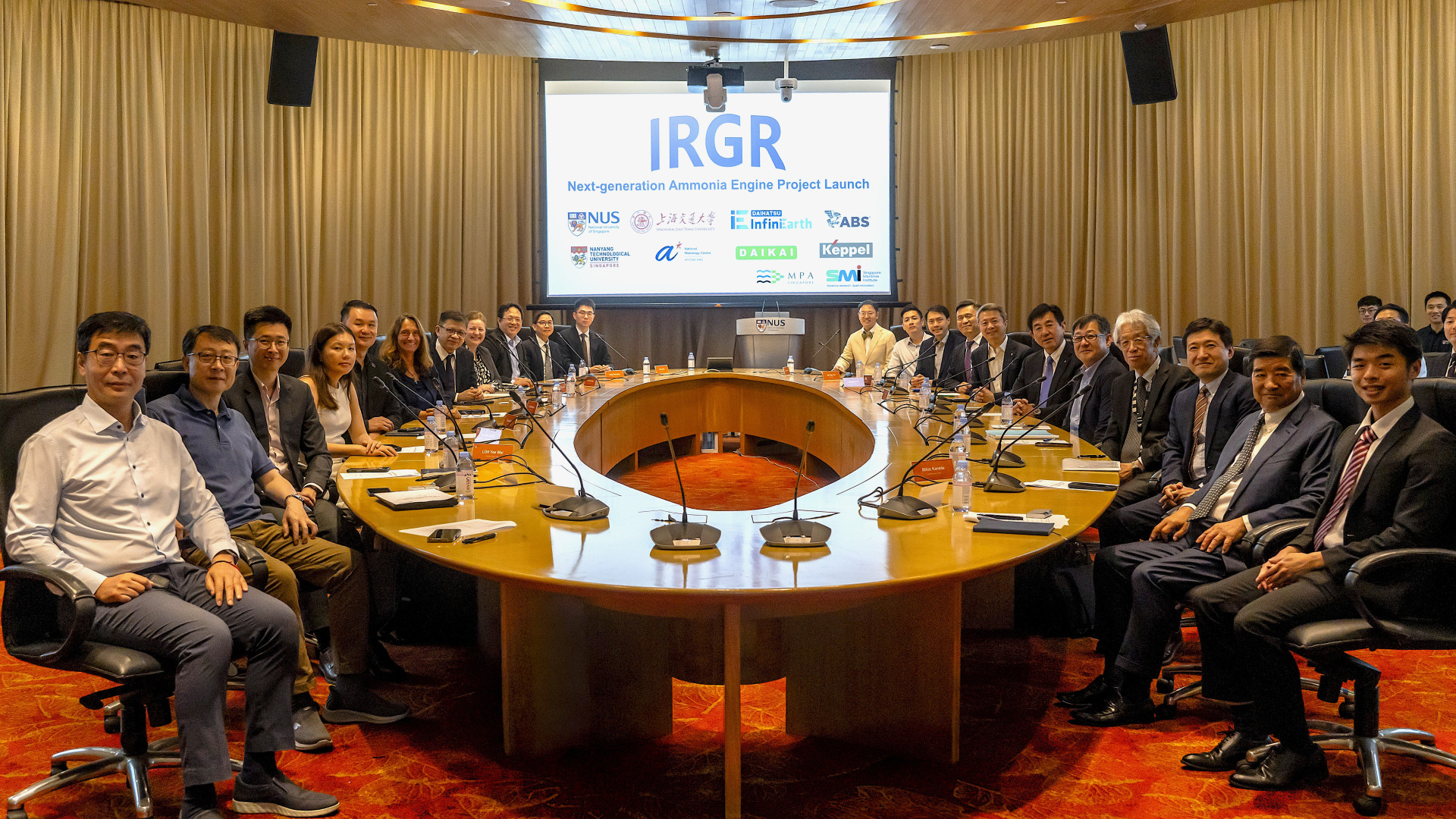
A major new research project to be located on the College of Design and Engineering (CDE) campus at the National University of Singapore (NUS) aims to accelerate the decarbonisation of the global shipping industry through the development of next-generation ammonia-fuelled marine engines with high efficiency and near-zero emissions.
Officially launched on 4 February 2026, the project is led by the NUS Centre for Hydrogen Innovations (CHI) with funding support from the Singapore Maritime Institute (SMI), in collaboration with leading academic and industry partners in Singapore and overseas. The project focuses on a novel in-cylinder reforming gas recirculation (IRGR) engine concept designed to address key limitations that have so far constrained the wider adoption of ammonia as a marine fuel.
"Ammonia has been recognised as one of the most promising fuels for achieving near-zero greenhouse gas emissions in marine transportation, but current ammonia engines face significant challenges in efficiency and emissions," said Associate Professor Yang Wenming from the Department of Mechanical Engineering at NUS, who leads the project as Principal Investigator. "The IRGR concept is designed to address these limitations by improving combustion efficiency while sharply reducing unburned ammonia and other pollutants."
"The project will be based in a dedicated laboratory on the CDE campus, featuring an engine test room, control room and facilities for fundamental combustion and systems research," said Dr Zhou Xinyi, Senior Research Fellow from the Department of Mechanical Engineering. Beyond technical development, the initiative also aims to strengthen Singapore's position as a hub for maritime innovation and sustainable shipping technologies by anchoring advanced engine research within a broader ecosystem of industry collaboration and talent development.
Speaking at the launch ceremony, Professor Silvija Gradecak, Vice Dean (Research and Technology) at CDE, described the IRGR Ammonia Engine Project as an important milestone for efforts to decarbonise the maritime sector.
"Marine transportation is central to global trade, yet it remains one of the most challenging sectors to decarbonise," she said. "Through this project, the team aims to develop and demonstrate the world's first prototype engine based on the IRGR concept, paving the way for the practical adoption of ammonia as a marine fuel."
Global shipping currently accounts for approximately 3 per cent of global carbon emissions, and the sector faces increasing pressure to reduce its environmental impact in line with international net-zero targets. While ammonia does not produce carbon dioxide at the point of combustion and is easier to store and transport than hydrogen, challenges related to thermal efficiency, combustion stability and pollutant emissions remain critical barriers to commercial deployment.
International collaboration is a central feature of the IRGR project. "The International Maritime Organization's net-zero emissions target must be achieved by 2050, and the time left is very short," said Professor Li Tie from Shanghai Jiao Tong University, a key academic partner in the project. "This goal cannot be realised by any single institution or country. It requires disruptive technologies and strong international cooperation, and the IRGR project reflects exactly that kind of collaboration."
The consortium includes partners from Shanghai Jiao Tong University, Nanyang Technological University, the A*STAR National Metrology Centre and Keppel Energy Nexus, alongside industry partners Daihatsu, a leading global marine engine manufacturer, and the American Bureau of Shipping (ABS). Their involvement is intended to ensure the research remains grounded in practical engineering requirements, safety considerations, certification pathways and commercial relevance.
The launch event at NUS was attended by senior representatives from the government, industry and academia, including leaders from SMI and the Maritime and Port Authority of Singapore, as well as the President of Daihatsu Infinearth, Mr Yoshinobu Hotta, and Vice President of ABS, Dr Gu Hai. The event also included the formal signing of research collaboration agreements between NUS and Daihatsu, and between NUS and ABS.
Closing the event, Professor Lee Poh Seng, Head of the Department of Mechanical Engineering, emphasised the broader significance of the initiative.
"This project is not merely the start of another research programme, but a deliberate step into one of the hardest and most consequential engineering challenges in the energy transition," he said. "Decarbonising hard-to-abate sectors like shipping requires technologies that can be validated, scaled and trusted in real-world operations."
The project is expected to run for three years, with the research team working towards scalable engine concepts that could support the future deployment of low- and zero-emissions vessels worldwide.


