
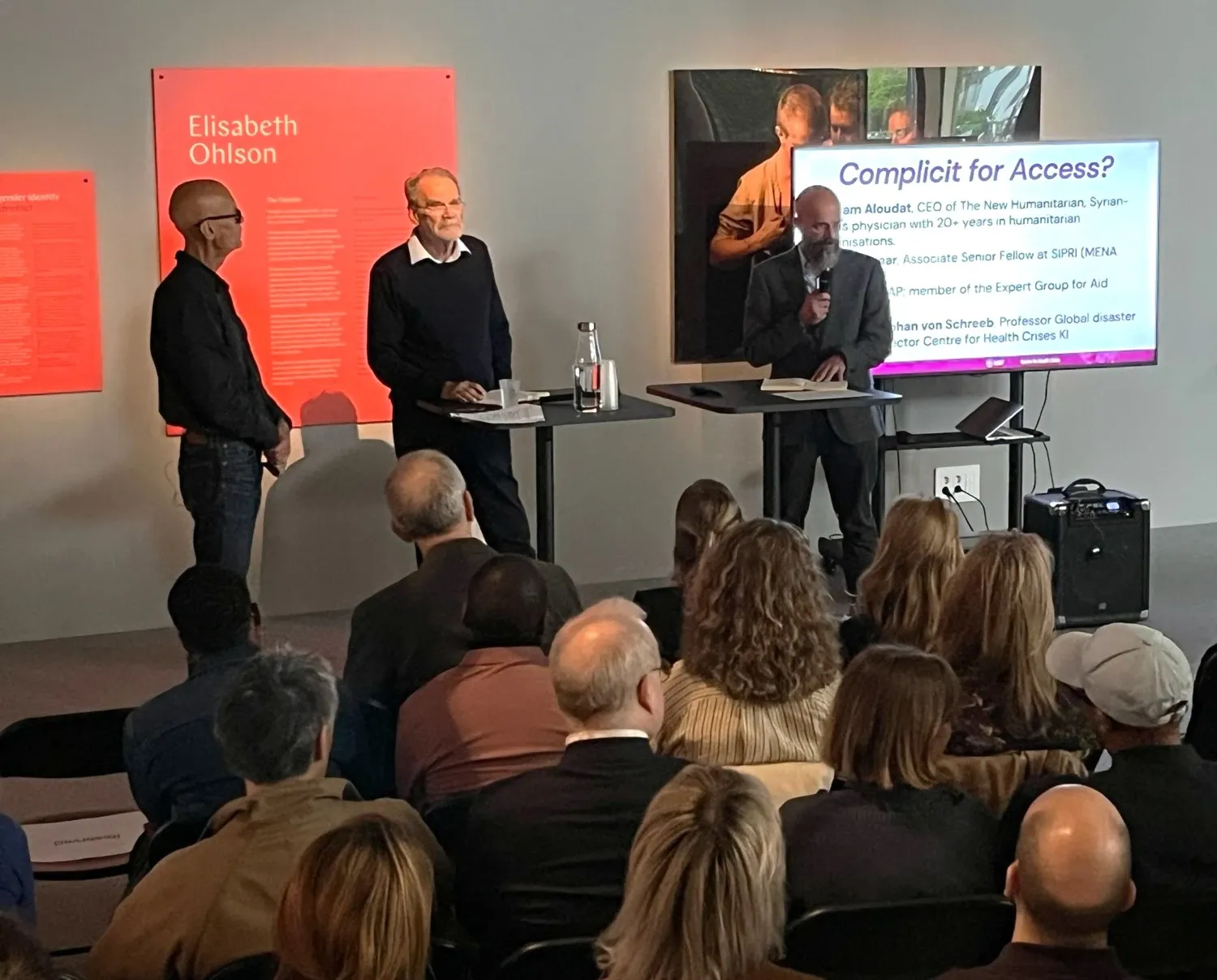
Humanitarianism is often seen as an implicit good. The dedication to preserve, protect and support human life, dignity, and the reduction of suffering. But its implicit goodness can also stand in the way of further analysis and debate about what it contributes to in practice. That is why Centre for Health Crises at Karolinska Institutet organised just such an evening of discussion.
The participants who gathered for an evening of debates, panel discussions and q&a at the Cell on 21 May came from academia, humanitarian and aid organisations, the media sector, the business sector, politics and more. Several of them were medical staff from all over the world attending a course, Anaesthesia and Critical Care with Limited Resources that Karolinska Institutet in collaboration with Médecins Sans Frontières (MSF) , ran during that week. The course trains and prepares doctors and nurses for humanitarian mission in low resource contexts
The importance of providing a forum for debate
The Centre for Health Crises organised the evening as part of their role as an independent forum for discussion on complex issues. It builds on expertise and experience that consider different needs and allows to discuss conflicting objectives. Because whilst humanitarianism might be seen as an implicit good, it is a complex topic, with unintended side effect that may not be obvious, including increasing power imbalances and that the assistance serves other purposes than serving the population in need.
- At the Centre our vision is a society better prepared for future health crises. Humanitarian health assistance plays a role in achieving that. But we have to be vigilant in ensuring that the populations immediate needs are in focus. That's why I'm proud that we could provide a forum for debating the challenges and include different perspectives that were raised by the discussants: Johan Schaar , Tammam Aloudat , Gunilla Carlsson , Fiona Terry , Marc Dubois and Caroline Delgado , who are all well renowned international experts in the field, says Johan von Schreeb , the director of the Centre for Health Crises.
A conversation starter on a complex issue
Tamam Aloudat's concluding words, where he highlighted that the basis of humanitarian medical assistance, to save a person's life, is always a good thing but that it is how that help is provided that needs to be continuously debated, was a fitting summary of what the Centre wanted to achieve with the event - to initiate a conversation on a complex topic, rather than to reach an all-encompassing conclusion.
In terms of what the Centre will do next, they have an upcoming webinar on the health care situation in Lebanon on 27 May , through which they also continue to shine a light on the issue of attacks on health care.


