
They spotted the first mat of sargassum seaweed several miles out in Biscayne Bay. So, the captain of the 37-foot Yellowfin brought the vessel to a full stop, allowing the scientists onboard to get a closer look at the brown macroalgae that has been washing ashore by the tons this summer and fouling the shorelines of Gulf Coast and Atlantic beaches.
The mat was just what University of Miami oceanographer María Josefina Olascoaga was looking for. She tossed a small canister-shaped drifter overboard into the center of the floating mat, where she hoped the device, equipped with special software and a camera, would remain entangled for several hours, tracking the path of the seaweed.
"We want to create a better way of tracking and predicting the path of sargassum," said Olascoaga, a professor of ocean sciences at the Rosenstiel School of Marine, Atmospheric and Earth Science. "But doing so is difficult. There are variables such as currents, winds and waves that must always be considered. Previous versions of drifters we developed would eventually become dislodged from the sargassum mats, and we were never certain whether they were traveling with the seaweed or floating alone in the ocean."
The drifters she and her team recently tested in Biscayne Bay have so far overcome those challenges, employing GPS technology, color detection sensors and built-in cameras that allow researchers to know whether the drifters are sticking to the stinky stuff.
"A sargassum mat is not expected to move in the same way as an isolated surface drifter," said Francisco Beron-Vera, a research professor in the Rosenstiel School's Department of Atmospheric Sciences, whose research focuses on how currents, winds and other physical processes transport and disperse material in the ocean. "The mat has a finite size, is partially exposed to the wind, interacts with waves and currents and consists of many connected pieces of seaweed. A drifter that reliably remains within the mat therefore provides much more meaningful observations of actual sargassum transport."
Developed in collaboration with the Miami-based aerospace and technology company Altametry, the drifters also transmit data wirelessly on the heading, position and acceleration rates of the sargassum mats.
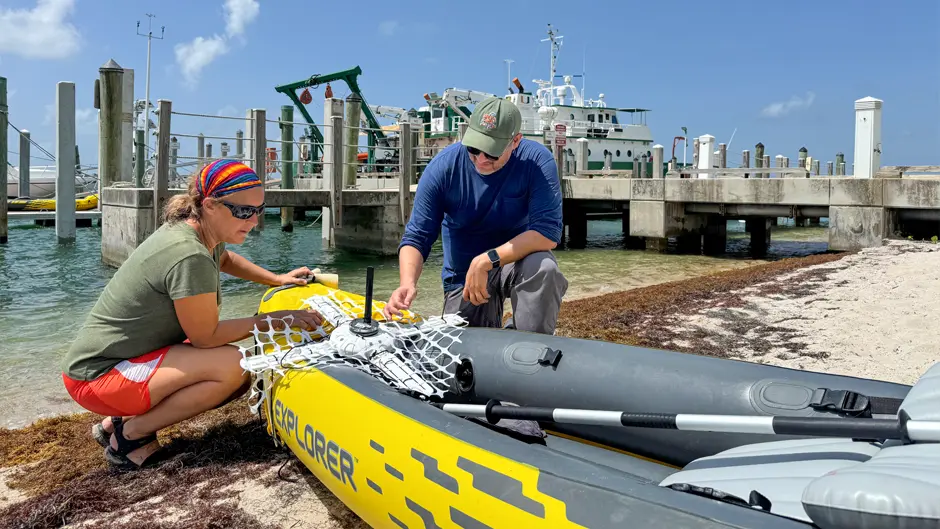
But it is special strips attached to the drifters that have so far proved to be the lynchpin in making sure the devices stay embedded within the seaweed.
"It's pieces of plastic fencing that we actually ordered online through Amazon," said Candido Hernandez, chief engineer at Altametry and a College of Engineering Ph.D. student who played a pivotal role in the drifter's design. "The special webbing attached to the drifters may be a low-tech solution to a challenging problem, but it's proved effective."
Effective not only when deployed in mats of sargassum in Biscayne Bay but also during testing in the Rosenstiel School's Air-Sea Interaction Saltwater Tank, which simulated wave and wind conditions the drifters encountered at sea, and at Darwin Beach on Virginia Key, where the devices were deployed in mats of seaweed floating just offshore.
Researchers eventually recover the GPS-equipped drifters, lessening the likelihood that the plastic strips securely attached to the devices will harm marine life.
As part of the Biscayne Bay testing phase, an uncrewed Altametry surveillance blimp launched from the Yellowfin and rose more than 300 feet in the air, using its imaging and tracking instruments to observe sargassum mats and the drifters from above. "Rock solid for the entire testing at sea, and it stayed aloft for about five hours," said Gary Rees, director of research at Altametry, which has partnered with the University on other research initiatives.
"They've done quite well," Miguel Izaguirre, senior manager in the Department of Ocean Sciences' research lab, said of the drifters. But more rigorous experimentation is needed, he said, pointing out that the next phase of testing could involve embedding the drifters in sargassum mats for weeks and even months to study their long-range transport across the Atlantic Ocean.
If perfected, they could eventually be mass-produced and used by other scientists not only to track sargassum but also for other research purposes, Olascoaga said.
Drifters such as the ones she is helping to develop are not the only devices that can track sargassum. Satellites can detect seaweed mats using ocean color sensors that measure specific wavelengths of sunlight reflected by the water. But cloud cover, sunglint and aerosols can interrupt satellite observations of seaweed. "So, they generally cannot provide a continuous trajectory of a given sargassum mat," said Beron-Vera.
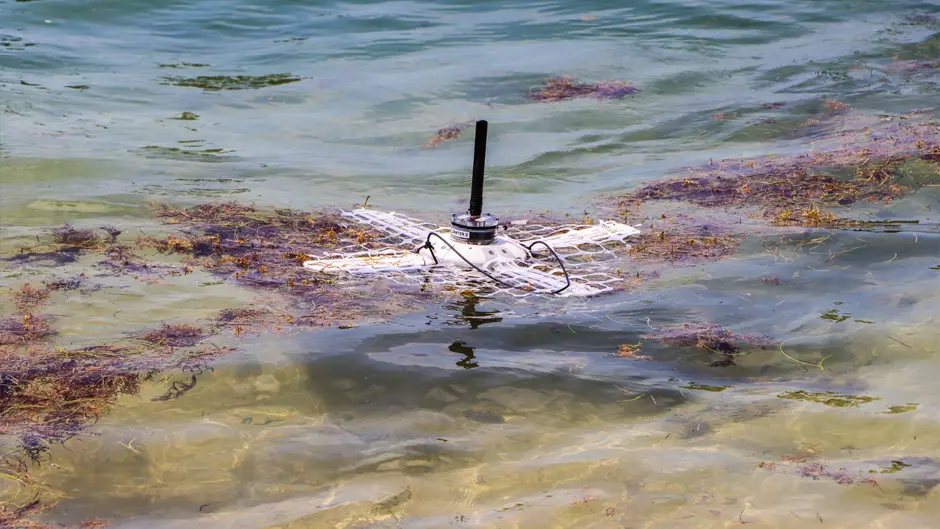
"Drifters, on the other hand, can provide something satellites cannot: a continuous record of the motion of an individual sargassum mat over weeks and even months," Beron-Vera continued. "And this is invaluable for validating transport models that predict how sargassum moves under the combined effects of ocean currents, winds, waves and the finite-size dynamics of the mats."
In the open ocean, sargassum seaweed is actually beneficial, providing habitat, food resources, protection and breeding grounds for hundreds of marine species. But when massive piles of the stuff wash ashore and decompose, they release toxic gases such as hydrogen sulfide and ammonia, the fumes from which can lead to breathing difficulties, skin rashes, headaches and eye irritation.
Pushed by ocean currents, millions of tons of sargassum travel across the Atlantic each spring, inundating shorelines across the Caribbean, Gulf of Mexico and Florida.
Olascoaga said the drifters could be a new tool in government officials' ongoing efforts to mitigate the impacts of sargassum, providing them with advanced information on when seaweed mats will reach shorelines.


