
From 25 to 30 October 2026, the OSCE Programme Office in Dushanbe facilitated the participation of five officers from the Ministry of Internal Affairs (MIA) and four prosecutors from the General Prosecutor's Office (GPO) in a five-day practical learning course on Digital Forensics and Open-Source Intelligence in Countering Cybercrime. The course was held at the Law Enforcement Academy of Uzbekistan in Tashkent, in co-operation with the OSCE Project Co-ordinator in Tashkent.
Participants from the MIA and the GPO were selected based on their active participation and performance during previously conducted basic learning courses organized by experts from the Law Enforcement Academy in Dushanbe in April and August 2026. The advanced on-site course aimed to build on participants' theoretical knowledge and improve their practical skills in combating cybercrime.
During the learning course, participants had the opportunity to exchange experiences and learn about advanced methods of digital forensics, the legal regulation of digital evidence, and techniques for gathering information from open sources.
Other topics included blockchain technology analysis, the role of the KODEX digital platform in cybercrime investigations, forensic examination of the darknet, and mechanisms for international co-operation in cybercrime investigations.
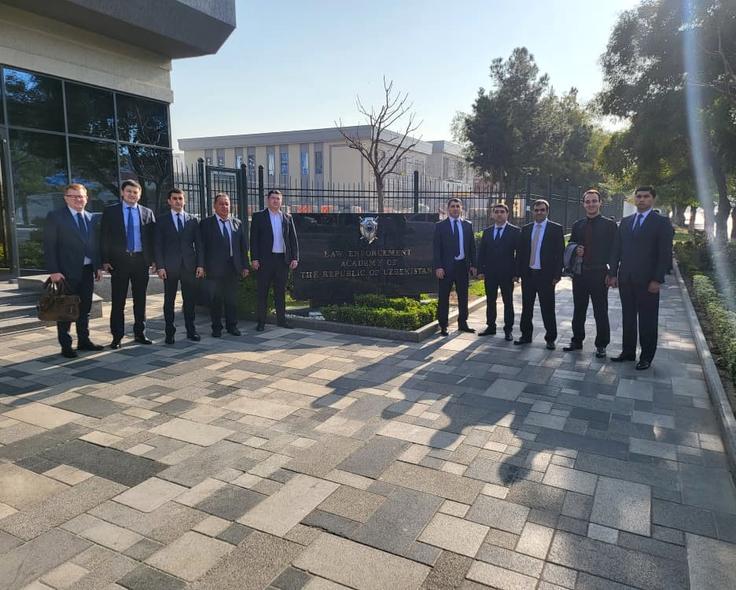
Participants from Tajikistan pose for a group photo in front of the Law Enforcement Academy of Uzbekistan, where the advanced training course took place, Tashkent, 30 October 2026.
This initiative, which included both basic and advanced practical learning courses, aimed to equip participants with the knowledge and skills needed for effective cybercrime intelligence gathering and investigations, while incorporating international best practices into their work.


