The starring role played by open-air theatre in strengthening regional identity and community cohesion has been placed centre stage in a new book.
Open-Air Theatre is the first to explore how the act of watching drama under open skies is a fundamentally different experience for audiences compared to when they attend an indoor venue.
The book uncovers a wealth of hidden history associated with the form and reveals how some theatre companies and individuals have played key community roles such as operating food banks.
The book's authors, Professors Evelyn O'Malley and Cathy Turner, both from the University of Exeter, have drawn upon years of research in the field, as well as interviews with industry professionals, from those working in amphitheatre performance to street theatre and contemporary live art.
"We wanted to reevaluate open-air theatre because we were so keenly aware of how weather, landscape, community, and access influence the way it is made and experienced," says Professor O'Malley, Associate Professor of Drama, in Exeter's Department of Communications, Drama and Film. "Theatre wasn't always behind four walls. For centuries, people have gathered under open skies to share stories and performances, from ancient amphitheatres to village greens and bustling streets. This rich history underpins a thriving and complex present picture of practice that often responds to global challenges in very local ways."
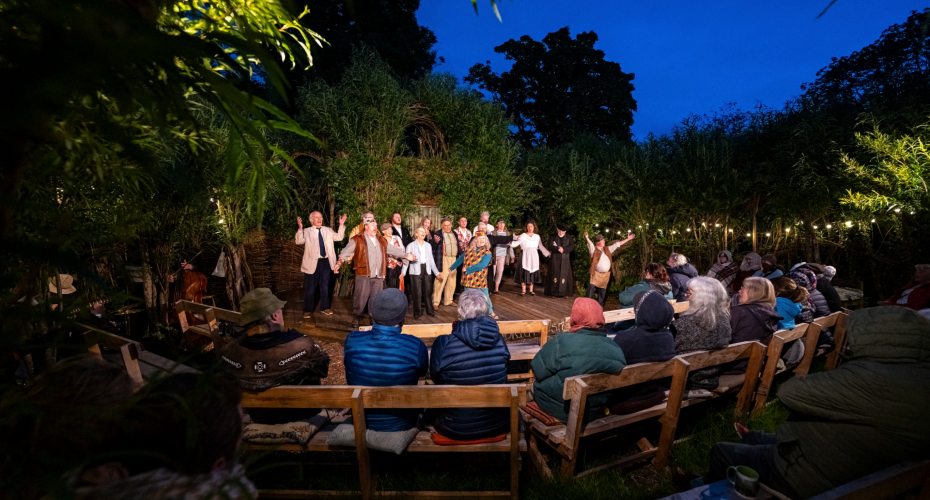
The book draws upon a sustained period of research, particularly since the pandemic, when the co-authors studied how open-air theatre enabled drama and performance to continue with safer social distancing.
Across five sections, including Health, Climate and Community, it features 30 case studies drawn from interviews and interactions with theatre-makers, many of them operating outside of London, most notably in the South West, Wales, Scotland, Northern Ireland and Ireland. They include landscape theatre specialists Wildworks in Cornwall; amateur acting at the Willow Globe in Powys; a team of women mountaineers, dancers and singers working with Simone Kenyon in the Cairngorms; and Suzanne Lacy's live art on the Irish border.
During these discussions, it emerged that several companies had supported, or were actively assisting, local communities, from running foodbanks and supporting asylum seekers to boosting wellbeing through a commitment to joy. Many also reflected real or imagined local histories in their performances.
"There might sometimes be an assumption that open-air theatre is either for picnickers to enjoy some classical fare on a heritage site, or for children to be kept amused on the seafront," says Professor Turner. "It is both these things, but so much more varied and often more subversive than that."
The authors uncovered a wealth of historical detail while researching and writing the book. This included: how the first full-length British plays were written in Cornish; how 'Rule Britannia' was first sung in a Royal garden; and how pageantry informed the Easter Rising in Ireland.
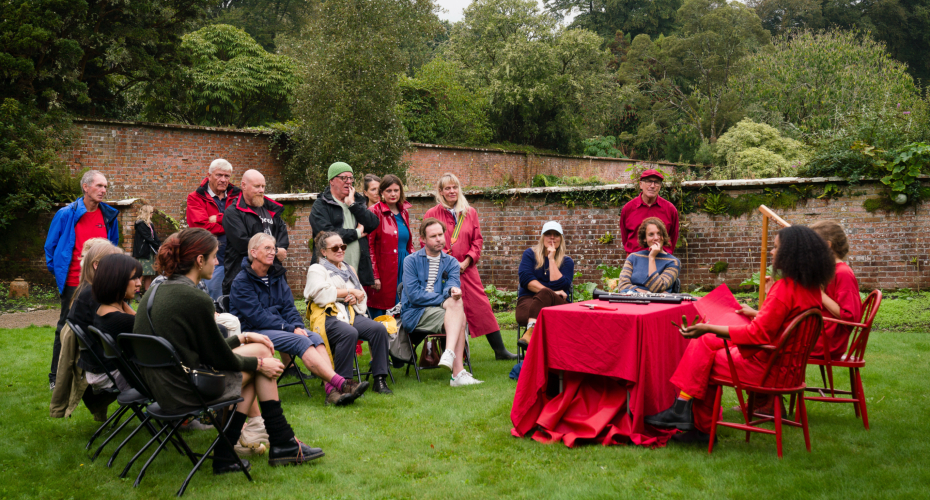
"Like most theatre, open air performance is in desperate need of funding," says Professor Turner. "However, where there are publicly accessible spaces, and where people like to gather, there will be theatre. These people are eminently skilled to support human flourishing in the places they occupy. There's plenty of evidence of that in the book."
Professor O'Malley adds: "We hope that the book will encourage readers to seek out this wider range of outdoor performance practices - across styles and political leanings - and to better understand their significant contribution to culture and society."