
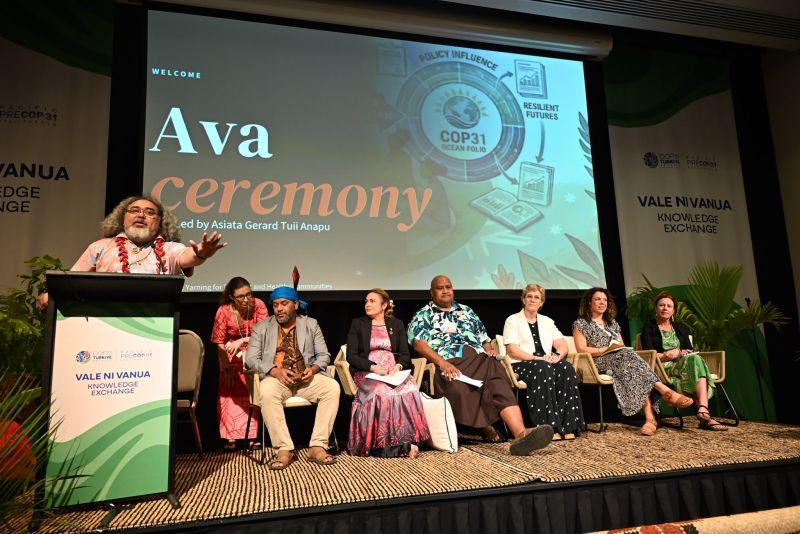
As Australia prepares to lead negotiations at COP31, some of the most important climate conversations ahead of the global summit have taken place in the Pacific, where communities are already living with the impacts of a changing climate.
Leaders, communities, researchers and policymakers met in Fiji and Tuvalu to discuss the issues they believe must remain at the centre of global climate action, from climate ambition and finance to health, resilience and the future of Pacific communities.
Participants highlighted the need to keep the goal of limiting global warming to 1.5°C within reach, accelerate the transition away from fossil fuels, improve access to climate finance and better recognise the impacts of climate change on oceans and coastal communities in international climate negotiations.
University of Melbourne climate law expert Professor Jacqueline Peel said the week had elevated Pacific voices at a critical moment in the lead-up to COP31, including calls for greater recognition of ocean-related issues in climate negotiations.
"The purpose of this pre-COP process has been to hear directly from Pacific nations about the priorities they want reflected in COP31," Professor Peel said.
"The discussions have articulated the issues by which Pacific countries will judge the success of COP31 and Australia's presidency, including keeping 1.5 degrees within reach, access to climate finance, action to transition away from fossil fuels and ensuring the ocean takes its rightful place in climate negotiations."
Professor Kathryn Bowen, Director of Melbourne Climate Futures and a Lead Author for the Intergovernmental Panel on Climate Change's Seventh Assessment Report on Human Health and Wellbeing, said discussions also highlighted the far-reaching impacts that climate change is having on communities across the Pacific.
"We often talk about climate change as an environmental issue, but communities experience it through its impacts on health, wellbeing and livelihoods," Professor Bowen said.
"Whether it's food and water security, mental health, displacement or economic resilience, climate change affects every aspect of community life. Those connections emerged strongly throughout the discussions in Fiji. "
Alongside climate ambition, finance and health, discussions also examined the less visible consequences of climate change.
At the Yarning for Resilience: Amplifying Solutions for Non-Economic Loss and Damage in Oceania event, speakers explored how climate change can affect cultural heritage, identity, community connections and relationships with place.
Former Samoan diplomat and President of the University of Melbourne Pacific Island Student Association, Seve Gerard Tuii Anapu, said those conversations reflected changes he has witnessed in his home community of Sa'anapu.
"Schools were relocated inland because they were too close to the shoreline. Communities have also had to move inland because of sea-level rise and storm surges," Mr Anapu said.
"The signs were always there, but we are becoming more aware because it is happening much faster than we have ever seen before.
"For Pacific communities, climate change is not a theoretical issue. It is a matter of survival."
For University of Melbourne Senior Lecturer and Samoan Matai (high chief) Dr Vili Iese, who holds the chiefly titles Te'o and Lau, one of the defining features of the week was the sense of connection across Pacific communities and partners.
"It is not just participation, it is connection and engagement," Dr Iese said.
"People are connecting and reconnecting, reaffirming their relationships, their commitment and their faith in working together. We listen, we speak, we value, we disagree, we agree and we respect one another's perspectives, stories and wisdom."


