
When soprano Caitlin Vincent, Peab '09 (MM), would get ready to perform an opera, she maintained a strict pre-performance ritual. She slept with a copy of the score under her pillow—to facilitate osmosis, of course—and put on her stage makeup while watching an episode of the BBC sitcom Blackadder the Third. She also ate the same meal: a large bowl of penne pasta with olive oil and Parmesan.
"I was very regimented," Vincent says over Zoom from her home in Melbourne, Australia, where she's lived since 2015. "I had mind games to calm myself down. And if I didn't do it, I was, like—that's it, gonna be a bad show. I didn't watch Blackadder, I'm screwed."
In 2009, around the time the Baltimore Opera Company dissolved in bankruptcy, Vincent recruited 11 singers, pianist Michael Sheppard, Peab '98 (BM), '00 (MM), '03 (GPD), and then-Peabody Opera Music Director JoAnn Kulesza as conductor for a version of The Marriage of Figaro called The Figaro Project. Over the next five years, Vincent was artistic director of The Figaro Project, an independent opera company that produced new works by Doug Buchanan, Peab '08 (MM), '08 (MM), '13 (DMA); Paul Mathews, Peab '98 (DMA); and Joshua Bornfield, Peab, '13 (DMA), '14 (MM); among others.
In 2013, The Figaro Project produced Camelot Requiem, an exploration of the immediate aftermath of President John F. Kennedy's 1963 assassination as experienced by the people closest to him, which was composed by Bornfield with Vincent as librettist—the person who writes the opera's text and story. Vincent has since become an in-demand, award-winning librettist and lyricist—Computing Venus, featuring music by Timothy C. Takach, is being staged January 23–25 at Vassar College; Paw and Tail, a song cycle featuring music by Juliana Hall, is performed March 9 at Missouri State University; and Love Songs from a Third Floor Walk-Up, featuring music by Raphael Fusco, is performed in July at the National Association of Teachers of Singing National Conference—while also earning her PhD and becoming a cultural labor researcher.
Vincent is currently a senior lecturer and Australian Research Council's DECRA Fellow at the University of Melbourne, where she is working on a three-year project to examine career pathways for conductors and stage directors working in opera. She's aiming to put data to some of the challenges facing the contemporary opera industry that she explores in her new book Opera Wars: Inside the World of Opera and the Battles for its Future, published Jan. 13 by Scribner.
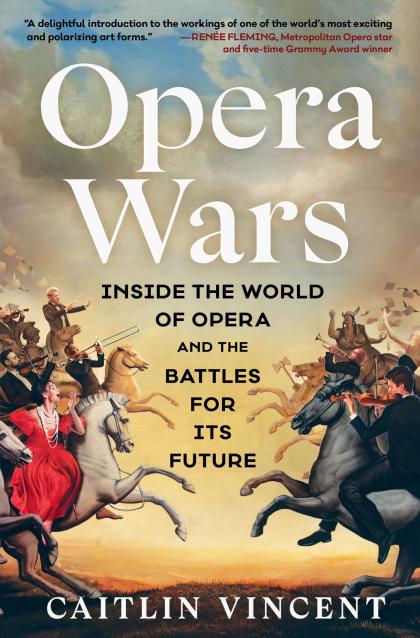
Drawing on her own experiences performing and running a company alongside numerous interviews with singers, directors, and administrators, Opera Wars provides a streamlined synthesis of scholarly opera history to discuss how opera companies are and aren't managing the tightrope walk of staging problematic 19th-century works for 21st-century audiences, making the career path more equitable, and paying for it all. She identifies the "battlefields" where these tensions and conflicts play out—at the level of the score, the stage, the singers, the company, and opera culture at large.
"I wrote this book like a libretto, because it's not academic," Vincent says. "I mean, it is academic, but I hide the academia and the research behind jokes. Each chapter follows a narrative arc and is structured as a scene. And I read it out loud as I was writing, in the same way I do my opera libretti, in terms of hearing the rhythm—which I think makes it more fun to read."
It does: Spending time with Opera Wars is like having a convivial conversation with a loquacious expert whose amusing anecdotes contain quiet wisdom and critique. It's as entertaining as it is educational. "I wanted to write a book about opera that might bring new people in," she says. "What we need is something to make people understand that opera is a fascinating industry that's still very much here. Rumors of its death have been greatly exaggerated—and you probably know more than you think you do from pasta sauce commercials and James Bond movies and more, because it's all around you.
"I also wanted to write something for younger singers, to let them know that there are many career paths for them if they want to work in opera," she continues. "They can be a singer but they don't have to be a singer. We need companies, we need smart administrators, we need people who have vision, we need librettists, we need composers, we need designers and directors and conductors—all of those people.
"And donors," she adds. "We also need donors. If someone wants to become a donor, that would be great!"
Peabody Magazine caught up with Vincent to talk about opera as a job and career, research and the arts, and the many battles of Opera Wars. An excerpt from the conversation follows, and the full interview can be read online at the Peabody Magazine website.
How has being a singer and running an opera company informed your approach to being a librettist?
My experience with The Figaro Project and as a singer definitely shapes the way I write as a librettist. As a singer, I think about the kinds of texts that I wanted to sing—or what is singable and the collaboration with composers. Part of my work with The Figaro Project was working with composers, and that was something that started at Peabody. The first time I ever sang new music—or even knew that a composer could be alive—was at Peabody.
All of those experiences have continued to shape that craft as I've been doing it now for more than a decade. For any new commission, I ask myself, what's going to be emotionally interesting for the performer? What character would they be able to pull out of this? And how can I make this [libretto] easy for the composer to set?
And then, of course, from the business side, practicality: I know that if I write a libretto that has 27 scenes, a chorus of 500, and requires digital projections, it's never going to get staged. All of that informs the kind of art I want to make.
Similarly, how has your experience as a librettist, singer, and administrator informed your pivot to research in 2015?
I didn't even mean to become an academic—I just followed the thread of my interests. I was always really interested in the making of opera and music, working behind the scenes, the collaboration, how singers work together, what it's like being in a rehearsal room—I think what I enjoyed most about being a singer was that part of the process, even more than the performing.
In my research, I really was just following that thread: How do people work together? How do they navigate the industry? What do careers actually look like? What could we do to make it better? What are the issues in the industry that I encountered during my own career and my colleagues are still dealing with?
Some of the work that I did around gender inequality in opera production was recognizing that people have been talking about these issues for years and years but there's no data to show who's actually being hired by companies. So if no one's pulling the data, I thought, how about I collect the data. Then we'll actually know who's being hired, and if we want to, we can try to change things.
Opera Wars takes an approach that opens the book up to a wide range of readers. As an insider, how did you go about deciding, say, for the reader who first heard opera via a Bugs Bunny cartoon what they need to know?
It was a challenge, of course, because I've been singing since I was 14 and I had classical music playing in my house, so I couldn't help but have some assumptions about what terms readers would know. There were some spots where my editor asked me, What's a fach? What's a score? And that was actually incredibly helpful!
I didn't want the book to become an Opera 101 introduction, as opera already has a lot of issues with seeming elite, snobby, like you have to do research in order to appreciate it—and that excludes so many people who I think would really enjoy opera. It was important to me that I didn't do that with this book and that no one felt like they needed to have the Grove Dictionary of Music on hand while reading. So to bring everyone in, where necessary I have as an aside, "by the way, here's what an aria is—now you're up to date, now let's keep going."
Now that you know so much more about opera than you probably did when you started at 14, would you have still decided to pursue this career?
When you're training, you think it's the only thing—I'm going to be an opera singer, full stop. And the chapter where I talk about giving up singing was probably the most personal and something I didn't want to talk about for a long time. It was something that I hadn't really dealt with and that I didn't realize I hadn't dealt with until I was writing that chapter, and being like, OK, this was the better path for me.
When you're training you don't know what it's going to be like to work in the industry. You don't know what the pressures are on the companies, what the interpersonal dynamics are, all these other things that are informing the kinds of opportunities you get and who's being hired. I think knowing that is important for singers so they don't take it personally if they don't "make it," the way that they told themselves was the only path.
You just don't know. You only think about the singing and the flowers you get afterward.
I performed professionally for 10 years—people paid me to sing, but I was never able to pay rent with it, and I never sang at the Met. So, you know, is that a failure? Or did it just inform what I'm doing now?
A decade into your career as a researcher, do you have any ideas where you think opera is headed?
I think the biggest pressure point is still these historical works that have ethnic exoticism in them—Madame Butterfly, Aida, Turandot—and the ones that have really overt gender-based violence, like Carmen and Tosca.
We've seen these works over and over again and we're just at the point in social discourse—especially in America and Australia and the U.K.—where they simply cannot be performed without commentary.
It's very difficult to do Madame Butterfly without some people pointing out that the only traditional Japanese melody in there is a song about eggplants. This work was not a thoughtful composition. It's cultural appropriation and in many ways a racist portrayal, full stop. And that is where it's just becoming such an increasing risk for companies and they don't know what to do.
I think we're going to see continued discussions about that, and I think we might see companies start moving away from some of those works. They're just not going to do them.
Of course, with Butterfly in particular, in the interviews with singers I was doing, one of the singers said, "If you cancel Butterfly it actually hurts our employment opportunities because that's the only thing we're being hired for. So maybe don't cancel Butterfly, hire us for other things as well."
But I have to say, I'm a librettist, and I would like the industry to be moving more toward new opera. It should not be 90% canon and 10% new work that's in the black box theater on the side. The only way we're going to build the next canon is if we actually produce a bunch of works. Some of them are going to be mediocre. Some of them are going to be good. And some of them are going to be amazing. But you have to keep generating the product in order to evolve the art form.
The challenge is finding the money for that. It's very difficult to find money for new works, especially right now. But I'm just going to keep writing operas. And hopefully I will convince people to buy tickets to see contemporary operas, because they'll read my book and say, Maybe it's not going to hurt me. Maybe it'll make me think about the world in a different way.


