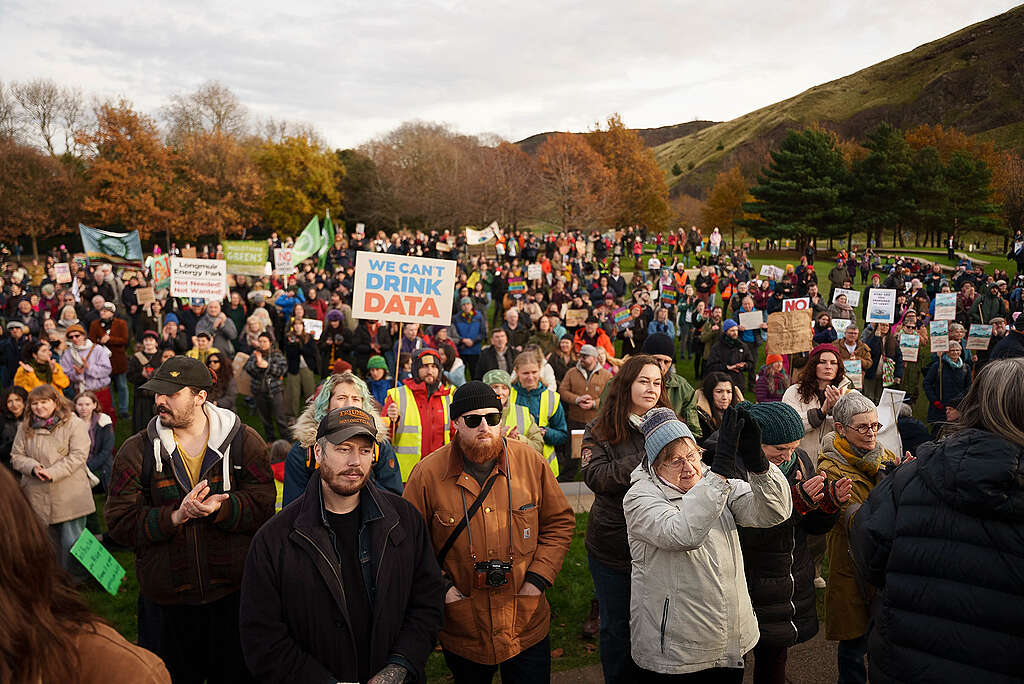
- Data centres are expanding into neighbourhoods, farmland and industrial sites around the world, bringing demands for electricity, water and land.
- Communities are asking who benefits, who pays and why they should bear the costs of Big Tech's expansion. Some are already securing restrictions on where these facilities can be built.
- The scale is already vast. Industry directory Data Center Map lists more than 12,000 data centres across 179 countries and territories, with 4,767 in the US alone. These facilities range from smaller sites to sprawling hyperscale developments.
Remember when alleys used to be famous for their prevailing blue colour, or their cobblestoned paths. Now there is 'Data Centre Alley', in Loudoun County, Virginia, USA, infamous for the incessant hum of nearly 200 data centres.
The mere existence of this moniker shows where we're at with data centres and Big Tech expansion, but let's dive deeper into the problem with data centres and why, around the world, resistance is growing against them.
Through public meetings, petitions, planning objections and legal challenges, people are refusing to treat the future of their communities as a decision for tech companies alone.
What are data centres, and how does AI use them?
Not all data centres are dedicated to AI, but AI's rapid expansion is driving demand for new infrastructure.
At the largest end of this infrastructure, power is concentrated in very few hands. Synergy Research Group reported in August 2026 that Amazon, Microsoft and Google together accounted for 57% of worldwide hyperscale data centre capacity. These are the large-scale facilities underpinning major cloud and internet services. Three corporations dominate this segment of the infrastructure, while communities are left to scrutinise its local costs.
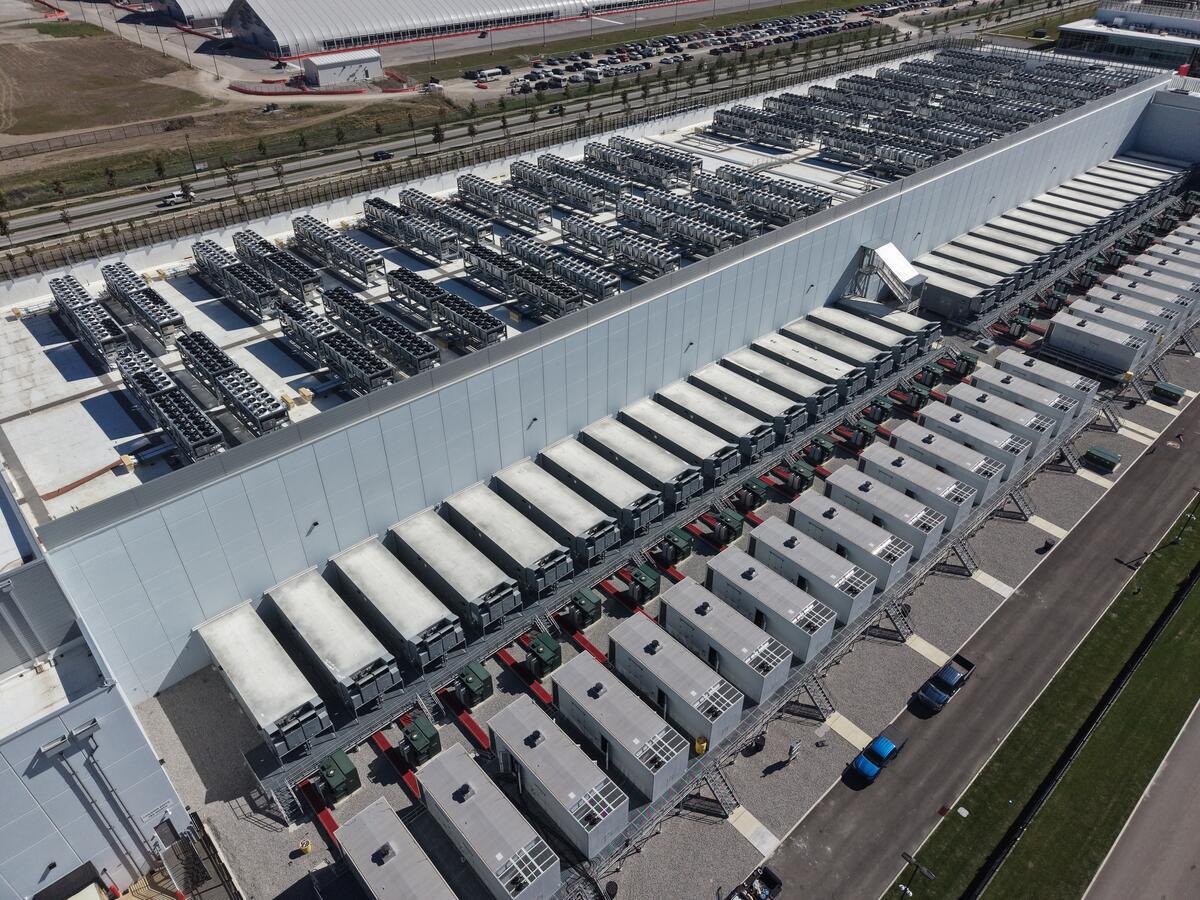
Data centres house computer servers and equipment used for data storage and processing, cloud computing, generative AI and streaming services. Their growth is being driven in part by the rapid expansion of AI tools such as ChatGPT, Claude and Google Gemini.
AI models are trained and run using computers in data centres. AI-focused facilities use specialised chips to perform large numbers of calculations, creating demand for electricity and cooling.
The impacts extend beyond the facilities themselves. Chips, equipment and buildings have to be manufactured. Greenpeace East Asia's analysis of Nvidia's disclosures found that the company's reported indirect emissions nearly tripled between its 2024 and 2026 financial years, largely because of emissions associated with producing components and manufacturing its systems.
The infrastructure behind AI reaches far beyond a chatbot's screen. Its costs are felt in manufacturing regions, electricity systems and the communities where data centres are built.
Where, why and how people are resisting AI and data centres
Around the world, communities are challenging data centre projects over noise pollution, pressure on water supplies, strain on electricity grids and the loss or compulsory acquisition of land. Opposition has been growing across the political spectrum in the US. A Gallup survey conducted in March 2026 found that 71% of US adults opposed the construction of AI data centres in their local area.
Data Center Watch reported that at least 75 US data centre projects were blocked or delayed by local opposition in the first quarter of 2026, the largest single-quarter total in its records. Communities are organising and attending public meetings to challenge proposals before decisions are made.
The resistance has reached Europe. In France, La Tribune reported in November that more than thirty data centre projects faced legal challenges or local opposition over concerns including land use, electricity demand and noise. In Étrechet, the mayor and four other elected officials resigned in September in protest against Google's proposed campus.
Opposition has also secured tangible results. In July, the Grenoble administrative court suspended the building permit for Sesterce's proposed AI data centre at Alixan, pending further proceedings. French collectives also joined coordinated European protests on 6-7 November, demanding a moratorium on mega data centres and democratic debate over digital development.
More than 9,000 people have signed a petition backed by organisations including Data for Good, Greenpeace France and Attac France, calling for an immediate moratorium on new mega data centre approvals and meaningful public participation in decisions about AI and its infrastructure.
In India, Rest of World reported in April 2026 that farmers were opposing Google and Microsoft data centre projects and said they were being pressured to give up land. The investigation also described concerns about opaque land acquisition. Microsoft denied allegations of encroachment and improper waste disposal, while Google did not respond to the publication's questions.
In the Netherlands, WIRED reported in 2023 that farmers and local politicians were challenging Microsoft's expansion over the use of farmland and disputed nitrogen permits. Microsoft said it had permission to continue construction while awaiting a final permit. Local opposition also helped bring down Meta's proposed campus in Zeewolde.
In the UK, thousands of people signed a petition opposing plans for a data centre at a business park on the outskirts of Reading. In August 2025, Tucson city council in Arizona voted to shelve a 290-acre proposal, approximately 117 hectares, following objections from residents.
In the USA, Microsoft withdrew plans in Caledonia, Wisconsin, following vocal opposition. CNBC reported that 40 of the 49 people who spoke at a September 2025 meeting opposed the proposal. "Why do we have to subsidize a company making billions of dollars a year?" resident Mike Kirchner asked. Microsoft subsequently said: "Based on the community feedback we heard, we have chosen not to move forward with this site."
Resistance has also produced preventive restrictions. In February 2026, New Brunswick city council in New Jersey removed data centres from the permitted uses for a redevelopment site following public opposition. No specific data centre had yet been proposed, so the decision restricted future development rather than cancelling an approved project.

Not every challenge succeeds. In Ireland, South Dublin County Council refused Google's proposed Grange Castle expansion in August 2024 over concerns including electricity grid capacity and the lack of significant on-site renewable energy. In September 2026, the national planning body overturned that refusal and granted permission subject to conditions.
Some US lawmakers have considered moratoriums, or temporary pauses, on large new data centres. In July 2026, in a first of its kind, the governor of New York signed an executive order to create the nation's first moratorium on new hyperscale data centers. In states including Florida, Michigan, Missouri and Texas, residents have launched campaigns to remove elected officials over their handling of data centre proposals.
Resistance takes creative forms too. In January 2026, volunteers in Quilicura, in a water-stressed region of Chile, answered questions that would otherwise have gone to an AI chatbot.
These examples show that the build-out is not beyond public challenge. People can organise, demand evidence and force decisions back into the open.
What is the local impact of living near a data centre?
AI tools like ChatGPT feel effortless, replying to questions and conjuring information seamlessly as if from thin air but the infrastructure behind them is power-hungry and the impacts on local people and the environment can't be ignored.
Households are dealing with rising electricity bills. Those increases have several causes, but the World Resources Institute reports evidence that infrastructure needed for data centres has contributed to higher costs in the US Mid-Atlantic region. Other regions could face similar pressures.
Communities are also concerned about water supplies. Residents near an overdrawn aquifer in South Carolina have sought limits on data centre groundwater withdrawals, while others are requesting greater oversight of local water impacts.
Land and public scrutiny
In Aragón, Spain, data centres approved under the PIGA (Project of General Interest of Aragon) process receive fast-track planning, land expropriation support, and tax breaks. However, after Spain's national government approved stricter energy and environmental rules for grid access on November 20, 2026, Aragón announced a legal challenge, warning it threatens investment. Meanwhile, right-wing parties pledged to repeal the decree, pass protective regulations, and launch an emergency grid investment plan if elected.
For one Amazon development, the public had 23 days to review about 25,000 pages of documentation and submit objections. Researcher Manuel García described the task as "physiologically impossible". The regional government said streamlining did not remove requirements, while Amazon said the process maintained compliance with applicable regulations.
A consultation is a tick-box exercise if people have no realistic chance to scrutinise or challenge what is being proposed. Communities must have a real say in data centre projects affecting their land, livelihoods and public resources.
Local restrictions can also trigger expensive legal battles. In August 2026, the New Jersey Monitor reported that developers had sued Montgomery, Andover and Monroe over data centre prohibitions. Developers sought $300m in damages in both the Montgomery and Monroe cases, arguing that the decisions were unlawful or improperly adopted. Those allegations remain matters for the courts.
Communities need resources and legal protections to fight back. Without them, developers can use the threat of costly lawsuits to silence opposition and push projects through.
Pax Silica: Resisting the land grab
In the Philippines, farmers and Indigenous Peoples are resisting a US-led initiative to build a 1,620-hectare technology and semiconductor hub as part of a bid to secure critical minerals and AI technology supply chains. Filipino activists have denounced the Pax Silica proposals for a water-thirsty and energy-hungry facility as an international land and resource grab to feed US AI ambitions.
Local communities and environmental advocates say the proposed Pax Silica development threatens to increase pressure on vulnerable ecosystems, affecting access to agricultural and ancestral land and endangering livelihoods at a time when farmers are already suffering from droughts, dry spells, extreme heat, and mounting production costs - and the country is bracing for impacts of another Super El Niño.
Gloria Capiz-Estabillo, 76, an elder of the Aeta Hungey Indigenous People, told Mongabay in Filipino, "They're setting up right in the middle of our land. Where are we going to live? How about our crops? Where will they take us, just drop us in the ocean? They'll have to kill us to take us off this land."
Protests calling for a halt to the Pax Silica initiative peaked in November ahead of the 49th ASEAN Summit and a visit to Manila by US president Donald Trump. Women and students led demonstrations in the Philippine capital urging their government to reject the Pax Silica project and US military agreements. No deal was signed during Trump's visit. Activists continue to push for full cancellation of the proposed project.
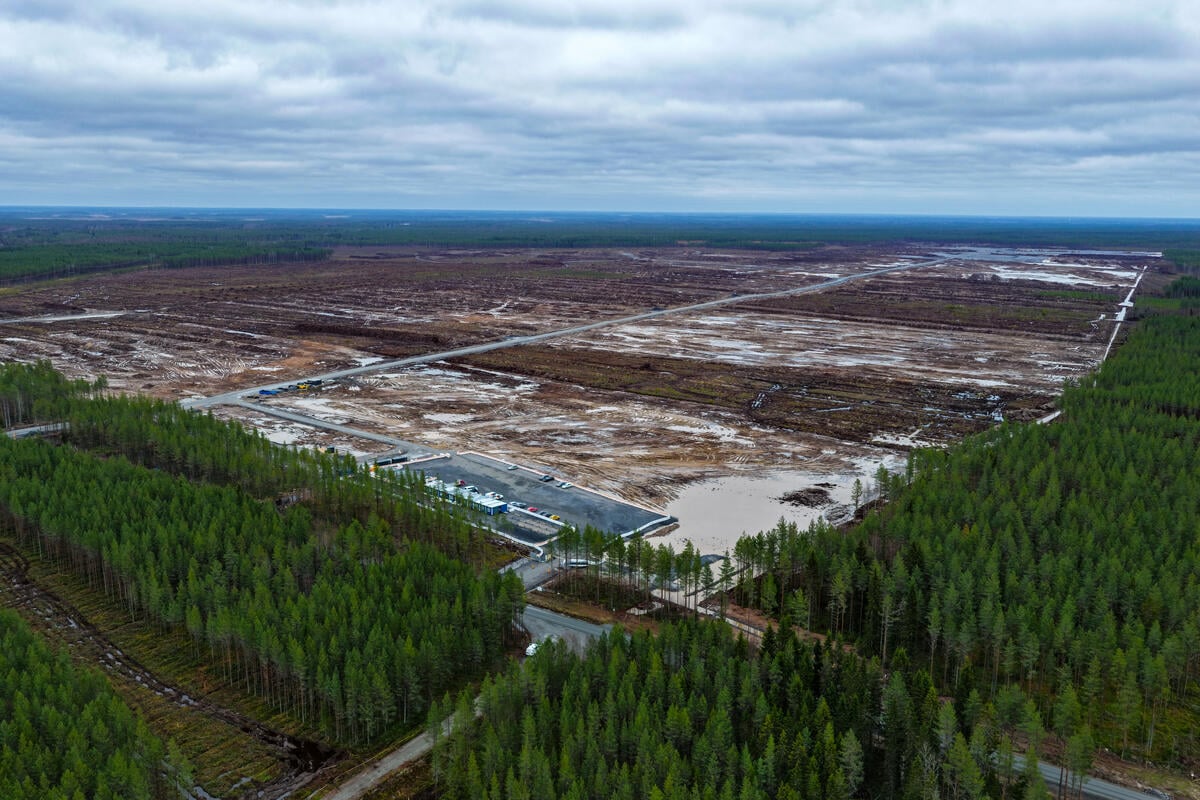
Pollution from power generation
Many data centres depend on gas-fired electricity, while some operate gas turbines on-site for routine power generation. Diesel generators provide emergency backup. Both sources produce air pollution and greenhouse gas emissions.
In the USA, Memphis, Tennessee, residents and the NAACP (National Association for the Advancement of Colored People) issued a notice of intent to sue under the Clean Air Act over xAI's (SpaceX's AI division) gas turbines. The NAACP alleged that the turbines were operating without required permits and posed public health risks. Its lawyers at the Southern Environmental Law Center described the surrounding predominantly Black neighbourhoods as communities already burdened by industrial pollution, high asthma rates and longstanding environmental injustice. In October 2026, SpaceX lost its bid to dismiss NAACP's lawsuit.
Noise pollution
Cooling equipment and generators can create persistent noise. For neighbours, the problem can be a continuous hum through the day and night. WRI reports that smaller diesel generators can reach 85 decibels and larger industrial units can approach 100 decibels, comparable to a motorcycle or jackhammer.
In the USA, in Loudoun County, the concentration of facilities has earned the area the nickname "Data Centre Alley". The BBC reported in October 2025 that the county had 199 data centres, describing their background hum and residents' concerns about noise and rising electricity bills. Resident Emily Kasabian said: "I would not have bought this house if I had known what was going on across the street."
 (@greenpeace)
According to the Environmental and Energy Study Institute, residents in Prince William County, Virginia, have complained of data centre noise exceeding 60 decibels. Amazon has fitted some facilities with acoustic shrouds to reduce noise.
In Chandler, Arizona, years of complaints about a constant hum helped prompt stricter siting rules in 2022. In 2025, the city council rejected another proposed data centre, with noise concerns playing a significant role in opposition. The institute also reports complaints about noise from gas-powered turbines at an xAI facility in Southaven, Mississippi.
Neighbours live with the noise. Equipment passing tests inside the site is no guarantee that people outside can sleep.
Environmental impact of data centres
Damaging emissions from data centres are increasing despite net zero pledges and climate promises by big tech companies
Big Tech's climate commitments must be judged against its actual footprint. More efficient chips do not guarantee lower total electricity use when companies keep selling more of them and expanding the systems they power.
According to a recent briefing on Nvidia from analyst and lead author Ketan Joshi and a consortium of civil society groups, including Greenpeace International, Beyond Fossil Fuels, Friends of the Earth, Green Screen Coalition, Stand.Earth, Kairos Fellowship, and Climate Action Against Disinformation, Nvidia's disclosed indirect emissions, largely from manufacturing, had risen 725% since 2020. The briefing also estimated substantial emissions from the use of sold chips that the company does not disclose as an absolute total. Those downstream figures are estimates, not measured disclosures.
Greenpeace East Asia's research found that only about a quarter of the electricity used by Nvidia's leading East Asian suppliers came from renewable energy. The environmental burden of the AI boom therefore reaches into the manufacturing hubs producing its hardware.
The problem extends beyond Nvidia. Reporting on the latest disclosures from Microsoft, Amazon and Google describes rising company-wide emissions as AI infrastructure expands.
In the EU, a Guardian investigation reported that Microsoft and industry groups lobbied to restrict public access to environmental information about data centres.
Public access to that information matters. Communities cannot properly scrutinise facilities' electricity use, water demand and emissions if the evidence is kept from them.
How much electricity do data centres consume, and do they strain the power grid?
The International Energy Agency estimates that data centres used 485 terawatt hours of electricity in 2025. Its central projection sees demand roughly doubling to 950 terawatt hours by 2030, accounting for around 3% of global electricity demand. Electricity use by AI-focused data centres is projected to triple over the same period.
An industry estimate from IDCA puts data centres' share of electricity consumption at 6% in the US and 5.8% in the UK, illustrating how demand can be concentrated in major hosting countries.
Using a separate estimate of 448 TWh for 2025, United Nations University researchers calculated that data centres would rank as the world's 11th-largest electricity consumer if treated as a country.
Data centre expansion can increase electricity bills when utilities pass the costs of additional supply and infrastructure on to households and businesses. The impact depends on local conditions and how regulators allocate costs. Communities should not be made to subsidise infrastructure built to serve Big Tech.
Data centres' greenhouse gas emissions
Growing electricity demand can increase emissions where it is met with fossil fuels. In the US, authorities have approved new gas-fired generation intended to supply data centres. Reports also describe delays to the retirement of fossil-fuel power plants.
Frontier Group identified at least 17 fossil-fuel generating units at seven power plants, totalling 9,100 megawatts, whose retirement had been delayed or was at risk of delay because of rising electricity demand. Data centres were named as a key concern in many cases. The finding shows how anticipated computing demand can prolong fossil-fuel dependence.
In Germany, a study by the Öko-Institut for Greenpeace Germany examined electricity sources at around 6,700 data centres worldwide and assessed their emissions using local electricity mixes. It underlines why the location and source of power matter, rather than just companies' global renewable energy claims.
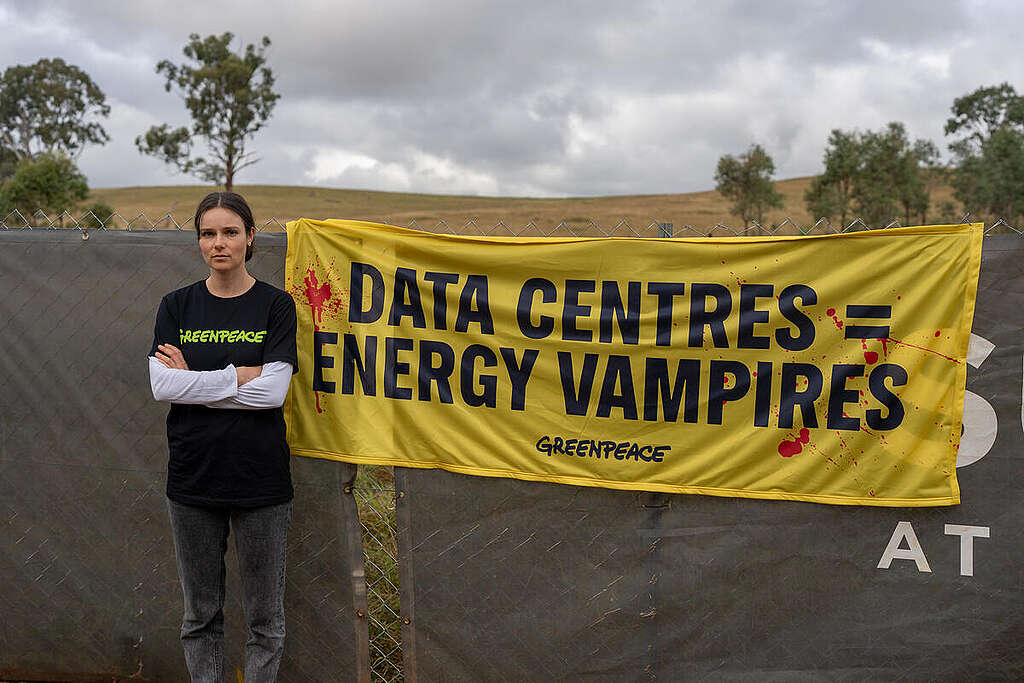
In Australia, Greenpeace Australia Pacific's "Energy vampires: the AI data centres draining Australia" warns that unchecked development risks entrenching gas and undermining the renewable energy transition. The report found that none of the operators it analysed adequately demonstrated claims that they were driving additional renewable energy growth. Its modelling estimated that the proposed Mamre Road campus's peak annual grid emissions would be equivalent to those of 560,000 petrol cars.
How much water do data centres use?
Some large data centres can use up to approximately 19 million litres of water a day, equivalent to the daily use of a town of 10,000 to 50,000 people, according to the Environmental and Energy Study Institute. A recent Greenpeace Germany report has shown that data centers for cloud and AI applications in Germany consumed around 13 billion litres of water for cooling last year. This is the equivalent of the amount of drinking water needed for a city with 275,000 inhabitants.
In India, more than half of data centres are in water-stressed regions. In South Africa, which has the most data centres on the continent (owned predominantly by American companies like Microsoft, Amazon, Google, Equinix and Digital Realty), civil rights groups are protesting their expansion. At the center of the protest is California-based Equinix, one of the world's largest data centre operators. The grassroots groups say Equinix's data centres would compete with residents for already-scarce resources, water and electricity.
In fact, Equinix had proposed two data centres in Cape Town, a city which was in the grip of a catastrophic three-year-long drought by 2018, when the city was close to "Day Zero" (the day in which all taps would require to be shut off and citizens would have to queue for a ration of 25 litres per person per day. Since then, residents have been rallying together and pushing the companies behind these data centres to disclose how much water and electricity their proposed data centres would use.
In Batam, Indonesia, an island that routinely faces water shortages, more than 300 locals protested at a data centres compound, holding up empty plastic bottles and jerry cans, to express their concerns about water shortages and having to compete with servers for water.
Google's data centre operations in The Dalles, Oregon, USA used approximately 1.34 billion litres of water in 2021, according to reporting cited by CNET. Meta's data centres withdrew approximately 5.3 billion litres worldwide in 2023. CNET reported that just under half was permanently removed from local water sources.
Withdrawal means water taken from a source. Consumption means water not returned for immediate local reuse. The distinction matters, but both require scrutiny where communities already face shortages.
The concern is where that water comes from and whose needs take priority. Building in water-stressed regions can add pressure to supplies that people and ecosystems already depend on.
Do data centres actually bring local jobs?
Promises of jobs are often used to justify data centre development. But the gap between temporary construction work and permanent employment is one reason communities resist: residents question whether a relatively small number of lasting jobs justifies the demands on their land, electricity and water.
Construction can employ hundreds or thousands of workers. Once a facility is built, however, staffing needs fall sharply. A Brookings analysis published in February 2026 found that the standard development model had delivered mostly short-term construction jobs and relatively little long-term, large-scale employment.
Temporary construction jobs cannot be used as a blank cheque for decades of resource demand. The people living with those demands have every right to challenge the bargain.
Beyond data centre resistance: AI surveillance
The debate is also about what data centres enable. Cloud services provide the storage and computing infrastructure behind surveillance systems, allowing information collected by cameras to be retained, searched and shared.
Flock Safety is one example. Its cameras use machine learning, a form of AI, to recognise number plates and identify vehicle characteristics such as make, model and colour. According to the company's own documentation, it stores images and metadata using Amazon Web Services. The camera on the street is one part of a wider system of data collection and cloud storage.
People are challenging Flock's camera networks because searchable records of vehicle sightings can reveal where people have travelled. Residents are concerned about privacy, access to records and the limits placed on police use. More and more people are fighting back against this technology in both legal and illegal ways. According to DeFlock, an advocacy group that tracks these cameras, more than 100 cities have deactivated the cameras or canceled their contracts with Flock or similar companies.
A recent report titled "The Tech Behind ICE: Oligarchs, Immigration Enforcement and the Threat to Democracy" published by immigration rights organisation Mijente, legal advocates Just Futures Law and the Surveillance Resistance Lab (a research group), revealed new details about how spending on technology and AI tools to find and track migrants has soared to record levels during Donald Trump's second term, shedding light on the unprecedented growth of the US government's immigration surveillance arsenal under Trump 2.0 and the human rights concerns surrounding it. The report notes this new growth is primarily driven by new contracts for Palantir (an important enabler of ICE's enforcement operations), as well as Anduril, a defence company.
Automated killing machines: AI for war and genocide
The use of AI in military targeting raises further questions about what this infrastructure enables and who bears responsibility for its consequences.
In March 2026, the Washington Post reported that the US military used AI tools incorporating Anthropic's Claude to support its campaign in Iran, during which it struck more than 1,000 targets in the first 24 hours. The reporting described AI identifying and prioritising potential targets.
The Lemkin Institute for Genocide Prevention and Human Security has warned that accelerating military targeting through AI risks reducing meaningful human scrutiny and mechanising mass atrocities. Its warning concerns the danger of people approving machine-generated outputs without thoroughly examining their basis and consequences.
In the early stages of the Israeli government's genocidal campaign in Gaza, an investigation by +972 Magazine and Local Call, based on accounts from six Israeli intelligence officers, reported extensive reliance on automated targeting systems. Lavender marked people as suspected militants, The Gospel identified buildings, and Where's Daddy tracked selected individuals to their family homes.
According to the investigation, Lavender marked as many as 37,000 Palestinians as suspected militants during the early weeks after 7 October 2023. Sources described an approximately 10% error rate. One officer said human personnel often acted as a "rubber stamp", spending around 20 seconds reviewing a target, largely to check that the selected person was male.
The same investigation also reported that suspected militants were deliberately targeted at home, where relatives could be present. An intelligence officer told the journalists: "It's much easier to bomb a family's home. The system is built to look for them in these situations."
Governments, military commanders and companies developing these systems must be held accountable. An algorithm cannot carry responsibility for the people killed by decisions made using its outputs. UN talks in November 2026 ended with a further two years to discuss possible rules on lethal autonomous weapons (often called "killer robots") with no guarantee those rules will be legally binding.
The global backlash against Big Tech's reckless expansion and unchecked power is growing
The people are rising and resisting. The data centre and AI boom may be immense, but so is the backlash. Communities are organising and refusing to sacrifice their health, environment and rights to unchecked corporate expansion.
That resistance deserves political backing. Governments must give people a meaningful say in decisions affecting their land, water and electricity bills, and stop treating every proposed facility as a public benefit.
Together with allies across climate, legal and digital rights movements, Greenpeace is calling for an immediate halt to approvals for new mega data centres until robust, legally binding social and environmental safeguards are written into national law.
These safeguards must:
- Protect a just transition away from fossil fuels.
- Require 100% new renewable energy without disrupting electricity grids or increasing household electricity bills.
- Put the needs of people and nature first in decisions about water and critical minerals.
- Set strict, enforceable environmental standards.
- Ensure the data and AI applications these facilities enable do no harm.
A pause would create space for democratic decisions before more resources are committed and more infrastructure locks communities into fossil-fuel dependence.
Technology should serve the public good. Sign the petition to demand a halt to unchecked mega data centre expansion.

Demand an immediate freeze on Big Tech's mega data centres. Protect our water, climate, and communities.