
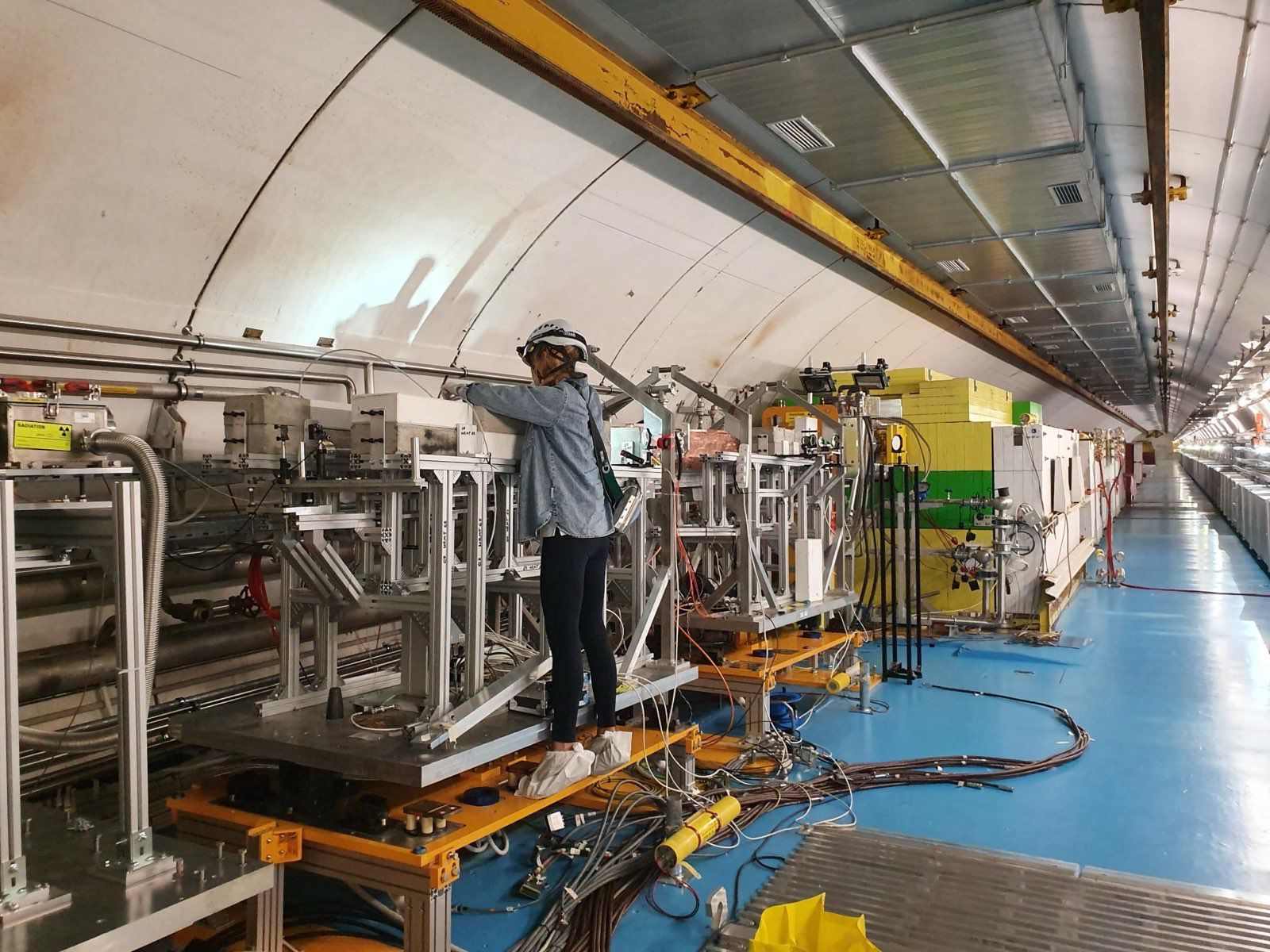
Installation of an experiment testing asteroid material at CERN's HiRadMat facility. (Photo: Karl-Georg Schlesinger)
Millions of asteroids orbit the Sun, most of them unnoticed. Far more rarely, larger objects cause serious damage on the ground, as was seen in the Tunguska explosion in 1908 and in the Chelyabinsk airburst more than a century later. Impacts with global consequences are extremely unlikely, but their potential severity means that they remain a scientifically relevant risk.
If an asteroid were to be discovered on a collision course with Earth and the warning time were short, the options available would be limited. Among the most controversial last-resort strategies is nuclear deflection, an approach that not only raises political and ethical questions but is also subject to a scientific unknown: how does asteroid material respond to an extreme and sudden deposition of energy?
This question is difficult to answer because it cannot be tested at full scale. Asteroids vary widely in composition and internal structure, and direct observations offer only partial clues. Laboratory experiments, meanwhile, struggle to reproduce the relevant pressures and timescales. This is where accelerator facilities can provide a rare experimental bridge between theory and reality.
In the latest issue of the CERN Courier, scientists report on experiments carried out at CERN's HiRadMat facility, where high-energy proton beams from the Super Proton Synchrotron were used to probe meteorite material under conditions relevant to planetary-defence scenarios. The work addresses the fundamental challenge of obtaining reliable material-response data in a domain where models often outpace measurements.
The experiments reveal behaviours that current assumptions may not fully capture, raising important questions about fragmentation, strength and energy coupling under extreme loading . The results highlight how much remains uncertain and why reducing that uncertainty matters for informed decision -making.
These accelerator-based studies complement a growing body of evidence from space missions, which has shown that asteroids range from loosely bound aggregates to more cohesive bodies. Future rare events, including the close flyby of near-Earth asteroid Apophis in 2029, will provide opportunities to observe how large objects respond to natural stresses. Together, laboratory experiments and space-based measurements are beginning to fill critical gaps in our understanding.
Learn more about this intriguing study in the January/February edition of the CERN Courier.


