
Frequently getting lost, even on the way to the supermarket in your own neighbourhood. It happens to a significant proportion of the population. What is going on in these people's brains? Neuroscientist Judith Schomaker has been awarded an NWO XS grant to investigate.
Researchers first used the term Developmental Topographical Disorientation, or DTD, in 2009 to describe a condition in which healthy people, with no brain injury, regularly get lost. It is therefore a relatively new phenomenon in psychology. 'Of course, there were people who had difficulty finding their way before then too,' says neuropsychologist Judith Schomaker. 'But there is a stigma attached to not being able to find your way around. People are often embarrassed by it and adapt their lives accordingly, which means the condition can go unnoticed. For example, imagine you're at a festival and you and your friends agree on a fixed meeting point. Some people may not dare to admit that they can no longer find their way back there. Instead, they always walk with a friend to hide the problem.'
''There is a stigma attached to getting lost'
Losing your way
According to various studies, between 3 and 25% of the population may have DTD. That is quite a broad range. 'At the moment, there is little consensus within the field about when someone should be considered to have DTD,' Schomaker explains. 'Perhaps that is because different criteria and questionnaires are being used.' To define the condition more precisely, Schomaker and her colleague Ineke van der Ham recently introduced the term 'Atopia'. 'We use that term to describe the group of people who get lost because they are probably unable to create a cognitive map of their surroundings. If, for example, you imagine walking to the playground with your children, you cannot form a mental representation of how you move through the space.' They have also launched the online platform De Weg Kwijt for this group, where people can share their experiences and take part in scientific research.
Cognitive map
At present, it is still unclear which factors play a role in forming a mental map: attention, working memory, or perhaps something else. Schomaker has therefore received an NWO XS grant, together with colleagues Ineke van der Ham and Dietsje Jolles, to investigate the cognitive processes underlying this ability. 'We are going to compare people with DTD and Atopia with a control group of people who do not experience problems with getting lost. We will ask these groups to complete various navigation tasks while they are in a brain scanner. We will then examine how a cognitive map of an environment you have never seen before is formed. What happens in the brain as a cognitive map gradually develops? And what are the individual differences between people who are good at this and those who are less good at it?'
'Research strongly suggests that navigational ability can be trained'
Navigation can be learnt
With this research, Schomaker hopes to lay the groundwork for developing better practical navigation training. Because, she stresses, in many cases people can learn to navigate better. 'Taxi drivers in London have to memorise 30,000 streets and hundreds of routes to pass their exam,' she says. 'Previous research involving these drivers has shown that their hippocampus has grown, which strongly suggests that navigational ability can be trained.' Practising this is becoming more difficult now that we increasingly navigate 'passively' using Google Maps or TomTom. But Schomaker also sees opportunities in modern technology. 'My children play games in which you have to navigate large 3D environments using a mini-map on the screen. It may well be that activities like these can help train your navigation skills too.'
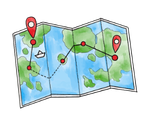
Do you often get lost?
Do you regularly get lost too, and would you like to understand better why this happens and how you can improve your ability to find your way? Take a look at De Weg Kwijt, where you can share experiences on the forum and learn more about the science of navigation. You can also sign up to take part in scientific research. On 21, 22 and 23 August, the research team will be at Lowlands, where they will use the Space Maze to investigate how people form a mental map of their surroundings.


