
Cats recorded stalking a bilby burrow
Stills and some gifs here: https://dams.wwf.org.au/resourcespace?c=6645&k=70803d8cfd
Karajarri Rangers were both delighted and concerned after conducting the first camera survey of Malupirti - the place of many springs - in Western Australia's Great Sandy Desert.
They were excited bilbies were surviving at this important freshwater place but disturbed that cats were waiting outside burrows ready to pounce. Concerningly, foxes were also recorded in the survey.
These two feral pests are a major cause of the dramatic decline of bilbies. Once found across three quarters of Australia, bilbies have contracted to 20% of their former range.
Old records held by the Karajarri Traditional Lands Association indicated there were bilbies and spectacled hare-wallabies at Malupirti. Rangers wanted to know if these species persisted and what else was there.
From 28 April to 2 May last year, Karajarri Rangers set up 41 camera sites around Malupirti - also known as Munro Springs - and the surrounding dunes.
They were joined by Pius Gregory, a Karajarri/Yawuru Traditional Owner and Biocultural Conservation Specialist and conservation officer Nick Weigner - both from the World Wide Fund for Nature-Australia.
In August, Rangers retrieved the cameras and used AI to help speed up the examination of 220,000 images.
Bilbies were detected at four of the camera sites. Spectacled hare-wallabies construct shelters to hide in during the day. While the species was not picked up by the cameras, one of the shelters was found at Malupirti.
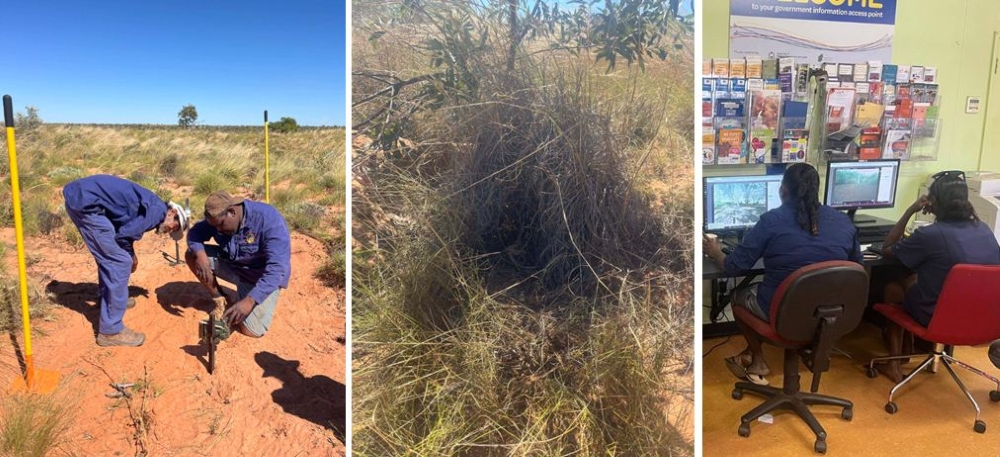
Pius Gregory and Ranger Julian Nagomara set up a camera; a spectacled hare-wallaby shelter; Karajarri Rangers Hayley Mulardy and Janelle Munro examining images © Karajarri Rangers
The cameras confirmed the springs are a biodiversity hotspot drawing in native species from the surrounding desert, including 21 bird species, six mammal species, and at least six reptile species.
But non-native species are a major concern at Malupirti with cats detected at 32 camera sites, foxes detected at 19 sites, cattle detected at 17 sites, and camels detected at 9 sites.
Camels break through fences erected to try to protect the springs and trample the delicate ecosystem.
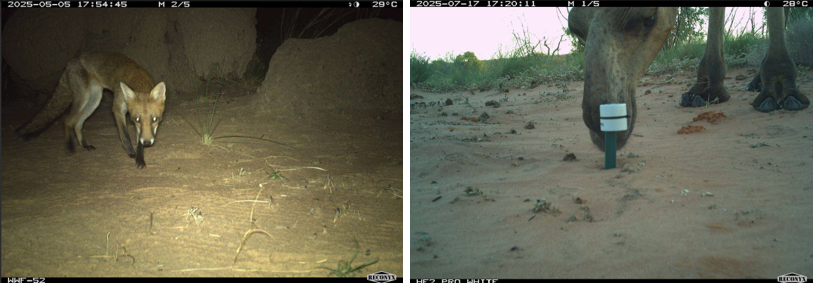
The Rangers loved seeing a bilby mother and her joey emerge from their burrow but were dismayed at the sight of two different feral cats stalking the entrance.
Bilbies can use up to a dozen different burrows and it's believed they were not at home when the cats were waiting, poised to attack.
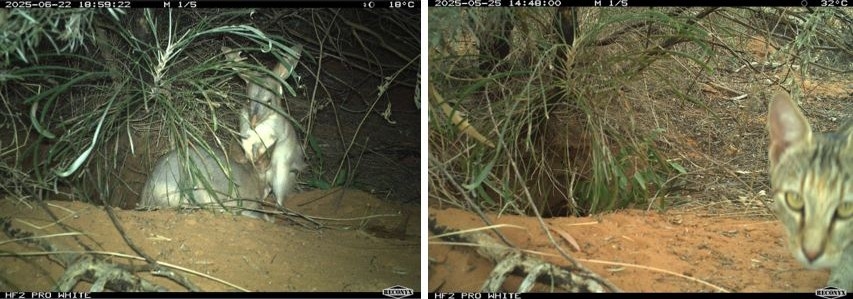
A bilby mother and joey at the burrow entrance; a feral cat poised to attack at the same burrow © Karajarri Rangers
The presence of so many non-native species shows what the Karajarri Rangers are up against as they try to care for Country across their vast Native Title Area. It covers more than 31,000 square kilometres, an area about half the size of Tasmania.
Rangers are planning feral pest control and repairs to the fence. But preserving Malupirti will be an ongoing, costly mission because camels will break through most barriers to reach water.
Much is at stake for the Karajarri people. Caring for Country includes the spiritual and cultural health of Country. It needs holistic care, as it is a living being, a relative, with kin connection. When Country is healthy it's not only plants and animals that thrive, it also supports community wellbeing.
Indigenous Protected Areas cover more than 55% of Australia's National Reserve System. Traditional Owner management contributes significantly to national biodiversity goals. However, the Karajarri and many other Indigenous ranger groups care for Country across huge areas with modest and uncertain funding.
Long-term conservation success will rely on securing sustainable funding, strengthening Indigenous land and sea management programs and supporting Traditional Owner aspirations for enduring stewardship.
Karajarri Ranger Hayley Mulardy said:
Looking after Country is a big responsibility. Our Country is a huge area so there's always work to be done. We look after important cultural places, wildlife, plants and waterways. Our knowledge as Traditional Owners helps us understand what is happening on Country and how we can better protect it for the future.
Managing our Country at this scale takes people on the ground, long-term commitment and proper investment in ranger programs.
Karajarri Ranger Janelle Munro said:
As rangers going back to Country alongside our Elders we keep collecting knowledge about our ancestors. It makes us happy. We're protecting our native species, looking after our springs, following the steps of our old people, doing what's right and learning better ways.
We're sharing knowledge and passing it on to our young generation and also other partners that also finding better ways to look after Country and native species.
Karajarri Ranger Julian Nagomara said:
It's good to learn about western science and the animals and their common names, scientific names and language names. We do this with our Old People out on Country, talking about 2-way science. Knowledge from the scientists and knowledge from the Old People.
Pius Gregory, Karajarri/Yawuru Traditional Owner and Biocultural Conservation Specialist, WWF-Australia said:
The Karajarri team were great to work with. It was good for me to work alongside my own people. On the drive from Malupirti back to Broome, I was excited thinking about what might show up on the cameras.
We used Traditional Owner knowledge to find signs of wildlife activity and positioned cameras nearby. Normally to review 220,000 images is a massive task. But using AI made the job a lot easier.
It was rewarding to see the bilbies and other native species. Karajarri Rangers know this Country and have a deep responsibility to care for it. Supporting Indigenous-led conservation is one of the most effective ways to protect places like Malupirti, now and into the future.
Please note Karajarri is pronounced Garra jaddi and Malupirti is pronounced Mula bidi


