
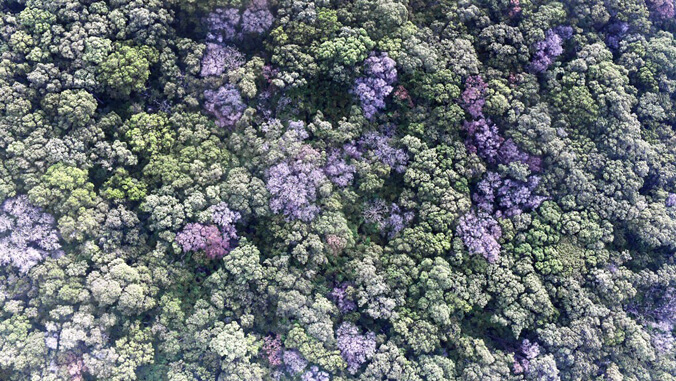
New findings reveal the spread of a fungal disease killing off hundreds of thousands of mature ʻōhiʻa trees (Metrosideros polymorpha) on Hawaiʻi Island could be exacerbated by the presence of ungulates or animals with hooves. A geographer at the University of Hawaiʻi at Hilo, along with colleagues from the National Park Service, U.S. Forest Service and U.S. Department of Agriculture, published a collaborative study that closely examines the link between the disease known as rapid ʻōhiʻa death (ROD) and ungulates such as feral pigs.
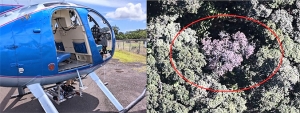
Lead investigator of the study, Ryan Perroy, an associate professor of geography and environmental science at UH Hilo, specializes in remote sensing and was integral in obtaining aerial imagery to detect ʻōhiʻa mortality at an individual tree level. The study's co-authors collected field samples and conducted laboratory testing using data from impacted areas within Hawaiʻi Volcanoes National Park (HAVO) and the Laupāhoehoe Forest Reserve.
The spatial patterns of ʻōhiʻa mortality observed across all four sites included in the study show significant differences in areas with and without ungulates, suggesting that ungulate exclusion is an effective management tool to lessen the impacts of ROD in forested areas in Hawaiʻi.
"The results from this work show us that the impacts of ROD can vary across the landscape," said Perroy. "We hope this information can be useful in managing and caring for our native forests."


