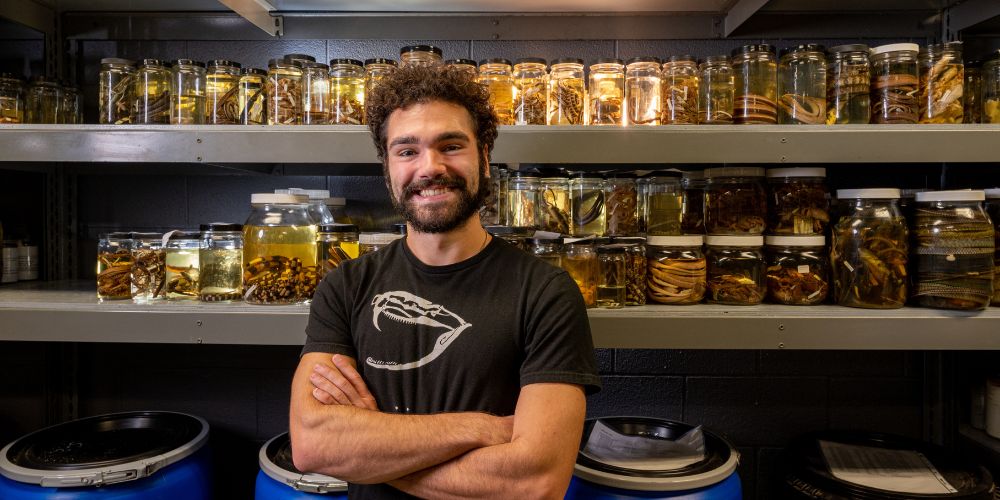
The University of Texas at Arlington's Amphibian and Reptile Diversity Research Center, known as ARDRC, recently added Denton County's first documented Western Diamondback rattlesnake to its extensive herpetology research collection.
"For decades, even hundreds of years, there have been scientists and herpetologists in Texas collecting specimens for research and making official records of the species occurring, yet there's never been one officially recorded from Denton County," said Greg Pandelis, collections manager at the ARDRC and coauthor of the latest scientific publication on the distribution of Texas reptiles.
The ARDRC houses 597 Western Diamondback specimens, 403 of which originate from Texas counties, including Tarrant, Parker, Dallas and Jack. Denton County joined that list when citizen-scientists discovered the rattlesnake in an Argyle garage on Nov. 6. They contacted the ARDRC and donated the specimen for further study by UTA's experts, who are also assisting in submitting documentation for formal publication of the new record in scientific literature.
Related: UTA becomes one of the largest natural history libraries
"This is especially odd because of how common that snake generally is," Pandelis said. "It's not something that usually eludes detection. So this specimen is very important and interesting because it will reform our understanding of not just where the species occurs in Texas, but maybe even what its habitat requirements are and what its limits are, as far as where it can occur and where it can't. Having this individual snake preserved as a research specimen is so important because it will fill a gap in our understanding of this species and will be used in studies being done on Diamondback biology."
Western Diamondbacks typically inhabit desert regions, making their presence in forested DFW counties unusual. However, there have been small pockets of Western Diamondbacks in similar environments documented over the years. Pandelis believes the snake came from a small undetected population within Denton County rather than migrating from neighboring areas.
In this instance, Pandelis said, the snake likely was seeking shelter, as many do when temperatures drop. He recommends that the public contact professionals if they encounter a snake in a similar situation. An added benefit is potentially making history, as in this case. If a snake is preserved as a specimen, it provides lasting research value—from genetic and venom analyses to color studies.
Related: UTA helps deliver major science library to Ecuador
"With a specimen, you can address broad-scale questions in ecology and evolution in a way that you cannot with photographs," Pandelis said. "Researchers worldwide use our collection for high-profile studies that feed back into our understanding of the biology of these species and their conservation. It's also important to know that specimens never expire. They can be used for generations."
The ARDRC is among the top 10 amphibian and reptile collections in the world, with more than 200,000 specimens. Open to scientists, the center is frequently sought after by researchers for herpetological studies. Once a week, on average, a new peer-reviewed publication is released utilizing specimens from the ARDRC collection, including samples of some species that are now extinct.
For Pandelis, this latest discovery highlights the value of collaboration between the public and the scientific community.
"We had some citizen-scientists discover something cool, reach out to us and contribute to science by depositing the specimen here," Pandelis said. "Now, we're helping them publish the first report on this. It's a great interplay between UTA, the ARDRC and the public that I'd like to see more of in the future."
About The University of Texas at Arlington (UTA)
Celebrating its 130th anniversary in 2025, The University of Texas at Arlington is a growing public research university in the heart of the thriving Dallas-Fort Worth metroplex. With a student body of over 42,700, UTA is the second-largest institution in the University of Texas System, offering more than 180 undergraduate and graduate degree programs. Recognized as a Carnegie R-1 university, UTA stands among the nation's top 5% of institutions for research activity. UTA and its 280,000 alumni generate an annual economic impact of $28.8 billion for the state. The University has received the Innovation and Economic Prosperity designation from the Association of Public and Land Grant Universities and has earned recognition for its focus on student access and success, considered key drivers to economic growth and social progress for North Texas and beyond.