
Abstract
Inspired by electric rays that generate high voltages through stacked electrocytes, researchers at UNIST have developed a novel energy harvesting technology that mimics this biological mechanism. Unlike electric rays, which require mechanical stimulation, this new approach produces power autonomously, without external inputs.
Led by Professor Hyunhyub Ko from the School of Energy and Chemical Engineering, the team has successfully fabricated a bioinspired bilayer ionic asymmetric stack (BIAS)-0.2-millimeter-thick ionic heterojunction cell. When multiple layers of these cells are stacked, they generate voltages exceeding 100V, enabling direct operation of electronic devices such as LED lights, calculators, and digital watches without the need for rectification.
While a single electric ray electrocyte produces only about 0.1V, stacking these cells in series allows for high-voltage output comparable to conventional batteries. The core innovation lies in the cell's structure: an asymmetric bilayer composed of cationic and anionic polymer films. This configuration creates an internal electric field that drives ion migration, generating a voltage similar to biological membrane potential.
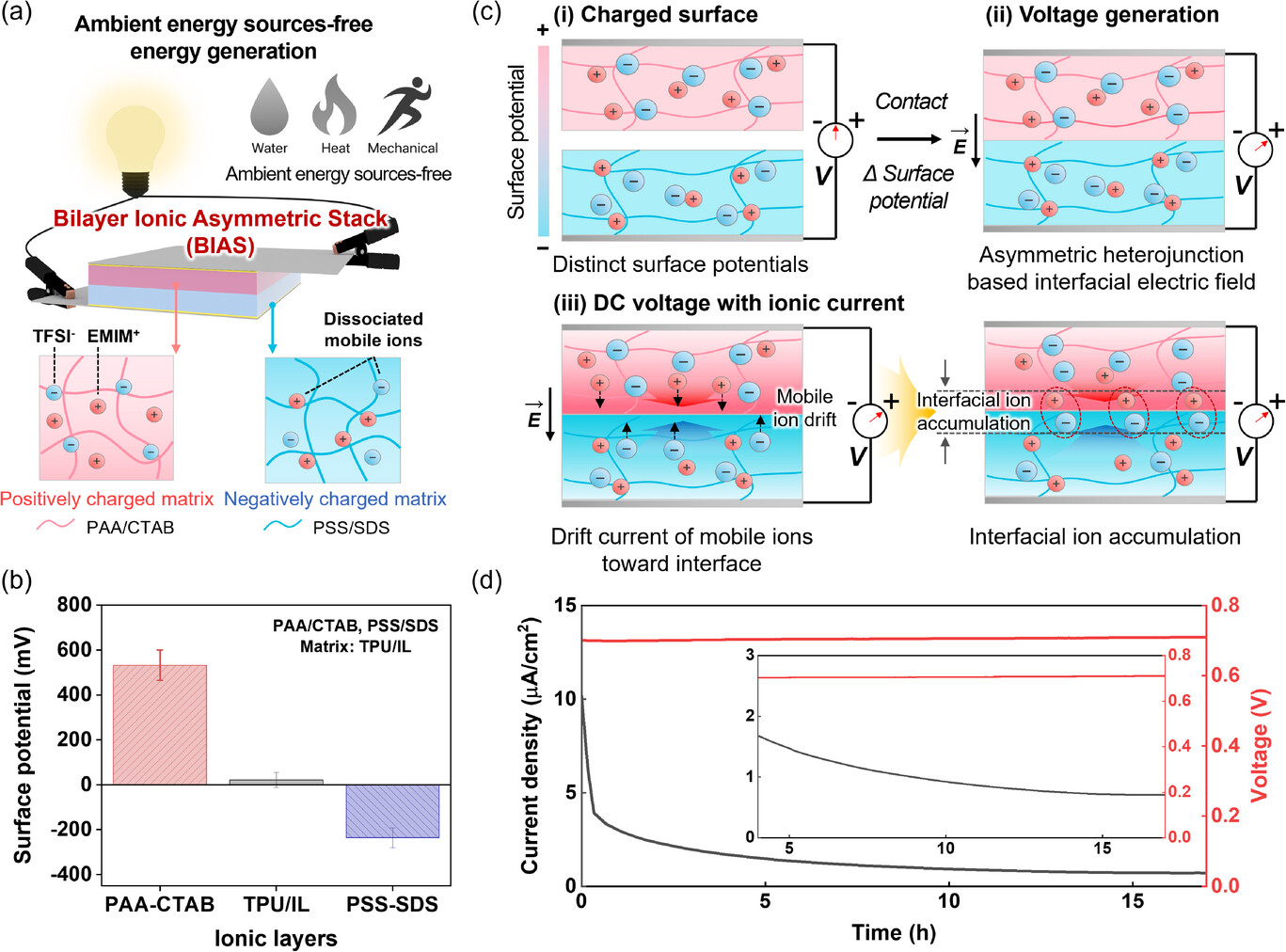 Figure 1. All-polymer bilayer ionic heterojunction generator operating independently of external energy sources.
Unlike traditional ionic devices that depend on external stimuli such as mechanical force or environmental changes, the BIAS generates electricity spontaneously through internal ion movement. The research team reported that a single cell produces approximately 0.71V-more than 30 times higher than symmetric structures-and that stacking multiple cells can sustainably power practical electronic devices.
The device demonstrated remarkable durability and environmental stability. It maintained voltage output after over 3,000 mechanical stretching cycles and could withstand elongation up to 1.5 times its original length without performance loss. Additionally, it operated reliably across a wide humidity range-from dry conditions to 90% humidity-with minimal power fluctuation. These qualities suggest strong potential for wearable electronics, where continuous movement and environmental variability are common.
Led by first authors Seungjae Lee, Youngoh Lee, and Cheolhong Park from the School of Energy and Chemical Engineering, the research team explained, "By mimicking the ion-selective membrane potential observed in biological cells, we developed the BIAS-a unit cell capable of generating high voltage autonomously when stacked."
Professor Ko added, "This technology utilizes internal ion migration within the bilayer structure to produce high voltage without any external energy source. Unlike conventional energy harvesting methods relying on wind, sunlight, pressure, or temperature differences, our approach requires no external stimuli, potentially reducing maintenance requirements for wearable power sources."
The findings of this research have been published in the online version of Advanced Energy Materials, a leading international journal in the field of energy materials published by Wiley, on December 8, 2025. The study has been supported by the National Research Foundation of Korea (NRF) and the Ministry of Science and ICT (MSIT) through projects focused on nanotechnology and energy materials.
Journal Reference
Seungjae Lee, Youngoh Lee, Cheolhong Park, et al., "A Bioinspired Ionic Heterojunction Generator Enabling Stimulus-Free, Scalable Energy Harvesting," Adv. Energy Mater., (2025).


