
Researchers have used AI to reconstruct the rules of a board game carved into a stone found in the Dutch city of Heerlen. The team concludes that this type of game was played several centuries earlier than previously assumed.
Archaeologist Walter Crist encountered the stone in 2020 in the collection of the Thermenmuseum - which has since been renamed the Roman Museum. The worked limestone slab, measuring 21 by 14.5 centimetres, was found in the ground in Heerlen in the late 19th or early 20th century. Heerlen was once the important Roman settlement of Coriovallum. Crist specialises in ancient games and was immediately intrigued. 'The stone's appearance, together with the wear, strongly suggested a game, but I didn't recognise the pattern from other ancient games I know.' The piece of limestone shows a rectangle containing four diagonal lines and one straight line.
What does the stone reveal?
Crist examined the stone under a microscope. 'Wear was visible on the lines of the stone, exactly at the places where you would slide your playing piece.' He enlisted the help of researchers from Heerlen and Maastricht. Restaura restoration studio from Heerlen produced highly detailed 3D scans. 'The scans make the traces on the stone much clearer,' Crist explains. 'Some of those traces are a fraction of a millimetre deeper than others, meaning they were used more intensively. We also see that the edges of the stone are neatly finished, which indicates that this is a finished product and not a stone that still needs further working.' The stone was worked an estimated 1,500 to 1,700 years ago.
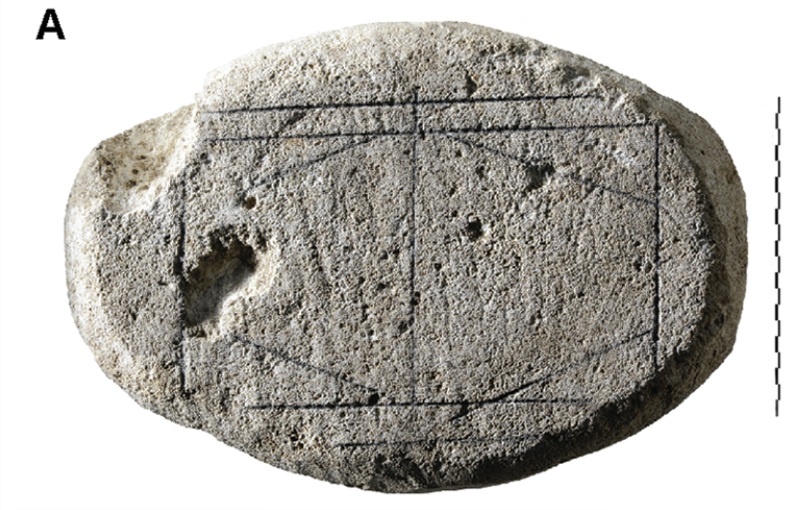
The stone with the carved pattern 
3D scan of the stone
Played earlier than previously thought
The team of researchers from Dutch, Belgian and Australian institutions used AI to infer the rules of the game and published their findings in the journal Antiquity. Using Ludii, an AI-driven game system from Maastricht University, the researchers had two AI agents play against each other using the stone as a board. They drew on the rules of ancient board games documented in Europe. They discovered that the wear on the stone is most likely linked to the playing of so-called blocking games: board games in which the goal is to prevent the opponent from moving.
This type of board game has only been documented since the Middle Ages. That makes the discovery particularly special, Crist emphasises. The study shows that the stone was used as a board game in Roman times and that it was played several centuries earlier than previously thought.
New research methods
The new approach may also lead to further discoveries. 'This is the first time that AI-driven simulated play has been combined with archaeological methods to identify a board game,' Crist says. 'This research provides archaeologists with additional tools to identify games from ancient cultures.'


