
Key Points
- Researchers at Florida State University are working to improve how people with limited speech communicate, using advances in technology, literacy instruction and social interaction to help them express themselves and connect with others.
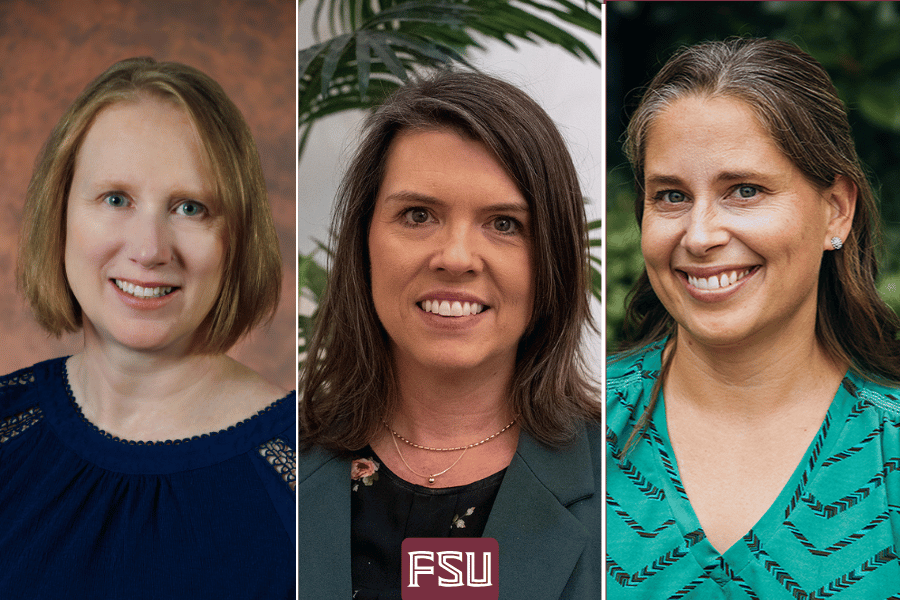
- At FSU's School of Communication Science & Disorders, Assistant Professor Dawn Sowers and Associate Professors Andrea Barton-Hulsey and Michelle Therrien are approaching that challenge from three complementary perspectives: making communication technology easier to use, expanding access to literacy instruction and helping people build friendships.
Researchers at Florida State University are working to improve how people with limited speech communicate, using advances in technology, literacy instruction and social interaction to help them express themselves and connect with others.
Nearly 100 million people worldwide could benefit from augmentative and alternative communication (AAC), experts say. These methods assist people with limited speech express themselves, including individuals with autism, ALS, Parkinson's disease and aphasia.
At FSU's School of Communication Science & Disorders, Assistant Professor Dawn Sowers and Associate Professors Andrea Barton-Hulsey and Michelle Therrien are approaching that challenge from three complementary perspectives: making communication technology easier to use, expanding access to literacy instruction and helping people build friendships.
"We now have such a breadth of expertise that so many universities do not have with AAC, and I think it shows the students that AAC is not one thing, but that it actually applies to lots of situations," Therrien said.
For Sowers, the challenge is not simply giving someone a communication device. It is making that device accessible to a person whose motor or visual disabilities may make it difficult to select a message. Her research examines how AAC system design can reduce those demands and support everyday communication.
Her work includes human-centered artificial intelligence and eye tracking as a way to access AAC. As part of a collaborative AI research effort, Sowers has explored how technology can detect natural gestures and connect them to spoken messages from a device. The goal is to make systems adapt to the user, rather than require the user to adapt to rigid technology.
"I'm trying to understand better how to make systems that do the heavy lifting for the individual instead of the individual having that burden on them," Sowers said.
"I'm trying to understand better how to make systems that do the heavy lifting for the individual instead of the individual having that burden on them."
– Dawn Sowers, FSU School of Communication Science & Disorders Assistant Professor
That emphasis on access connects with Barton-Hulsey's work on reading development and Therrien's research on social interaction. Together, their projects address not just how a person communicates, but what communication makes possible in school and community life.
Therrien studies ways to support social interaction and friendship for people who use AAC. One project examines children's experiences on community playgrounds to guide the development of technologies that support social participation. The work treats opportunities to play, engage with peers and make friends as important outcomes of communication support.
The literacy and playground projects that Barton-Hulsey and Therrien are co-leading are part of a broader effort supported by a five-year, $5 million federal grant awarded to the research team in 2025. Funded through the U.S. Department of Health and Human Services, the grant supports the Rehabilitation Engineering Research Center on AAC, which develops technologies and shares knowledge to improve outcomes for children and adults with disabilities.
"Communication is power," Therrien added. "When we can provide supports that let people show who they are and what they're capable of, I just think that's amazing."
Barton-Hulsey focuses on making literacy assessment and instruction accessible to children with limited speech. Her team is developing a tool with Temple University for children as young as pre-kindergarten, with input from teachers and speech-language pathologists. Her broader research examines how vocabulary, understanding of language and awareness of speech sounds relate to reading development, alongside children's access to literacy instruction at home and school.
"For me, it means providing them equitable access to instruction in school, access that their peers have because they have access to speech," Barton-Hulsey said.
Collaboration also shapes how the researchers work. Barton-Hulsey draws on Sowers' technology expertise and Therrien's experience with research methods, while connections with the Florida Center for Reading Research bring additional perspectives to the team's literacy work.
"The actual research methods that I use have shifted after being part of the team here, Barton-Hulsey added. "Dr. Therrien is an expert in single case research and I wasn't trained in that, so I could bounce questions and ideas off her. It's a nice place to be able to share and learn and grow together."
Their shared goal is to expand opportunities for people whose speech does not reliably meet their communication needs.
"If I could provide a way for someone to communicate whose speech was not reliable for them, that [creates] limitless opportunities," Sowers said. "It changes their trajectory for school, for community, for work, for all parts of their lives."


